• Skip to primary navigation
  • Skip to main content
  • Skip to primary sidebar

Ad Fontes

  • About Ad Fontes
  • Blogroll & Resources

Mitchell

Quote of the day

חפשו בתורה היטב ואל תסתמכו על דברי

“Search in the Torah carefully and do not rely on my words”

this quote is often attributed to Anan ben David one of the major founders of what would later become known as Karaism. However, as this line of thought is very much parallel to the concept of Ad Fontes: Back to the Sources (למקורות), I thought it was worth posting here.
It’s in Pausal Form

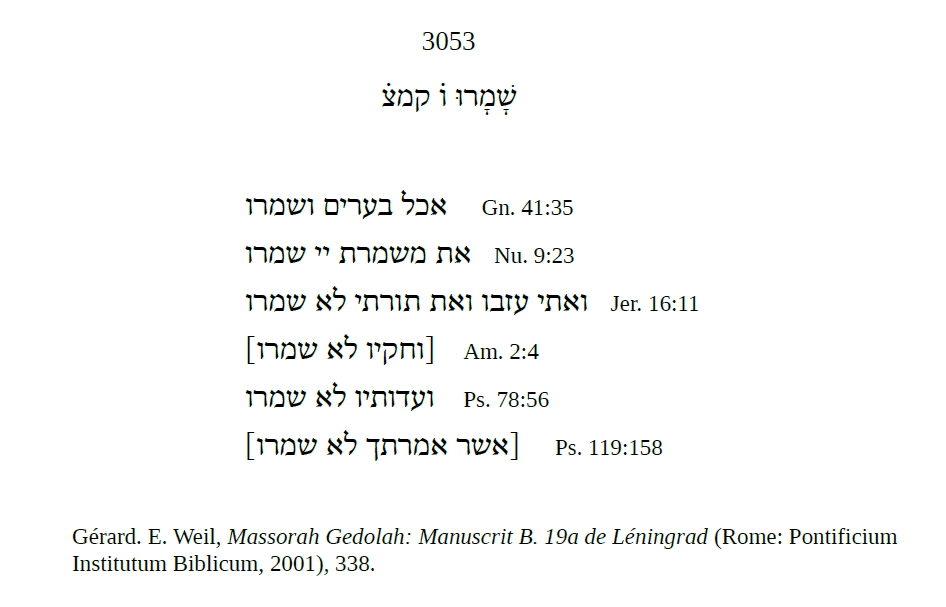
Illustration of Numbers 9:23 and related Masoretic notes and lists discussed in the article
Numbers 9:23 (they kept/obeyed)

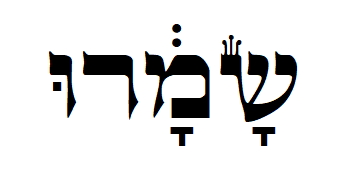
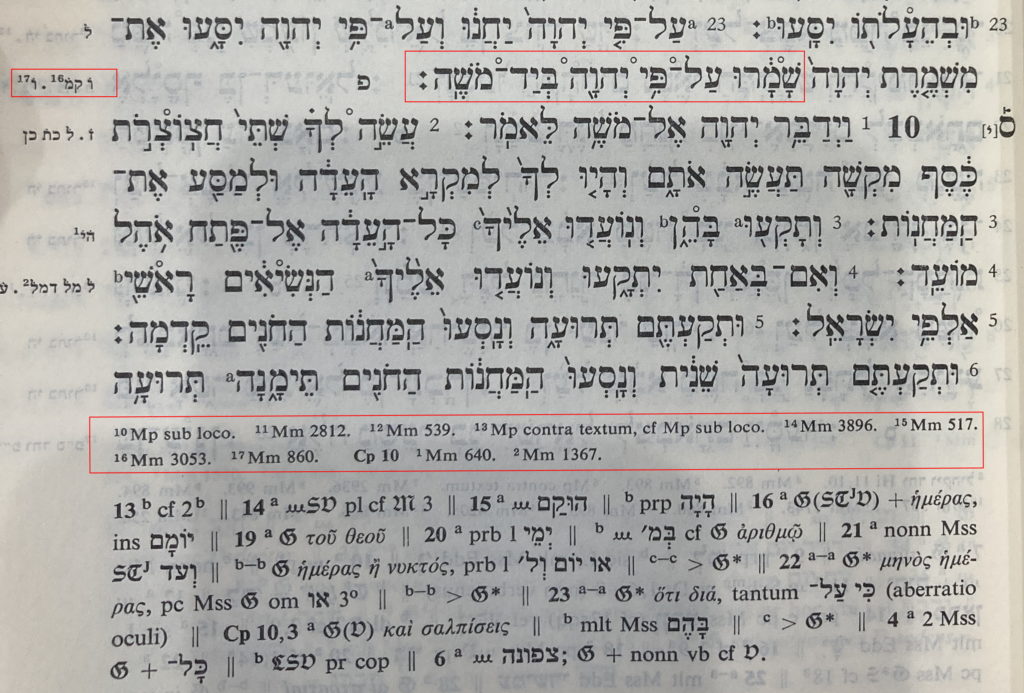
שָׁמָ֔רוּ (they kept/obeyed) in numbers 9:23 is grammatical in pausal form and, this particular morphological form of the lexeme only appears six times in the Tanakh/Hebrew Bible. If you have access to software with a database of the Hebrew Bible you may be able to run vowel point and accent mark sensitive searches to find all six occurrences of שָׁמָ֔רוּ.

However, did you know that before software was available it was possible to local all six occurrences if you had access to the Masorah or an edition of the Hebrew Bible with the Masorah. What is the Masorah? The Masorah is a very broad ancient corpus of notes concerning various textual and scribal matters of the Hebrew Bible. Some of these notes were written in the margins of Hebrew manuscripts, as notes were written on the top of pages, and much longer notes were often written in the back of the codices of the Hebrew Bible. According to Page Kellly the purpose of the Masorah …

was to safeguard the sacred text from any additions or deletions. The Mp notes function within that larger purpose by providing the reader or copyist instant information in the margin about how a given text feature ought to appear. If the text was found to be contrary to its Mp notes, the circumstances needed investigation in order to ascertain whether an error had occurred. Without Mp notes, errors would not so readily be brought to the attention of the reader or copyist. Although the rubrics marked by Mp notes often appear trivial to the uninitiated, there is actually a fundamental principle at work behind the text features that are annotated. Mp notes mark features in the text where an error could easily be made. Many Mp notes, for example, pertain to vowel letters, which are sometimes present (plene) and sometimes absent (defective), yielding different spellings for the same word. In such cases, the Mp marks the traditional spelling so that a letter will not be accidentally inserted or deleted where it might not be noticed otherwise.

Kelley, Page H., Daniel S. Mynatt, and Timothy G. Crawford. The Masorah of Biblia Hebraica Stuttgartensia: Introduction and Annotated Glossary. Grand Rapids, MI: William B. Eerdmans Publishing Company, 1998. Print.

Now, If you have a hard copy of the Biblia Hebraica Stuttgartensia you will notice on page 229 (Numbers 9:23) the Massorah Parva (on the left margin) and the BHS masorah magna register (underneath the main text) alert you to important information about verse 23 (the part in the red box).

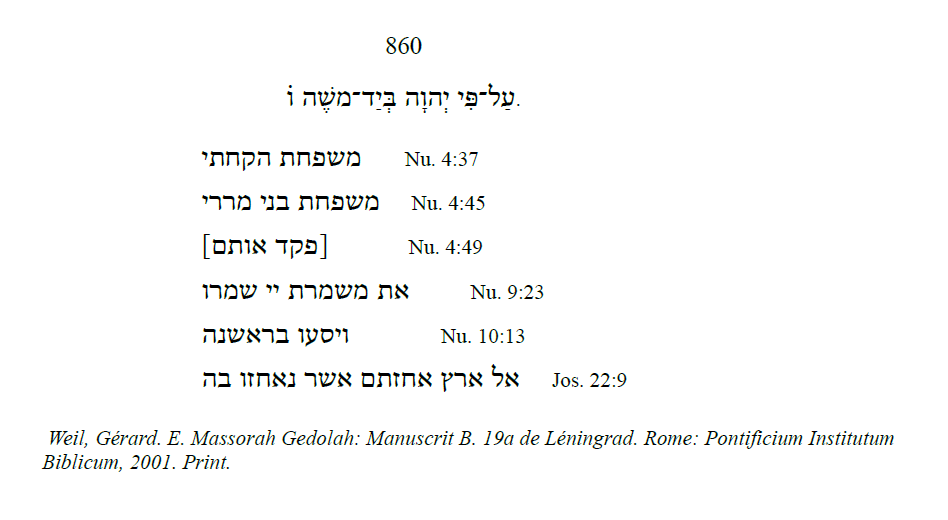
Illustration of Numbers 9:23 and related Masoretic notes and lists discussed in the article

The Masorah Parva tells us that the phrase על־פי יהוה ביד־משה only occurs 6 times in the Hebrew Bible and that special morphological form שָׁמָ֔רוּ also occurrences 6 times. The Masorah register below tells us where we can find the corresponding lists to the Massorah in the companion Masorah Gedolah volume. List 3053 for שָׁמָ֔רוּ and list 860 for על־פי יהוה ביד־משה .

Illustration of Numbers 9:23 and related Masoretic notes and lists discussed in the article

Introduction to Textual Criticism

What is Textual Criticism?

Textual criticism is a branch of textual scholarship, philology, and of literary criticism that is concerned with the identification of textual variants, or different versions, of either manuscripts or of printed books…The objective of the textual critic’s work is to provide a better understanding of the creation and historical transmission of the text and its variants.

https://en.wikipedia.org/wiki/Textual_criticism

What does Textual Criticism look like in real life? Or, what is a simple example of Textual Criticism?

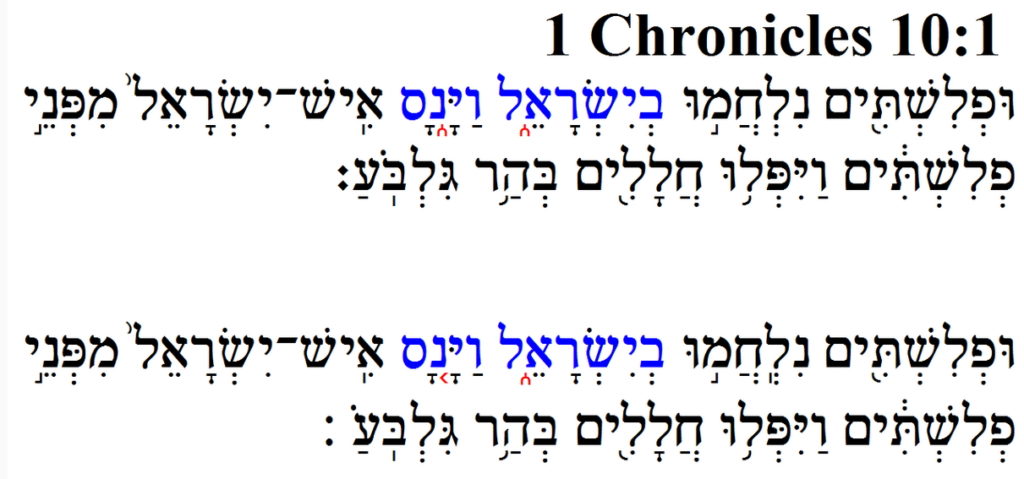
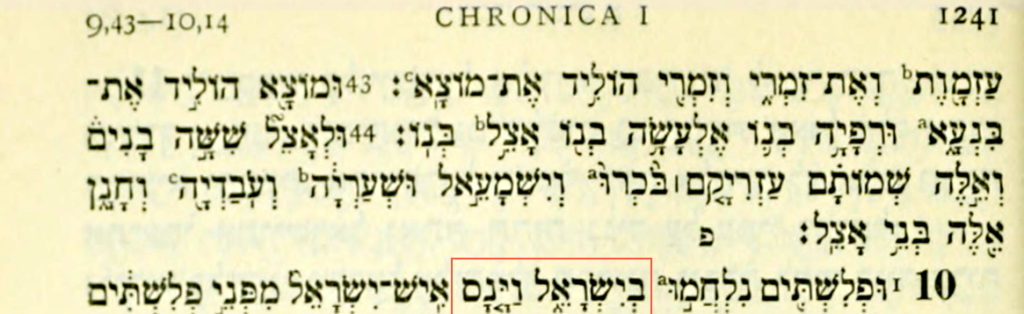
If you happen to have two or more editions of the Hebrew Bible (Tanakh) take a look at 1 Chronicles 10:1. How does it read? Do you find two consecutive Ethnachta accents as in the first example below or do you see an Ethnachta אֶתְנַחְתָּא followed by a mehuppach מְהֻפָּ֤ךְ as in the second example (the accents are in red)?

Textual-criticism illustration comparing 1 Chronicles 10:1 in printed editions and Codex Leningradensis

Here are 11 common printed editions of the Hebrew Bible worth checking out:

  1. Letteris Hebrew Bible / OT (London 1852) pg. 1290
  2. Ginsburg Hebrew Bible/OT (London 1894 /1998 ) pg. 1698
  3. Snaith Hebrew Bible/OT (London 1958) pg. 1274
  4. Koren Tanakh ( Jerusalem 1966)
  5. Biblia Hebraica Kittel (1937)
  6. The Biblia Hebraica Stuttgartensia (Deutsche Bibelgesellschaft, Stuttgart 1982)
  7. Breuer Tanach ( Jerusalem 1989)
  8. Art Scroll Tanach (Brooklyn 1996) pg. 1898
  9. Aron Dotan, Biblia Hebraica Leningradensia (Peabody, Massachusetts 2001) pg. 1146
  10. JPS Hebrew-English Tanakh 2nd edition ( Philadelphia 2004 ) pg. 1911
  11. Jerusalem Crown (Jerusalem 2004) pg. 8

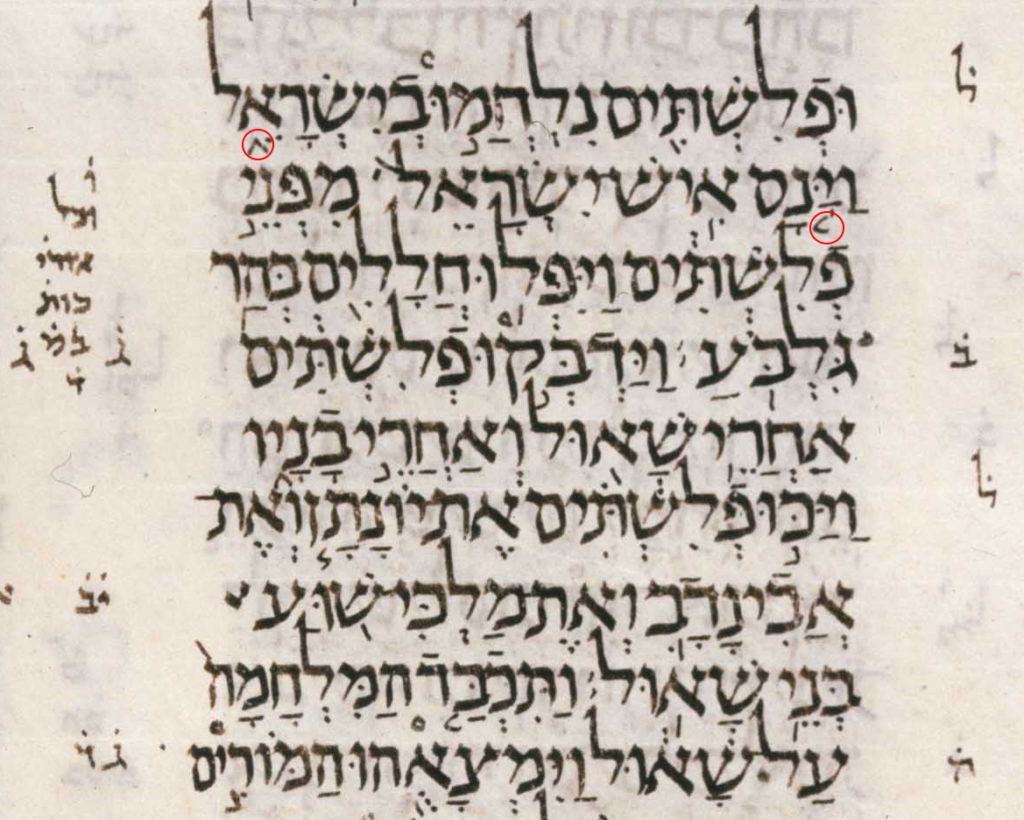
A check of the eleven editions above reveals that three of these texts have the repeated Ethnachta in 1 Chronicles 10:1: the Biblia Hebraica Stuttgartensia (BHS), the Hendrickson Biblia Hebraica Leningradensia (BHL) edited by Aron Dotan, and the Jewish Publication Society’s Hebrew-English Tanakh, 2nd edition. Because all three editions are based in significant part on the Leningrad Codex, it is useful to compare them directly with a facsimile or digital image of the codex at this point.

Textual-criticism illustration comparing 1 Chronicles 10:1 in printed editions and Codex Leningradensis
image from Accordance Bible Software’s Leningrad Codex photo collection database

A comparison with the facsimile of the Leningrad Codex suggests an accentual or transcriptional discrepancy between the manuscript and these printed editions. In other words, the repeated Ethnachta found in BHS, BHL, and the JPS edition does not appear to reflect the manuscript at this point. The earlier BHK instead prints an Ethnachta אֶתְנַחְתָּא followed by a mehuppach מְהֻפָּ֤ךְ. This is therefore better described as a discrepancy between manuscript and edition rather than confidently labeling it a textual variant or identifying exactly where the error originated.

Textual-criticism illustration comparing 1 Chronicles 10:1 in printed editions and Codex Leningradensis
Biblia Hebraica Kittel (1937)

Okay, this very brief example of a very simple issue demonstrates in part what Textual Criticism is.

Quote of the Week

“The real New Testament is the Greek New Testament. The English is simply a translation of the New Testament, not the actual New Testament. It is good that the New Testament has been translated into so many languages. The fact that it was written in the koiné, the universal language of the time, rather than in one of the earlier Greek dialects, makes it easier to render into modern tongues. But there is much that cannot be translated. It is not possible to reproduce the delicate turns of thought, the nuances of language, in translation.”

A.T. Robertson (The Minister’s Use of His Greek New Testament 1923)

What is meant in the BHS Critical Apparatus of Genesis 38:9, 16, 18?

I highly recommend acquiring the Biblia Hebraica Stuttgartensia if you have an interest in the philology of the Hebrew Bible. One of the many interesting features of the BHS is its critical apparatus. For example, if you turn to Genesis 38:9 in the BHS (p. 62) and look at the apparatus at the bottom of the page, you will find the following: Gen 38:9a sic L, mlt Mss Edd לאֹ

Okay so let’s parse the shorthand notes above:

sic L = thus in L, indicating the reading of Codex Leningradensis
mlt = many    Mss = manuscripts    Edd = editions

So what? What does that mean?

First of all, this means that the Biblia Hebraica Stuttgartensia diplomatically preserves the textual reading found in the Leningrad Codex. In other words, לאֹ is present in many Hebrew Bible manuscripts and modern editions, while the Leningrad Codex has a different pointing, namely לֹּ֥א. The niqqudot (vowel points) as well as the taʿamei (accents) in the Leningrad Codex apparently differ here from many other manuscripts and editions. It is then up to the reader to consider whether the Leningrad reading reflects an alternative tradition, a scribal feature, or another textual phenomenon. A similar form appears earlier in Genesis 19:2, although that parallel by itself neither proves nor disproves anything.

Gen 38:16a sic L, mlt Mss Edd ל sine dageš
Notice that the BHS and L have לִּ֔י, but many manuscripts and editions have the lamed sine dagesh (without the dagesh).
Gen 38:18a ut 16a || b ut 16a — ut = as in verse 16

This indicates that the issue in verse 18 is the same as the one noted in verse 16 with regard to the lamed and dagesh.

  • « Go to Previous Page
  • Page 1
  • Interim pages omitted …
  • Page 6
  • Page 7
  • Page 8
  • Page 9
  • Page 10
  • Interim pages omitted …
  • Page 15
  • Go to Next Page »

Primary Sidebar

SEARCH

Categories

Recent Posts

  • Miqra According to the Masorah: Manuscripts, Masorah, and the Editing of the Masoretic Text
  • Jude 5 The Textual Variant Ἰησοῦς / κύριος and the Agent of the Exodus
  • It Is Difficult to Know Oneself: Thales and the Byzantine Tradition
  • A Review of the Concise Dictionary of Classical Hebrew in Accordance Bible Software
  • Hebrew/Aramaic Quote #1: Search the Torah Carefully

Recent Comments

  • Mitchell on The Ethnachta Clause
  • Mitchell on Miqra According to the Masorah: Manuscripts, Masorah, and the Editing of the Masoretic Text
  • Mitchell on The Brown-Driver-Briggs Lexicon in Accordance
  • Ben Denckla on Miqra According to the Masorah: Manuscripts, Masorah, and the Editing of the Masoretic Text
  • Anonymous on The Brown-Driver-Briggs Lexicon in Accordance

136 PROUD SUBSCRIBERS

Copyright © 2026 · eleven40 Pro on Genesis Framework · WordPress · Log in