Rabbi Dr. David Moster, director of the Institute of Biblical Culture, has produced a very interesting and informative video on puns in the Hebrew Bible.
What do you think?
Rabbi Dr. David Moster, director of the Institute of Biblical Culture, has produced a very interesting and informative video on puns in the Hebrew Bible.
What do you think?
Abram K-J author of the Words on the Word Blog reports on the 8th and most recent Fascicle of the BHQ so far to be published here: https://abramkj.com/2021/09/17/new-biblia-hebraica-quinta-bhq-volume-leviticus/.
The BHQ like the BHS before continues the tradition of being a diplomatic edition of the Leningrad Codex (the oldest complete codex of the Hebrew Bible). In other words, rather than creating an eclectic text like the editors of the Nestle-aland novum testamentum graece are fond of the editors of the BHS and now the BHQ intended to reproduce an actual existing codex of the Hebrew Bible. This time around the editors are including both the unedited Masorah Parva and the Masorah Manga, too as well as a commentary.
Opening your Biblia Hebraica Stuttgartensia (BHS) to page 1105 you notice Psalm 23:1 at the bottom of the page.

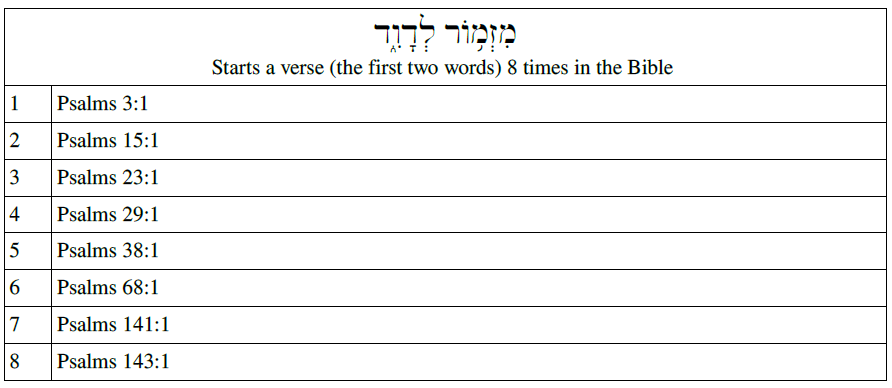
Scanning the first verse you notice the two raised circles in the verse. One above the phrase מִזְמ֥וֹר לְדָוִֽד (a Mizmor of David) and one above רֹעִ֗י (my Shepherd). The first circle alerts you to the Masorah Parva (the ancient abbreviated Masoretic reference notes on the side of the page in a codex now reproduced in the BHS). The note reads as follows ח̇ ר״פ . Recalling that Hebrew Letters can sometimes act as numbers you recognize that letter chet ח̇ is functioning as the number 8 and ר״פ abbreviation on side of it is shorthand for ראש פסוק (rosh Pasuk / head of verse). You quickly conclude that the ancient masoretes are trying to tell you that:
Psalm 23:1 contains one of 8 instances where מִזְמ֥וֹר לְדָוִֽד occurs as the first two words of a verse.
Naturally, this arouses your interest. The short Masora Parva note itself does not list the other seven occurrences. Bible software or a concordance, however, can quickly help locate them. The string מִזְמ֥וֹר לְדָוִֽד occurs repeatedly in the Hebrew Bible, and the Masoretic note indicates that it occurs at the beginning of a verse eight times.
Now turn your attention to the second raised circle, above רֹעִ֗י (“my shepherd”). In the margin you find ה̇, he, the fifth letter of the Hebrew alphabet, functioning as the number five. This indicates that something about this particular form occurs five times. Since the word “shepherd” itself obviously occurs more frequently, the question is what precise feature the Masoretic note is recording. The BHS Masora Magna register points the reader to entry 3232 in the separate companion volume.
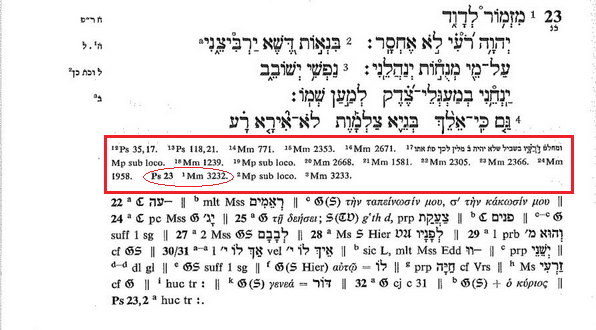
Next, you can consult Gérard Emmanuel Weil‘s transcription of the Masorah Magna in the companion volume to the BHS, either in print or in Faithlife Logos Bible Software’s digital edition, as pictured below.
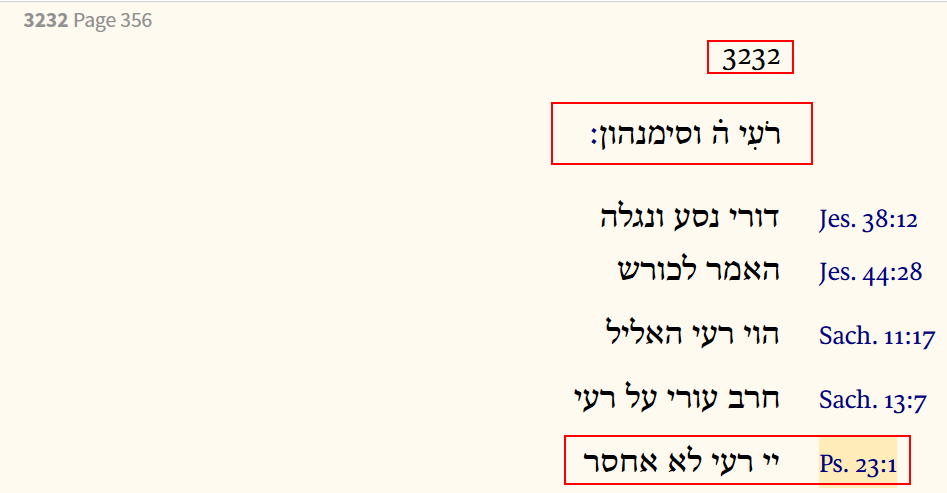
Directly above the verse list, you see the note רֹעִ֗י ה̇ סימנהון telling you that these are the five times.
Now, you understand that although the lemma for Shepherd appears 167 times in 138 verses “My shepherd” in this morphological form is found only five times and thus these terms and verses are special in the scriptures. Of course a word looking the same as my shepherd but meaning my friend also occurs throughout scripture. In the pre-Masoretic text without the vowel points and accents, both ‘My friend’ and ‘My Shepherd’ would have been identical. This leads you to consider the possibility that the writer of Psalms may have had both meanings in mind.
There are many more layers of Masoretic notes, but here we have looked only briefly at two examples of one type of note. Keep in mind that this exercise has considered only the word level. Later, one might also look at the semantic, sentence, passage, and discourse levels.
Here is an excellent intro to the BHS (Biblia Hebraica Stuttgartensia) by Dr. David Moster of the Institute of Biblical Culture.
The Software used in the video presentation at 7:07 ~ 8:14 and 11:58 ~ 12:19, and 12:29 ~ 13:29 is Accordance Bible Software.
Zwinglius redivivus does it again! If you haven’t checked out his blog I highly recommend you do for you will find intriguing quotes like the following one there as well as the best of the ancient and modern:
“How can a preacher know theology, if he is ignorant of Hebrew, Greek and Latin?”- Sir Thomas More
via Quote of the Decade — Zwinglius Redivivus
My Opinion: In an idealistic world and under idealistic conditions all pulpit preachers should be instructed in Biblical languages as well as Latin (and maybe theological German), however, this simply is not a possibility at least not in the typical seminary (graduate school of theology / Divinity School/preachers school) due to the time constraints of imposed by the programs and or the curriculums not to mention individuals’ dispositions. Of course one can study on their own, or outside of a theological program should one desire to.
I would, however, say that it is much more of a priority for a preacher or a missionary to know the culture and the language of the intended audience or the congregation at large unless, of course, the preacher/missionary has a dedicated interpreter. I am pleased to say that in my very limited experience here in Japan all of the foreign preachers I have met have been fluent in modern Japanese to at least an upper-intermediate level, if not an advance one!