What is Textual Criticism?
Textual criticism is a branch of textual scholarship, philology, and of literary criticism that is concerned with the identification of textual variants, or different versions, of either manuscripts or of printed books…The objective of the textual critic’s work is to provide a better understanding of the creation and historical transmission of the text and its variants.
https://en.wikipedia.org/wiki/Textual_criticism
What does Textual Criticism look like in real life? Or, what is a simple example of Textual Criticism?
If you happen to have two or more editions of the Hebrew Bible (Tanakh) take a look at 1 Chronicles 10:1. How does it read? Do you find two consecutive Ethnachta accents as in the first example below or do you see an Ethnachta אֶתְנַחְתָּא followed by a mehuppach מְהֻפָּ֤ךְ as in the second example (the accents are in red)?
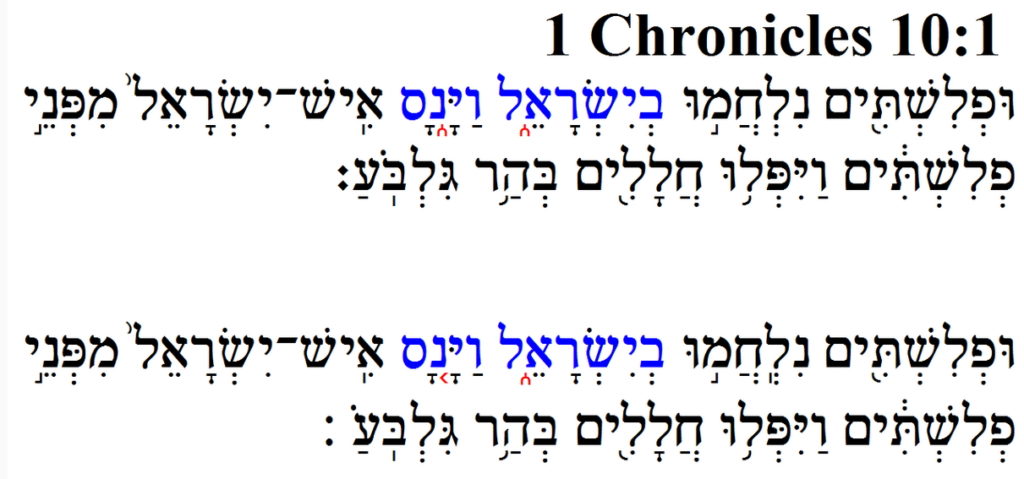
Here are 11 common printed editions of the Hebrew Bible worth checking out:
- Letteris Hebrew Bible / OT (London 1852) pg. 1290
- Ginsburg Hebrew Bible/OT (London 1894 /1998 ) pg. 1698
- Snaith Hebrew Bible/OT (London 1958) pg. 1274
- Koren Tanakh ( Jerusalem 1966)
- Biblia Hebraica Kittel (1937)
- The Biblia Hebraica Stuttgartensia (Deutsche Bibelgesellschaft, Stuttgart 1982)
- Breuer Tanach ( Jerusalem 1989)
- Art Scroll Tanach (Brooklyn 1996) pg. 1898
- Aron Dotan, Biblia Hebraica Leningradensia (Peabody, Massachusetts 2001) pg. 1146
- JPS Hebrew-English Tanakh 2nd edition ( Philadelphia 2004 ) pg. 1911
- Jerusalem Crown (Jerusalem 2004) pg. 8
A check of the eleven editions above reveals that three of these texts have the repeated Ethnachta in 1 Chronicles 10:1: the Biblia Hebraica Stuttgartensia (BHS), the Hendrickson Biblia Hebraica Leningradensia (BHL) edited by Aron Dotan, and the Jewish Publication Society’s Hebrew-English Tanakh, 2nd edition. Because all three editions are based in significant part on the Leningrad Codex, it is useful to compare them directly with a facsimile or digital image of the codex at this point.
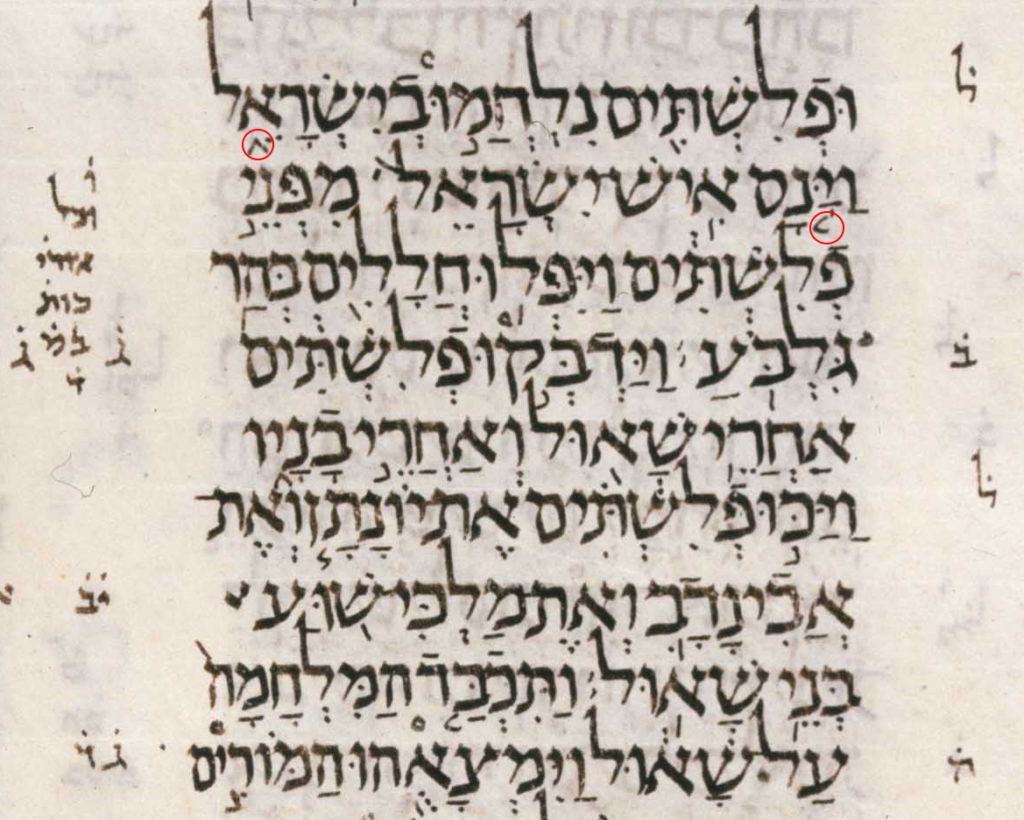
A comparison with the facsimile of the Leningrad Codex suggests an accentual or transcriptional discrepancy between the manuscript and these printed editions. In other words, the repeated Ethnachta found in BHS, BHL, and the JPS edition does not appear to reflect the manuscript at this point. The earlier BHK instead prints an Ethnachta אֶתְנַחְתָּא followed by a mehuppach מְהֻפָּ֤ךְ. This is therefore better described as a discrepancy between manuscript and edition rather than confidently labeling it a textual variant or identifying exactly where the error originated.
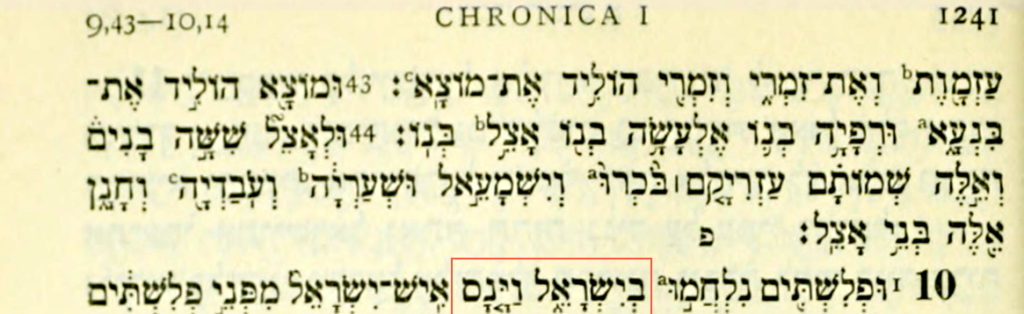
Okay, this very brief example of a very simple issue demonstrates in part what Textual Criticism is.
Dude your posts recently have been brilliant and very illuminating! You are really good at making difficult subjects easy to understand. I noticed the list of Hebrew Bible editions in today’s post and the fact that this blog rarely if even makes mention of English translations of the Bible. So I am really curious as to your views on Bible translations? Is there any translation that you personally use or recommend?
Yan thank you so much for the compliments it means a lot to me.
Now, to answer your questions:
(1) As a general rule of thumb whenever I am invited to someone’s congregation I use whatever Hymnal/Songbook and Bible translation that is available in the pew rack at least as far as the service or liturgy is concerned. And, I recommend that others do the same out of respect.
(2) This blog rarely mentions English translations, because the raison d’etre of Ad Fontes is to go to the sources.
regards,
Brian