Students of Biblical Hebrew quickly discover that a good lexicon is one of the most important tools they can own. While familiar works such as BDB and HALOT remain essential, the Concise Dictionary of Classical Hebrew(CDCH), edited by David J. A. Clines, offers a somewhat different approach to the Hebrew language. When combined with Accordance Bible Software, it becomes an especially convenient resource for reading, word study, and research.
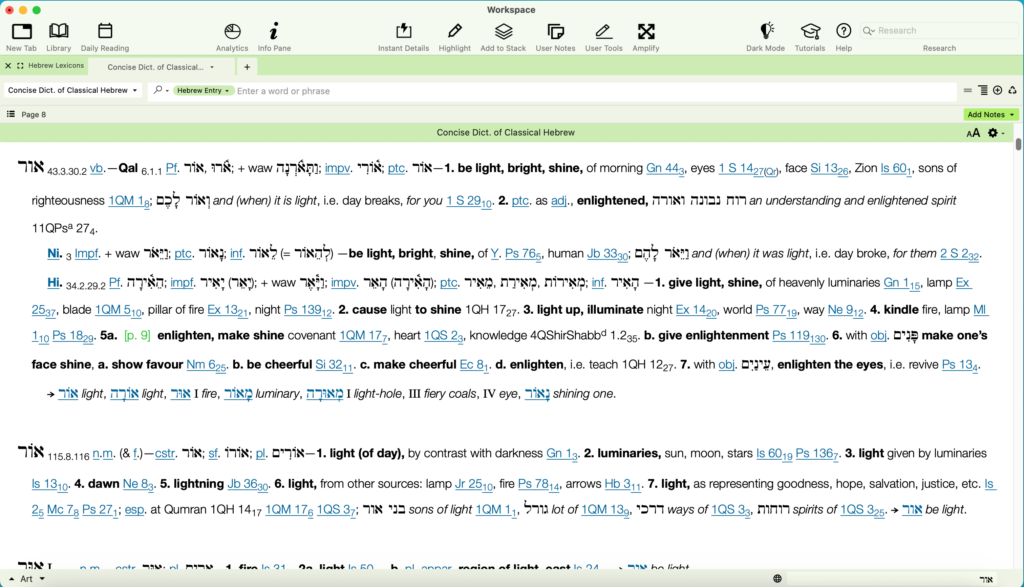
The CDCH was published by Sheffield Phoenix Press in 2009 as a condensed version of the much larger Dictionary of Classical Hebrew. Although the full dictionary extends across multiple volumes, the CDCH manages to place its vocabulary into a single, manageable volume. More importantly, it contains all the words represented in the original Dictionary of Classical Hebrew.
More Than Biblical Hebrew
What makes the CDCH particularly interesting is its broad understanding of “Classical Hebrew.” Many traditional Hebrew lexicons concentrate primarily on the Hebrew Bible. The CDCH takes a broader view. Along with the vocabulary of the Hebrew Bible, it incorporates words found in the Dead Sea Scrolls, the Hebrew text of Ben Sira, and ancient Hebrew inscriptions.
According to the publisher’s description, this results in more than 3,000 additional words beyond those normally represented in standard Biblical Hebrew dictionaries. This wider scope can be helpful even if your main interest is the Hebrew Bible. Biblical Hebrew did not exist in isolation, and seeing its vocabulary within the broader world of ancient Hebrew can provide additional perspective on how words were used.
Another welcome feature is the organization of the dictionary. Words are arranged alphabetically rather than being placed exclusively under reconstructed roots. Consequently, students do not always have to determine a word’s root before finding its entry. The dictionary also supplies English translations for the Hebrew words and phrases it cites and gives occurrence statistics across major bodies of Classical Hebrew literature.
Using the CDCH in Accordance
The electronic edition is where the CDCH becomes especially convenient.
Accordance has long made Hebrew lexical work remarkably fast. With a tagged Hebrew Bible open, you can triple-click a Hebrew word and have Accordance open the corresponding entry in your preferred Hebrew lexicon. Accordance also provides tools such as Instant Details, Amplify, and Live Click that make moving between the biblical text and lexical resources much easier.
This means that while studying, you do not have to interrupt your reading to locate a printed dictionary, identify the proper entry, and search through a column of Hebrew text. With a click or two, you can move directly from the biblical word in your text to the corresponding CDCH entry.
The Accordance edition also adds something a printed copy cannot provide: hyperlinks. Accordance states that its CDCH module includes links to original texts as well as internal links to related words. These connections can turn a simple dictionary lookup into a much more productive study session.
For example, you might begin by examining the meaning of a Hebrew word in a biblical passage, follow a related lexical form, and then investigate examples of its usage elsewhere. Instead of treating the dictionary merely as a source of English definitions, Accordance encourages you to use it as an entry point into the Hebrew evidence itself.
Strengths and Limitations
The CDCH’s greatest strength is probably the balance it achieves between breadth and accessibility. It gives students access to the broader vocabulary of Classical Hebrew without requiring them to work constantly through the full multi-volume DCH.
Its conciseness, however, is also its limitation. A concise dictionary cannot provide the same depth of discussion, bibliography, comparative Semitic evidence, and detailed argumentation available in larger scholarly lexicons. For serious exegetical work, I would not treat the CDCH as a replacement for HALOT, BDB, or the complete Dictionary of Classical Hebrew. It works best alongside them.
That is actually one of the advantages of using it in Accordance: several lexicons can sit beside one another digitally. You can begin with the CDCH for a clear overview and then compare its analysis with HALOT or another Hebrew lexicon when a word deserves closer investigation.
Final Thoughts
The Concise Dictionary of Classical Hebrew is an excellent addition to an Accordance Hebrew library. Its broader coverage reminds us that Biblical Hebrew belongs to a larger corpus of ancient Hebrew literature, while its concise format makes that scholarship accessible to students and regular readers.
Accordance makes the resource even more useful by connecting the dictionary directly to tagged Hebrew texts and providing quick lexical lookup, hyperlinks, and cross-references. For anyone who regularly reads the Hebrew Bible in Accordance, the CDCH is therefore more than another dictionary on a digital bookshelf. It can become a practical companion for daily reading, sermon preparation, classroom study, and more serious Hebrew research.
There is also a sense in which a resource like the CDCH fits naturally with the purpose of Ad Fontes. The phrase ad fontes—“to the sources”—expresses a commitment to return to the earliest and most authoritative evidence rather than relying uncritically on summaries, inherited assumptions, or secondhand interpretations. A lexicon is, of course, itself a secondary resource, but at its best it serves precisely that larger goal.
The value of the CDCH is not simply that it tells us what a Hebrew word means. It helps direct us back to the texts in which that word actually occurs. In Accordance, that movement can become especially natural: from a biblical word to its lexical entry, from the entry to related forms, and from there back into the Hebrew Bible and the wider corpus of Classical Hebrew, including the Dead Sea Scrolls, Ben Sira, and ancient inscriptions. The software does not replace close reading of the sources; used well, it facilitates it.
That is ultimately the kind of movement encouraged by ad fontes: from definitions and interpretations back to the evidence itself, where those interpretations can be examined, tested, and refined. A good lexicon should not become the end of lexical study but a guide into deeper engagement with the language and the texts.
One current point is worth noting: a revised Concise Dictionary of Classical Hebrew appeared in print in 2026, incorporating developments from the revised larger dictionary. The Accordance product page currently describes its module as the original 2009 CDCH edition, so prospective buyers interested specifically in the newest revision should check which edition Accordance is offering.
Don't be shy leave a reply!