• Skip to primary navigation
  • Skip to main content
  • Skip to primary sidebar

Ad Fontes

  • About Ad Fontes
  • Blogroll & Resources

Mitchell

Greek Quote #10

κρείσσων γὰρ σοφία λίθων πολυτελῶν,
        πᾶν δὲ τίμιον οὐκ ἄξιον αὐτῆς ἐστιν.

indeed wisdom is greater than expensive jewels, and nothing is as valuable as it.

glossary:

  • κρείττων    better, greater
    γάρ    for, since, then, indeed
    σοφία    skill; wisdom
    λίθος    stone
    πολυτελής    expensive
    πᾶς    all, every; the whole
    δέ    but, and, now
  • τίμιος    precious, rare; honorable
    οὐ    not; no
    ἄξιος    worthy; worth, value, dignity
    αὐτός    he, she, it; self, same; they
    εἰμί    to be, exist
Question About Blank Parentheses in Electronic Texts of the Biblia Hebraica Stuttgartensia (BHS)

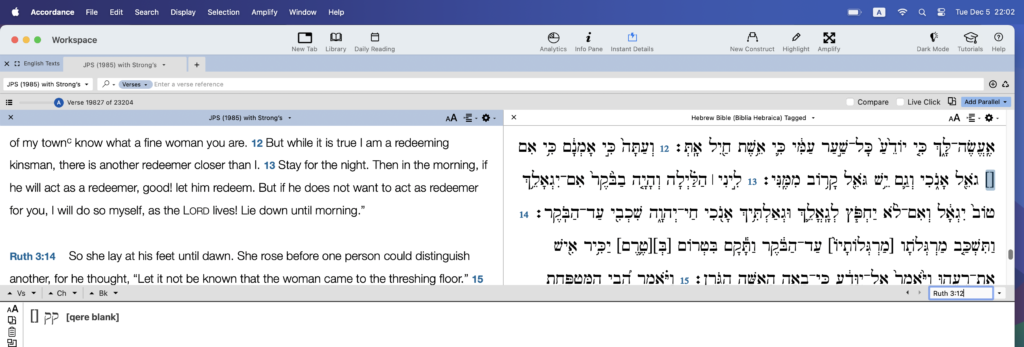
If you have ever used a digital version of the Biblia Hebraica Stuttgartensia (link) in Bible software, you may have encountered words in parentheses. These often represent the קרי (qere, “read”) in the Qere/Ketiv tradition. Qere/Ketiv records a traditional distinction between what is written in the consonantal text—the כתיב (ketiv, “written”)—and what is to be read aloud. The reasons for these distinctions vary and may involve spelling, grammar, euphemism, traditional pronunciation, or textual correction. Rather than altering the consonantal ketiv, the Masoretic tradition records the qere reading through marginal notation and vocalization. In digital Hebrew texts, qere readings are often displayed in parentheses. Sometimes, however, you may encounter an empty or “blank” qere. In Accordance Bible Software(link), this may be tagged as קק or “qere blank.” Ruth 3:12 provides an example.

Screenshot illustrating the Ruth 3:12 Qere/Ketiv example and related Masoretic lists

Well, what does this mean…

In Ruth 3:12, the issue is a case of ketiv velo qere: a word is written in the consonantal text but is not to be read aloud. The BHS Masora Parva on page 1323 notes that אִם is one of eight such cases. In other words, the Masoretic note is not supplying a replacement qere for אִם; it indicates that the written word is to remain unpronounced.

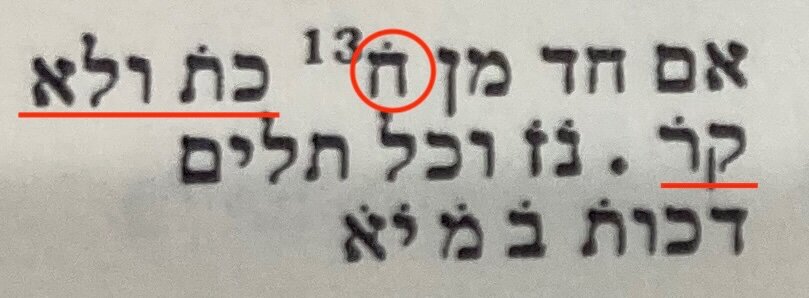
Here is a picture of the Masorah Parva / Masorah Katana of the BHS on page 1323

Screenshot illustrating the Ruth 3:12 Qere/Ketiv example and related Masoretic lists

It reads:

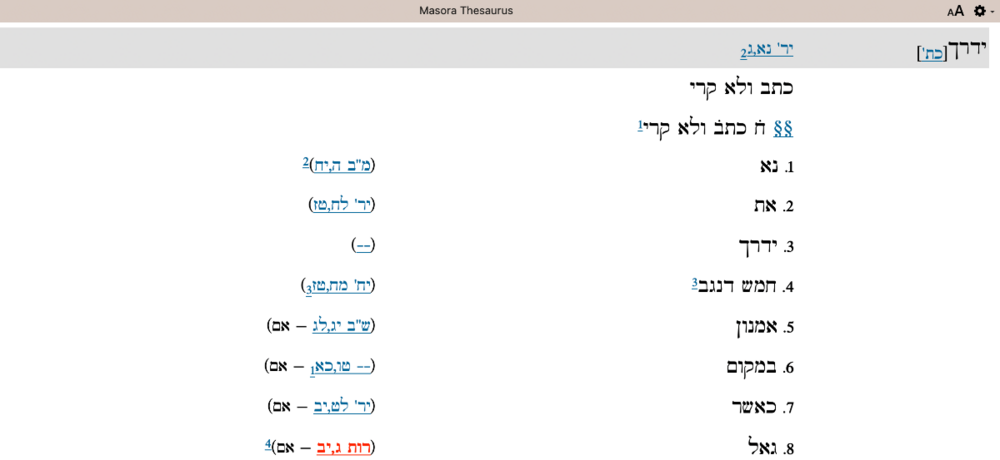
אִם חד מן ח̇ כת̇ ולא קר̇ — “The word אִם is one of eight words that are written but not read.” Naturally, you may want to know where the other occurrences are. Accordance’s Masorah Thesaurus module(link) lists all eight instances of this “written but not read” phenomenon:

Screenshot illustrating the Ruth 3:12 Qere/Ketiv example and related Masoretic lists

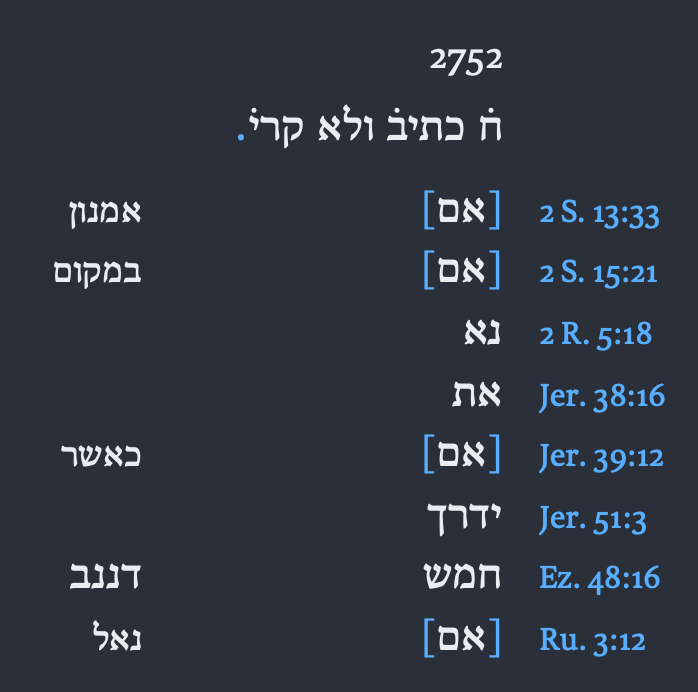
The electronic Logos edition of Gérard E. Weil’s Massorah Gedolah: Manuscrit B. 19a de Léningrad (Rome: Pontificium Institutum Biblicum, 2001) also lists all eight occurrences, although in a different order:

Screenshot illustrating the Ruth 3:12 Qere/Ketiv example and related Masoretic lists

At first sight, Logos’ Massorah Gedolah may look more immediately accessible because English verse references appear alongside the material. Accordance’s Masorah Thesaurus, however, provides additional cross-references and information drawn from a wider range of Masoretic resources. For example, a search for Ruth 3:12 can return several related lists. Weil’s Massorah Gedolah, by contrast, is an edited presentation centered on the Masorah of the Leningrad Codex. The two resources therefore serve somewhat different purposes, and it is useful to have access to both.

Today’s post is a slightly edited version of an answer I wrote earlier this year on a thread in the Accordance Forums see: https://forums.accordancebible.com/topic/35879-qere-blank-in-hebrew/

Thanks for reading!

How to use a Biblical Hebrew Dictionary: Verbs

Rabbi Dr. David Moster is the director of the Institute of Biblical Culture and an Adjunct Assistant Professor of Hebrew Bible at the Jewish Theological Seminary. He is the author of two Biblical Hebrew cards (links above) and “Etrog: How a Chinese Fruit Became a Jewish Symbol.” David received his PhD in תנ״ך (Hebrew Bible) from Bar-Ilan University in Israel, and holds degrees in Bible, Education, and Rabbinics from Yeshiva University and New York University.

Accordance Bible Software and The Concise Dictionary of Classical Hebrew module available for purchase from the Accordance store are used throughout this video. 

Disclaimer: The posting of this video represents neither an endorsement nor a negation of the lexicography and theories employed by the concise dictionary of classical Hebrew. The purpose of posting this video is to show how a dictionary or lexicon of your choice (provided it is available on the Accordance store) could be use in Accordance Bible Software.

Greek Quote #9

Το αποδημείν εί αρίστη παιδεία

Traveling is the best education.

Brief Parsing Information:

  • Το is the definite article
  • τὸ ἀποδημεῖν — an articular present active infinitive of ἀποδημέω, meaning “to travel,” “to be abroad,” or “to be away from home”; the phrase functions substantivally, “traveling.”
  • Textual note: the form εί as commonly printed in this saying is grammatically problematic if treated as straightforward Classical Attic Greek, so it is better not to give it a confident word-by-word parsing without identifying a primary source.
  • ἀρίστη — feminine nominative singular superlative adjective meaning “best” or “excellent.”
  • παιδεία — feminine nominative singular noun meaning “education,” “training,” or “formation.”

This saying is commonly presented as an ancient Greek proverb, although its precise source and original wording are uncertain.

Greek Quote #8

Μέγιστον τόπος. Άπαντα γαρ χωρεί.

Diogenes Laertius, Lives of the philosophers, book 1, chapter 35

This quote is attributed to Thales of Miletus (Θαλής ο Μιλήσιος) who lived from 624/623  – c. 548/545 BC (640 ή 624 π.Χ. Μίλητος, Ιωνία – 546 π.Χ.)

Here is some brief glossary/Parsing info:

  • μέγιστον — neuter singular superlative of μέγας, used here substantivally/predicatively: “greatest [thing].”
  • τόπος — masculine nominative singular noun meaning place or space.
  • ἅπαντα — neuter accusative plural of ἅπας, meaning all things or everything; it is the object of χωρεῖ.
  • γάρ — postpositive conjunction meaning for.
  • χωρεῖ — present active indicative, third-person singular, of χωρέω: contains, holds, or has room for.
  • « Go to Previous Page
  • Page 1
  • Page 2
  • Page 3
  • Page 4
  • Page 5
  • Interim pages omitted …
  • Page 15
  • Go to Next Page »

Primary Sidebar

SEARCH

Categories

Recent Posts

  • Miqra According to the Masorah: Manuscripts, Masorah, and the Editing of the Masoretic Text
  • Jude 5 The Textual Variant Ἰησοῦς / κύριος and the Agent of the Exodus
  • It Is Difficult to Know Oneself: Thales and the Byzantine Tradition
  • A Review of the Concise Dictionary of Classical Hebrew in Accordance Bible Software
  • Hebrew/Aramaic Quote #1: Search the Torah Carefully

Recent Comments

  • Mitchell on The Ethnachta Clause
  • Mitchell on Miqra According to the Masorah: Manuscripts, Masorah, and the Editing of the Masoretic Text
  • Mitchell on The Brown-Driver-Briggs Lexicon in Accordance
  • Ben Denckla on Miqra According to the Masorah: Manuscripts, Masorah, and the Editing of the Masoretic Text
  • Anonymous on The Brown-Driver-Briggs Lexicon in Accordance

136 PROUD SUBSCRIBERS

Copyright © 2026 · eleven40 Pro on Genesis Framework · WordPress · Log in