• Skip to primary navigation
  • Skip to main content
  • Skip to primary sidebar

Ad Fontes

  • About Ad Fontes
  • Blogroll & Resources

Mitchell

HALOT in Accordance Bible Software

If you are serious about studying the Hebrew Bible, HALOT is one of those resources that can completely change the way you work with the text. The Hebrew and Aramaic Lexicon of the Old Testament is the English translation and adaptation of the third edition of Ludwig Koehler and Walter Baumgartner’s landmark Hebrew lexicon, a work also associated with Johann Jakob Stamm. The English edition was translated and edited under the supervision of M. E. J. Richardson and published in stages throughout the 1990s, with the complete five-volume set finished around 2000.

For serious Hebrew study, HALOT is simply one of the major reference works to own. And in Accordance Bible Software, it becomes far more useful than a five-volume print set sitting on a shelf. The Accordance edition gives you the complete, unabridged five-volume English HALOT in a searchable, hyperlinked digital format. Instead of spending time flipping through volumes and tracking down entries manually, you can move from the biblical text to detailed lexical analysis in seconds.

That convenience matters because HALOT is much more than a dictionary. It does not simply tell you, “this Hebrew word means X.” Instead, HALOT helps you see the different semantic senses a Hebrew or Aramaic word can have in different contexts, shows you where those senses occur and gives you the linguistic, textual, and comparative evidence behind those meanings.

What You Get in a HALOT Entry

A substantial HALOT entry may give you all of the following in one place:

  • The Hebrew or Aramaic lemma and grammatical information;
  • proposed etymology and related forms;
  • comparisons with Aramaic, Arabic, Akkadian, Ugaritic, Syriac, and other Semitic languages;
  • clearly distinguished semantic senses, rather than one oversimplified English gloss;
  • Scripture references showing where each sense occurs;
  • idioms and unusual grammatical constructions;
  • discussion of difficult or debated passages;
  • evidence from ancient versions and textual traditions;
  • references to scholarly literature and alternative interpretations.

At first glance, HALOT can look dense. Even a short Hebrew word may produce an entry packed with abbreviations, cognates, references, and scholarly discussion. But that is exactly what makes it so valuable.

HALOT does not merely give you an answer—it gives you the evidence behind the answer.

That makes it especially powerful when you are trying to move beyond surface-level word studies and understand how a term is actually functioning in a particular biblical context.

And this is where the Accordance edition really shines.

With a tagged Hebrew Bible open, Accordance allows you to triple-click a Hebrew word and jump directly to its entry in your preferred Hebrew lexicon. Set HALOT as your preferred lexicon, and one of the most important scholarly Hebrew reference works available is instantly connected to the text you are reading. Accordance also supports features such as Instant Details and Amplify/Live Click, making it easy to move back and forth between the biblical text and your lexical resources without interrupting your workflow.

In print, your process might look something like this: Hebrew Bible → identify the root → find the right HALOT volume → locate the page → identify the correct homonym → read the entry → return to the biblical text.

In Accordance, that process can become: Hebrew Bible → click the word → HALOT.

That is a dramatic difference in day-to-day use. Scripture references and cross-references in the electronic edition are hyperlinked as well, so you can move quickly from lexical discussion to the biblical passages being cited. Accordance has also documented HALOT’s Scripture links working with its Instant Details functionality.

The result is that HALOT stops being the kind of resource you consult only when you encounter a difficult word.

You start using it constantly.

That may be the biggest advantage of owning HALOT in Accordance. You are not just buying a famous five-volume lexicon. You are putting one of the premier tools for Hebrew Bible study directly into your everyday reading workflow.

For rabbis, pastors, seminary students, scholars, teachers, and anyone working seriously with Biblical Hebrew, HALOT in Accordance is one of the most valuable lexical investments you can make.

From the Lexicon Back to the Text

A simple example helps show why this matters. Suppose you encounter a familiar Hebrew word and think you already know what it “means.” It is tempting to click on the word, find an English gloss, and move on. But that is not really lexical study.

A resource such as HALOT invites you to slow down. Instead of asking only, “What English word corresponds to this Hebrew word?” you can ask which sense of the word is appropriate in this particular passage, where else that sense occurs, whether a particular construction affects its meaning, what related Semitic languages may contribute to the discussion, and whether the ancient versions or textual traditions preserve evidence worth considering.

Accordance makes following those questions unusually easy. A click takes you from the Hebrew text to the lexical entry; the references in the entry take you back into other biblical passages; and from there you can compare usage for yourself. The important thing is that the lexicon does not replace the Hebrew text. Properly used, it continually sends you back to it.

Ad Fontes: Back to the Sources

That is also one reason a resource such as HALOT belongs on a site called Ad Fontes.

The old humanist cry ad fontes—“to the sources” or “to the fountains”—was a call to return to the texts themselves: to learn the languages, read carefully, and test received assumptions against the evidence. Modern Bible software can serve exactly that purpose when it is used well.

The value of having HALOT in Accordance is therefore not merely that electronic lookup is faster than pulling a volume from the shelf. Speed is useful, but it is not the ultimate goal. The real advantage is that the distance between the reader and the sources becomes smaller. The Hebrew text, its lexical evidence, parallel passages, cognate languages, ancient versions, and scholarly discussion can all become part of a continuous process of reading and investigation.

Technology can encourage superficial study when it gives us instant answers. But it can also do the opposite. A well-designed electronic edition can make it easier to ask better questions, examine the evidence, and return again and again to the text itself.

That, at least, is the kind of technology I am interested in at Ad Fontes: tools that help us get back to the sources.
The Brown-Driver-Briggs Lexicon in Accordance

The Accordance Edition of the “Hebrew and English Lexicon of the Old Testament, with an Appendix Containing the Biblical Aramaic, edited principally by Francis Brown, with S. R. Driver and Charles A. Briggs.”

For anyone who has spent serious time working in Accordance, BDB Complete is one of those modules that illustrates why the platform has long been so well suited to biblical-language research. The underlying work, of course, is the classic A Hebrew and English Lexicon of the Old Testament, with an Appendix Containing the Biblical Aramaic, edited principally by Francis Brown, with S. R. Driver and Charles A. Briggs. Commonly abbreviated BDB, it stands in the lexicographical tradition of Wilhelm Gesenius, particularly as that tradition came into English through Edward Robinson. But BDB is much more than a repackaged Gesenius. Brown, Driver, and Briggs carried out substantial additional lexicographical and comparative work of their own, and the result became one of the foundational tools of modern Hebrew Bible study.

The publication history can be a little confusing at first. The lexicon appeared in fascicles beginning in 1891, while the editors’ preface is dated March 1906. For that reason, one encounters both 1906 and 1907 in bibliographic records for the completed work. Accordance itself identifies the base edition for its module as Clarendon Press, 1907, so that is the date I would use when citing the Accordance resource specifically. More generally, it is probably safest to say that the work was completed in 1906 and appeared in complete form in 1906–1907.

What has always made BDB impressive is the sheer density of information packed into each entry. It is organized largely around Hebrew lexical roots, with senses subdivided according to usage, and it draws heavily on comparative Semitic evidence. Arabic, Aramaic, Syriac, Ethiopic, and Assyrian/Babylonian material appears throughout, along with extensive biblical citation. The Biblical Aramaic material is treated in an appendix. In print, all of this makes BDB extraordinarily rich but also notoriously compact and visually demanding. That is precisely where the Accordance edition becomes interesting.

BDB seems to have been part of Accordance from very early in the program’s history. During the development of Accordance 2.0 in late 1995, work was already under way on an abridged BDB, and Accordance 2.0, released in May 1996, introduced the “Tool” architecture that became the home for lexicons, dictionaries, commentaries, and other reference works. In other words, BDB belongs to the first generation of serious Accordance research modules.

For many years, however, the BDB available in Accordance was an abridged version. Accordance later explained that the electronic source text it had inherited omitted two enormous portions of the original work: the Scripture references and the comparative or cognate Semitic material. The abridged module was still useful—far more useful than some older electronic resources bearing the BDB name—but it was not the complete printed lexicon.

That changed around 2008, when Accordance released BDB Complete. An Accordance article from October 2009 refers to the unabridged edition as having been released “last year,” which places its arrival in 2008, even if the precise original release date is difficult to document. The important point is that the complete module finally restored the biblical references and comparative linguistic material that make the printed BDB what it is.

For me, though, the real value of BDB Complete is not simply that Accordance put the missing material back in. It is what Accordance did with that material.

Anyone who has used the printed BDB knows how compressed its typography is. A single entry may contain several levels of meaning, grammatical notes, numerous references, cognate forms, abbreviations, and typographical conventions, all packed together with very little visual breathing room. Accordance’s developers did not simply reproduce that density on a screen. They manually broke the material into subarticles, sections, and paragraphs, creating a much clearer hierarchical structure.

That may sound like a modest improvement until you actually work with the module. In practice, it makes a substantial difference. The print edition often requires the reader to decode the hierarchy visually from typography and indentation; in Accordance, that hierarchy is much easier to follow. The information is still BDB’s, but the electronic presentation makes the logic of an entry far more accessible.

The handling of Scripture references is equally important. In the printed lexicon, they are, naturally, just references on the page. In Accordance, they become live links. You can hover over them, inspect them through Instant Details, or move directly into the biblical text in your library. That transforms the way you use BDB. Instead of constantly moving between a lexicon and a printed Bible, the lexical entry and the passages supporting it become part of the same working environment.

The comparative Semitic material receives similar treatment. Much of it is represented as searchable text in the appropriate scripts rather than merely being reproduced as an image of the printed page. That matters if you actually use BDB for comparative work rather than simply for English glosses. Accordance did have to preserve certain unusual characters or forms as images, and the program later introduced image-scaling support to improve the display of such material. But the overall approach is clearly that of a genuine electronic edition rather than a page facsimile.

The module also continued to improve after its initial release. BDB Complete 4.0, released on July 22, 2014, included substantial proofreading and corrections to page numbers. That is worth noting because it means the current module is not simply the original conversion frozen in time; Accordance continued to refine the electronic text.

The older BDB Abridged also remained available as a separate module and received its own updates. In 2021, Accordance added Strong’s numbers and incorporated the previously separate Biblical Aramaic glossary into the abridged module. That makes the two resources somewhat different in purpose: the abridged edition is convenient and more accessible for quick lookup, while BDB Complete preserves the full scholarly apparatus.

The most important distinction, however, is between revision and digital enhancement. Accordance has not created a new lexicographical revision of BDB. The definitions, etymological proposals, semantic judgments, and comparative conclusions remain those of Brown, Driver, and Briggs, with all the strengths and historical limitations that this entails. BDB Complete should therefore still be read as an early twentieth-century lexicon, not as a modern replacement for more recent Hebrew lexicographical work.

But as an electronic edition of BDB, it is exceptionally well conceived. Accordance has taken an extraordinarily dense print reference work and turned it into a genuinely usable digital research tool. The hierarchical formatting, live biblical references, searchable scripts, structured fields, and later proofreading do not change the scholarship of BDB, but they make that scholarship far easier to navigate and exploit.

There is also something particularly ad fontes about using BDB in this form. The point of returning “to the sources” is not simply to prefer old books because they are old, nor is a lexicon itself the ultimate source for the meaning of a biblical word. Ideally, a lexicon helps send us back to the Hebrew and Aramaic texts, to the passages in which a word actually occurs, and to the linguistic evidence on which lexical judgments have been made. In that respect, the Accordance edition serves BDB unusually well. Its live biblical references and searchable linguistic material make it easier to move beyond an English gloss, examine the evidence cited by Brown, Driver, and Briggs, and then return to the biblical text itself.

At the same time, the complete electronic edition allows us to go ad fontes in another sense: back to BDB as BDB actually was. Rather than relying upon an abridgment that removed much of its biblical and comparative evidence, we can consult the complete historical work and distinguish what Brown, Driver, and Briggs actually argued from what later summaries or electronic derivatives may have preserved. Returning to the sources does not require us to accept every conclusion of an older authority. It allows us to see the evidence and the argument more clearly—and therefore to judge both more responsibly.

That is why I would describe BDB Complete for Accordance not simply as a digitized BDB, but as a carefully engineered electronic edition of the 1906–1907 lexicon. It preserves the historical content while taking advantage of the strengths of the Accordance environment. For anyone who still uses BDB regularly—and especially for anyone who works seriously with Biblical Hebrew—the Accordance version is one of the best ways to experience the lexicon today.

The Cairo Bible, of the year 1010

Leningrad Codex manuscript or software image illustrating the article

Throughout the world, there are many manuscripts—ancient copies—of individual books and sections of the Hebrew Bible. The most famous are probably the manuscripts found at Khirbet Qumran near Ein Feshka—in other words, the manuscripts popularly known as the Dead Sea Scrolls. These scrolls include some of the earliest surviving manuscripts of portions of the Hebrew Bible.

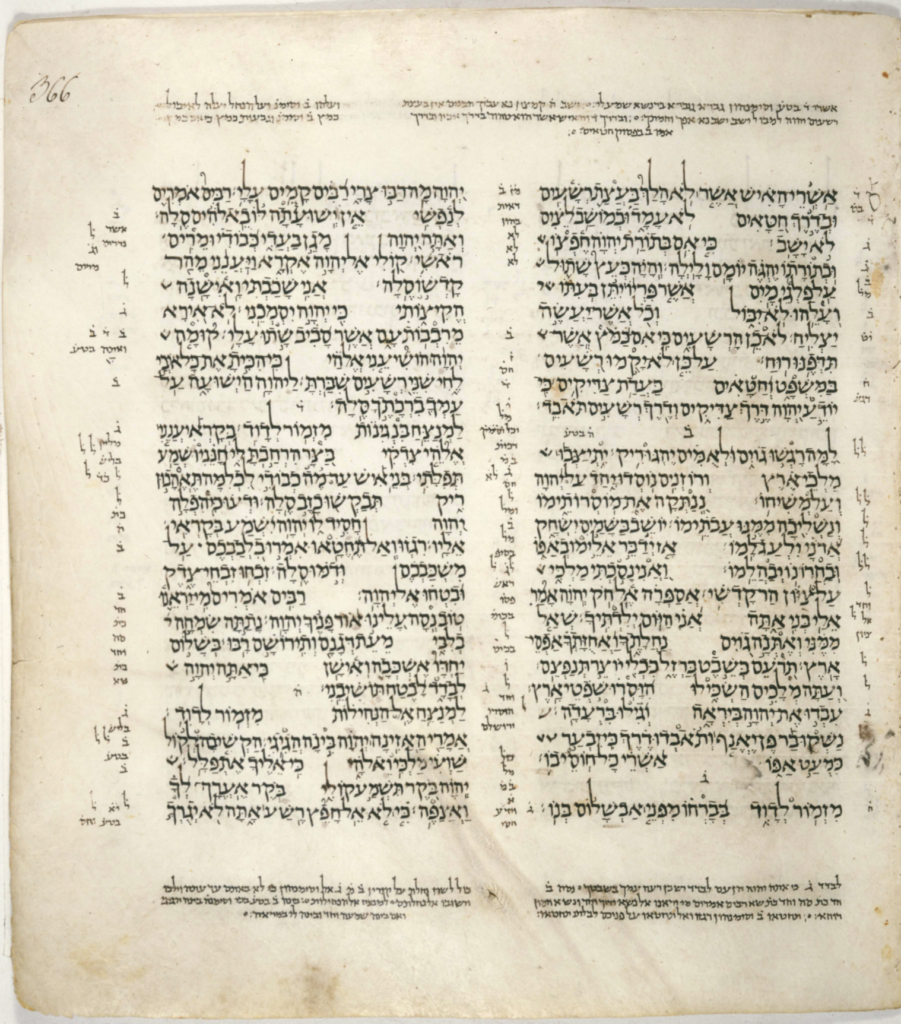
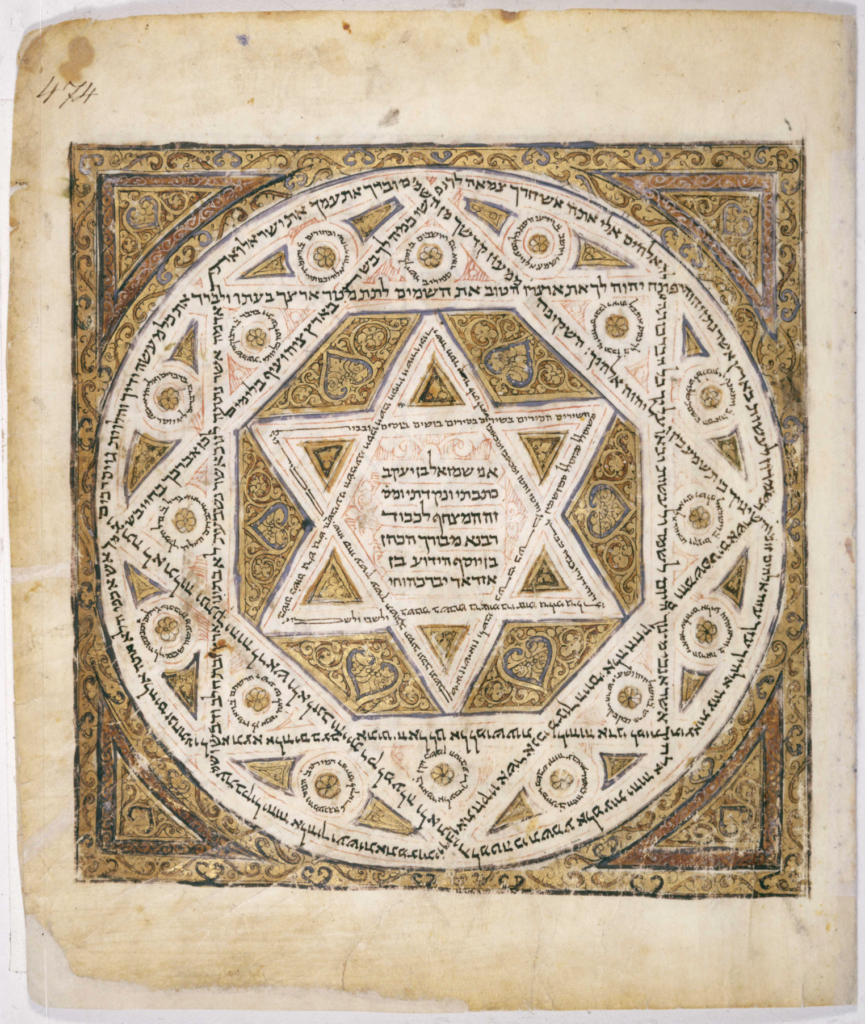
Two other important, though considerably later, manuscripts are the Aleppo Codex and the Cairo Bible, of the year 1010, better known today as the Leningrad Codex. The Aleppo Codex is slightly older than the Leningrad Codex, but the Leningrad Codex is complete, while the Aleppo Codex has a number of missing sections. Thus, although the Leningrad Codex is far from being the earliest surviving witness to any individual book of the Hebrew Bible, it is nonetheless the oldest complete codex of the Hebrew Bible.

Today, the Leningrad Codex is housed in the National Library of Russia in St. Petersburg as part of the First Firkovich Collection. The codex is generally dated to approximately 1008–1009 CE and is associated with Cairo, Egypt. Its scribe was Samuel ben Jacob.

The Leningrad Codex became part of Abraham Firkovich’s First Collection, although exactly where and when he obtained it remains uncertain. In 1862, funds were allocated for the Imperial Public Library to purchase Firkovich’s collection; in 1863, the manuscripts—including the Leningrad Codex—entered the library in St. Petersburg.

What is not a mystery is the importance the manuscript later acquired for printed editions of the Hebrew Bible. Paul E. Kahle advocated using the Leningrad Codex as the base text for the third edition of Kittel’s Biblia Hebraica. In 1935, the codex was loaned for two years for work connected with the edition, which appeared in 1937. The Leningrad Codex subsequently became the textual basis for major scholarly editions including Biblia Hebraica Stuttgartensia and Biblia Hebraica Quinta. Through these editions, it has exercised enormous influence on the textual basis used in modern translations of the Hebrew Bible/Old Testament.

While the Leningrad Codex is not nearly as old as the Dead Sea Scrolls, its importance for modern editions of the Hebrew Bible makes it an extraordinarily significant manuscript. However, not everyone can afford a flight to St. Petersburg, and even those who can may find it difficult to obtain permission to study the Leningrad Codex in person.

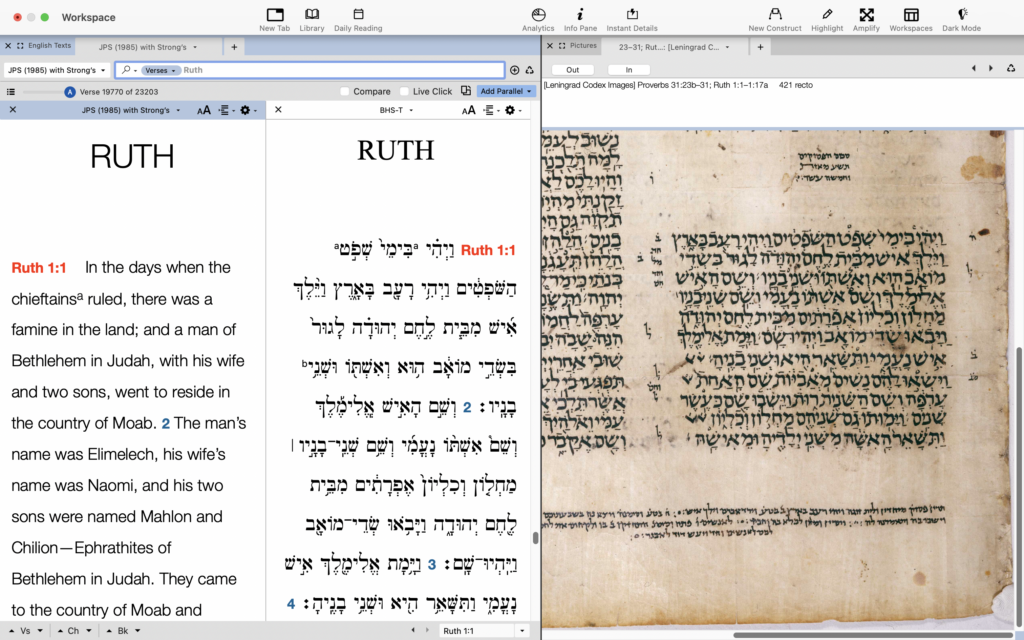
But fear not! Why? Because the West Semitic Research Project’s photographic facsimile of the Leningrad Codex can now be accessed digitally on computers, smartphones, and tablets through Accordance Bible Software. With Accordance’s Leningrad Codex Images module, one can double-check readings in BHS and BHQ, read the Masoretic notes, and examine the manuscript at home or on the go.

Leningrad Codex manuscript or software image illustrating the article
Leningrad Codex Images

Greek Quote #12

Κάλλιστον κόσμος, ποίημα γαρ θεού.

“The Universe is most beautiful for it is the work of God (Ο Θαλής ο Μιλήσιος / Thales of Miletus))


Parasing Information:

Κάλλιστον  is the neuter form of the superlative adjective “κάλλιστος” (kállistos), which means “most beautiful” or “best.” Because Κάλλιστον is neuter while κόσμος is masculine, the adjective is not simply agreeing with κόσμος. It is better understood substantivally or predicatively: roughly, “The most beautiful [thing] is the cosmos/universe.” 

κόσμος is a Greek noun that means “world” or “universe” in English. Grammatically, it is masculine in gender and can take different forms depending on its role in a sentence, such as nominative, accusative, genitive, etc.

ποίημα is a Greek noun that means “workmanship”, “creation”, or “poem” in English. It is neuter in gender.

γαρ  is a Greek particle used in ancient Greek and Koine Greek. It’s commonly translated as “for” or “indeed” in English. Grammatically, it serves as a conjunction or a particle that connects clauses, providing an explanation, justification, or reason for what was said before. It doesn’t inflect like nouns or verbs, so it doesn’t have different forms.

θεού is a Greek noun that means “of God” in English. Grammatically, it is in the genitive case, which typically indicates possession or relationship. In this form, it shows possession or association with the noun it modifies. In this case, “θεού” indicates possession by or association with God.

Greek Quote #11

Υἱὸς σοφὸς εὐφραίνει πατέρα, υἱὸς δὲ ἄφρων λύπη τῇ μητρί. (Παροιμίαι (Παλαιά Διαθήκη) 10:1)

“A wise son maketh a glad father: but a foolish son is the heaviness of his mother. “( Proverbs 10:1 KJV)

Brief Glossary and Parsing notes follow:

The masculine noun υἱός (son) appears 2x times in this verse and both times it is found in the nominative singular dictionary form.  

  •  All the following lexical items in verse relating the singular (son) are also all singular.
    σοφός  (wise/wisdom) masculine nominative adjective in the plain dictionary form.
    εὐφραίνει  (to make glad, happy, cause to celebrate)  is the present active indicative 3rd person form of the verb εὐφραίνω    
    πατέρα    (Father, Dad, parent) is the accusative masculine form of the noun πατήρ   
    δὲ  (but, however, now) is a conjunction
  • ἄφρων (stupid, foolish) is the masculine nominative form of the adjective  ἄφρων   
  • Naturally the following are all feminine singular(s)
    λύπη   (sorrow, grief, unhappiness) is a nominative noun  
    τῇ is the of course the article ὁ   
    μητρί (mother) is the dative form of the noun μήτηρ  
  • « Go to Previous Page
  • Page 1
  • Page 2
  • Page 3
  • Page 4
  • Interim pages omitted …
  • Page 15
  • Go to Next Page »

Primary Sidebar

SEARCH

Categories

Recent Posts

  • Miqra According to the Masorah: Manuscripts, Masorah, and the Editing of the Masoretic Text
  • Jude 5 The Textual Variant Ἰησοῦς / κύριος and the Agent of the Exodus
  • It Is Difficult to Know Oneself: Thales and the Byzantine Tradition
  • A Review of the Concise Dictionary of Classical Hebrew in Accordance Bible Software
  • Hebrew/Aramaic Quote #1: Search the Torah Carefully

Recent Comments

  • Mitchell on The Ethnachta Clause
  • Mitchell on Miqra According to the Masorah: Manuscripts, Masorah, and the Editing of the Masoretic Text
  • Mitchell on The Brown-Driver-Briggs Lexicon in Accordance
  • Ben Denckla on Miqra According to the Masorah: Manuscripts, Masorah, and the Editing of the Masoretic Text
  • Anonymous on The Brown-Driver-Briggs Lexicon in Accordance

136 PROUD SUBSCRIBERS

Copyright © 2026 · eleven40 Pro on Genesis Framework · WordPress · Log in