• Skip to primary navigation
  • Skip to main content
  • Skip to primary sidebar

Ad Fontes

  • About Ad Fontes
  • Blogroll & Resources

Masora

The Masora Thesaurus (part two)

I originally posted the following as a series of replies on the Accordance forums in December of 2015.

The printed BHS only contains the Masora Parva, Masora finalis (and a highly edited form of that). The editors of the BHS put theMasora Magna in a separate volume that is now out of print (although a digital edition of that does exist).

The  Masorah Thesaurus has so much more. It has the unedited Masorah Parva, the Masorah Magna of the Leningrad Codex(and other sources, too), as well as cross-references to other Masoretic lists, notations, and texts (as well as more). The Masorah Thesaurus is of course searchable in ways that neither the print edition of the BHS nor the digital edition of Gerard E. Weil’s Massorah Gedolah: Manuscrit B. 19a de Léningrad are.

MP notes

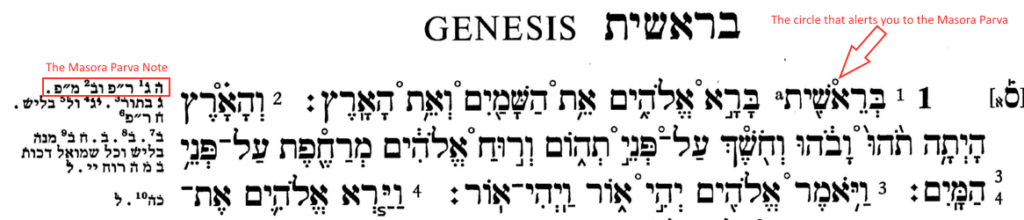
In a printed edition of the BHS we turn to page one or to Genesis 1:1. Now, we notice the raised circle above  בְּרֵאשִׁית . That circle in our printed BHS alerts us to the marginal notes called Masora Parva. To better illustrate what has just been said take a look at the following: 

In the photo (or in the BHS) we notice that the first letter of the note is the fifth letter of the Hebrew Alphabet  ה̇.  We also notice that the  ה̇ has a small dot over it. When we see a dot over a letter that often tells us that the letter is meant to be read as a number. In this case, we read this as telling us that there are five occurrences of the word  בְּרֵאשִׁית in the text of the Tanach/Hebrew Bible.

We also notice that there are two other Hebrew letters in the note with dots; both ג̇ and ב̇ followed by abbreviations or shorthand notes.   ג̇ being the third letter of the alphabet represents 3, and ב̇ being the second letter represents two (2 plus 3 is, of course, five). So, the Masora tells us that בְּרֵאשִׁיתstarts a stanza(ר״פ)   three times (ג̇) , and is embedded in a stanza ( מ״פ)   two times(ב̇).

This may help us understand the above abbreviations:

(Within, inside) מ = מצעא

(Head, start)      רֹ =ראש

(verse/Stanza)  פ  = פסוקֹ, פסֹ, פסוֹ

Sometimes (or at least I have seen some use) קֹ in place of פסוקֹ

However, since the Masora Parva is brief it does not list those occurrences mentioned above. Before the advent of the Masorah Thesaurus, we would need to run an Accordance search, consult a paper concordance, or work through Masoretic lists to locate all of the occurrences mentioned in the BHS’ Masora Parva.

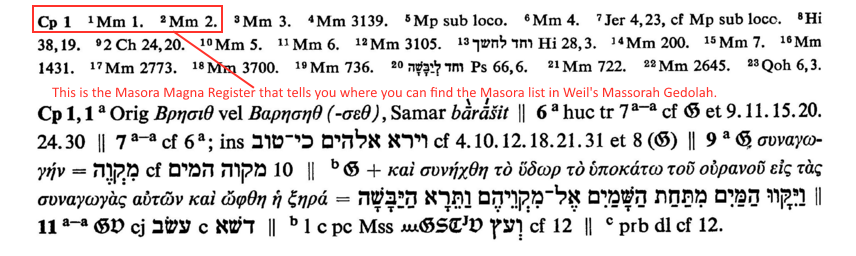
The Masora Magna Register at the bottom of the printed BHS, however, does indicate where we can (or could in past time) quickly locate the list in Weil’s Massorah Gedolah.

Unfortunately, the Massorah Gedolah is out of print, but as mentioned before, there is a digital version of it in another software platform. Before I got access to the Masorah Thesaurus module I will admit, I used to use the digital version of Weil’s Massorah Gedolah a fair bit and it still has its place. However, the  Masorah Thesaurus module  offers much more than what Weil’s Massorah Gedolah does.

Now, turn to Genesis 43:8 in a printed edition of the BHS (page 71). Let’s look at a rather famous example:

וַיֹּ֨אמֶר יְהוּדָ֜ה אֶל־יִשְׂרָאֵ֣ל אָבִ֗יו שִׁלְחָ֥ה הַנַּ֛עַר אִתִּ֖י וְנָק֣וּמָה וְנֵלֵ֑כָה וְנִֽחְיֶה֙ וְלֹ֣א נָמ֔וּת גַּם־אֲנַ֥חְנוּ גַם־אַתָּ֖הגַּם־טַפֵּֽנוּ׃

Take a look at the Masora Parva note for Genesis 43:8 : י̇ב̇ פסוק̇ גם גם גם

י̇ב̇ = 12

Verses =פסוק̇

גם גם גם = a construction/string גם

The meaning = There are 12 verses in the Tanach where גם occurs three times.

The Mm register for Genesis 43:8 only has Mm index numbers for the following words:

שִׁלְחָה= Mm index number 2915

וְנָקוּמָה = Mm Index number 3078

In other words neither the BHS nor its companion volume Weil’s Masorah Gedolah can help you in finding the list or references for the 12 occurrences of the גם גם גם construction.

Also, in this case, a paper concordance will be of little help since

גם appears something like 769 times in the Tanach/Hebrew Bible.

Click-searching on גם will similarly not help you much.

(However, Accordance’s construction search can find examples of the structure and depending on how many intervening words you select between each of the גם your results will vary).

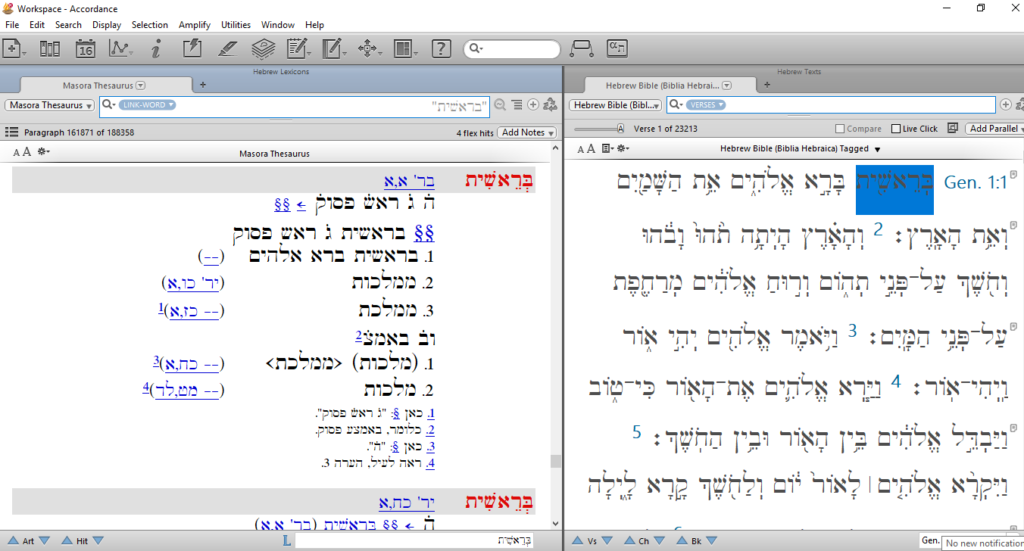
However, since we have the Masorah Thesaurus we can easily find everything the Masora Parva note of the BHS was alluding to:

(1) Open the Masorah Thesaurus

(2) Open the Table of Contents

(3) Type in גם and search

(4) Now, we will find the information we wanted to know at:

Paragraph 43839 of 188291

Paragraph 43844 of 188291

Paragraph 43850 of 188291

As we can see there simply isn’t enough space in the printed/paper BHS to provide that type of detailed information for every Masorah Parva note. This is one reason (there are many more) why the Masorah Thesaurus is indispensable for Masoretic studies.
The Masorah Thesaurus

Yet, another reason to get excited about Accordance for Windows and the original Mac OS version as well! Accordance has just released the first part of the Masora Thesaurus. When completed this encyclopedic like volume will contain the complete text of the Masorah Gedolah, Masorah Ketanah, and the Masorah Finalis of the oldest complete codex of the Hebrew Bible/Tanakh known as the Leningrad Codex B19a. This work will also include 30 years worth of Aron Dotan’s notes on the Masora. Aron Dotan is chair of the International Organization for Masoretic Studies and editor of the Biblia Hebraica Leningradensia. Now, this begs the question of what is the Masora?

The term Masorah is ordinarily used in modern biblical studies to refer to the body of marginal notes (i.e., Masoretic notes) which are transmitted with the text, either in a manuscript or in a printed edition. However, this is the narrow sense of the word. In its broadest sense, Masorah refers to traditions and rules, passed down in Judaism for generations, which regulate all aspects of the copying and use of Bible manuscripts…

The Masorah can be divided into several subdivisions. The Masorah Parva (Mp) consists of the Masoretic notes in the side margins of manuscripts (cf. BHS). The Masorah Magna (Mm) includes the notes in the upper and lower margins of the manuscripts…

The Masorah Finalis (Mf) refers to the material collected at the end of a particular book, section (e.g., Torah) or manuscript. In manuscripts, the Mf consists of summary lists, such as the number of verses, sedarim, etc., and information of this type is included in BHS at the end of books.

Kelley, Page H., Daniel S. Mynatt, and Timothy G. Crawford. The Masorah of Biblia Hebraica Stuttgartensia: Introduction and Annotated Glossary. Grand Rapids, MI: William B. Eerdmans Publishing Company, 1998.

The Biblia Hebraica Stuttgartensia (BHS) the longtime popular edition of the Hebrew Bible. only contains the Masora Parva, Masora Finalis (and a highly edited form of that). The Masora not unlike the annotations one finds in a reference Bible. However, the Masora goes further, noting issues like grammar, syntax, spelling, unusual/rare words, word counts, and even typography. The editors of the BHS put the Masora Magna in a separate volume that is now out of print (although a digital edition of that does exist) and hard to find. The Masorah Thesaurus makes the Masoretic information associated with Codex Leningradensis available in a searchable electronic format and supplements it with cross-references to other important Masoretic resources.

Enter Accordance Bible Software‘s Masorah Thesaurus database.

Screenshots illustrating the Masorah Thesaurus and BHS Masoretic notes discussed in the article

The Masorah Thesaurus has so much more than the printed Masora Magna of the BHS. Accordance database has the unedited Masorah Parva, the Masorah Magna of the Leningrad Codex(AND other manuscripts, too), as well cross-references to other Masoretic lists, notations, and texts (as well as much more). Accordance digital Masorah Thesaurus database is, of course, searchable in ways that neither the print edition of the BHS nor the standard digital edition of Gerard E. Weil’s Massorah Gedolah: Manuscrit B. 19a de Léningrad are. 

So, that we can better appreciate the Masorah Thesaurus let’s first take a quick look at what the printed BHS offers. 

In a printed edition of the BHS we turn to page one or to Genesis 1:1. Now, we notice the raised circle above  בְּרֵאשִׁית . That circle in our printed BHS alerts us to the marginal notes called Masora Parva. To better illustrate what has just been said take a look at the following screenshot: 

Screenshots illustrating the Masorah Thesaurus and BHS Masoretic notes discussed in the article

In the photo above (or in the BHS) we notice that the first letter of the note is the fifth letter of the Hebrew Alphabet  ה̇.  We also notice that the ה̇ has a small dot over it. When we see a dot over a letter that often tells us that the letter is meant to be read as a number. In this case, we read this as telling us that there are five occurrences of the word  בְּרֵאשִׁית in the text of the Tanach/Hebrew Bible.

We also notice that there are two other Hebrew letters in the note with dots; both ג̇ and ב̇ followed by abbreviations or short hand notes.   ג̇ being the third letter of the alphabet represents 3, and ב̇ being the second letter represents two (2 plus 3 is of course five). So, the Masora tells us that בְּרֵאשִׁית starts a stanza(ר״פ)   three times (ג̇) , and is embedded in a stanza ( מ״פ)   two times(ב̇).

This may help us understand the above abbreviations:

  (Within, inside) מ = מצעא

  (Head, start)      רֹ =ראש

  (verse/Stanza)  פ  = פסוקֹ, פסֹ, פסוֹ 

Sometimes (or at least I have seen some use) קֹ in place of פסוקֹ

However, since the Masora Parva is brief it does not list those occurrences mentioned above. Before the advent of the Masorah Thesaurus, we would need to run a quick Accordance search, consult a paper concordance, or wade through Masoretic lists to find all of the occurrences mentioned in the BHS’ Masora Parva. The Masora Magna Register at the bottom of the printed BHS, however, does indicate where we can (or could in past time) quickly locate the list in Weil’s Massorah Gedolah. See:

Screenshots illustrating the Masorah Thesaurus and BHS Masoretic notes discussed in the article

At the time this post was written, Weil’s Massorah Gedolah was difficult to find in print, though a digital edition was available on another software platform. The Accordance Masorah Thesaurus was also priced at roughly $100, so I considered it the better value because it contained substantially more Masoretic material and search functionality.

Searching the Cantillation Marks (Ta’amim) of the Hebrew Bible

Historical note: This post was originally written in 2013 and describes BibleWorks as it existed at that time. BibleWorks ceased operation as a commercial Bible-software provider in 2018, although existing users may still maintain installations.

Modern software makes it possible to search individual accents/cantillation marks as well as specific combinations of them in the Hebrew Bible. BibleWorks included two different databases that could be used for accent searching: the WTM (Westminster Morphological Database) and the JDP (Dr. James D. Price accent database). The accent codes differ between the databases, and the JDP database also uses different codes for prose and poetic books. Let’s say you’d like to search for every occurrence of the Mereka accent in the WTM.
(1) Enable the Permit accent code searching in Hebrew morph. version(s) option. (2) Select the WTM database as your search version. (3) On the command line, type: .*@*Zy*

This yielded 286 hits in 283 verses.
For reference, here are the WTM accent codes:

  1. Segolta (a)
  2. Sinnorit (s)
  3. Zarqa, Sinnor (b)
  4. Pazer (t)
  5. Pashta, Azla Legarmeh (c)
  6. Pazer Mag or Qarne Parv (u)
  7. Pashta (with previous left) (d)
  8. Zaqep Magnum (v)
  9. Telisha Parvum (e)
  10. Mahpak or Mehuppak (w)
  11. Paseq [separator] (f)
  12. Mereka (y)
  13. Yetib (g)
  14. Mereka Kepulah (z)
  15. Dehi or Tipha (h)
  16. Tipha, Majela, or Tarha (0)
  17. Mugrash (i)
  18. Munah (1)
  19. Telisha Magnum (j)
  20. Silluq [meteg (left)] (9,2)
  21. Ole or Mahpakatum (k)
  22. Meteg (right) (3)
  23. Geresh or Teres (l)
  24. Tebir (4)
  25. Gershajim (m)
  26. Atnah (5)
  27. Azla or Qadma (n)
  28. Galgal or Jerah (6)
  29. Illuj (o)
  30. Darga (7)
  31. Shalshelet (mag,parv) (p)
  32. Telisha Qetannah (med) (A)
  33. Zaqep Parvum (q)
  34. Telish Magnum (med) (B)
  • « Go to Previous Page
  • Page 1
  • Page 2
  • Page 3

Primary Sidebar

SEARCH

Categories

Recent Posts

  • How to Display Noncontiguous Verses in Accordance
  • Miqra According to the Masorah as Structured Textual Data: Technical Examination of Its Machine-Readable Representations and Software Ecosystem (initial thoughts)
  • The curious case of 1 Chronicles 10:1
  • Greek Quote #13
  • Miqra According to the Masorah: Manuscripts, Masorah, and the Editing of the Masoretic Text

Recent Comments

  • Mitchell on The Ethnachta Clause
  • Mitchell on Miqra According to the Masorah: Manuscripts, Masorah, and the Editing of the Masoretic Text
  • Mitchell on The Brown-Driver-Briggs Lexicon in Accordance
  • Ben Denckla on Miqra According to the Masorah: Manuscripts, Masorah, and the Editing of the Masoretic Text
  • Anonymous on The Brown-Driver-Briggs Lexicon in Accordance

136 PROUD SUBSCRIBERS

Copyright © 2026 · eleven40 Pro on Genesis Framework · WordPress · Log in