Yet, another reason to get excited about Accordance for Windows and the original Mac OS version as well! Accordance has just released the first part of the Masora Thesaurus. When completed this encyclopedic like volume will contain the complete text of the Masorah Gedolah, Masorah Ketanah, and the Masorah Finalis of the oldest complete codex of the Hebrew Bible/Tanakh known as the Leningrad Codex B19a. This work will also include 30 years worth of Aron Dotan’s notes on the Masora. Aron Dotan is chair of the International Organization for Masoretic Studies and editor of the Biblia Hebraica Leningradensia. Now, this begs the question of what is the Masora?
The term Masorah is ordinarily used in modern biblical studies to refer to the body of marginal notes (i.e., Masoretic notes) which are transmitted with the text, either in a manuscript or in a printed edition. However, this is the narrow sense of the word. In its broadest sense, Masorah refers to traditions and rules, passed down in Judaism for generations, which regulate all aspects of the copying and use of Bible manuscripts…
The Masorah can be divided into several subdivisions. The Masorah Parva (Mp) consists of the Masoretic notes in the side margins of manuscripts (cf. BHS). The Masorah Magna (Mm) includes the notes in the upper and lower margins of the manuscripts…
The Masorah Finalis (Mf) refers to the material collected at the end of a particular book, section (e.g., Torah) or manuscript. In manuscripts, the Mf consists of summary lists, such as the number of verses, sedarim, etc., and information of this type is included in BHS at the end of books.
Kelley, Page H., Daniel S. Mynatt, and Timothy G. Crawford. The Masorah of Biblia Hebraica Stuttgartensia: Introduction and Annotated Glossary. Grand Rapids, MI: William B. Eerdmans Publishing Company, 1998.
The Biblia Hebraica Stuttgartensia (BHS) the longtime popular edition of the Hebrew Bible. only contains the Masora Parva, Masora Finalis (and a highly edited form of that). The Masora not unlike the annotations one finds in a reference Bible. However, the Masora goes further, noting issues like grammar, syntax, spelling, unusual/rare words, word counts, and even typography. The editors of the BHS put the Masora Magna in a separate volume that is now out of print (although a digital edition of that does exist) and hard to find. The Masorah Thesaurus makes the Masoretic information associated with Codex Leningradensis available in a searchable electronic format and supplements it with cross-references to other important Masoretic resources.
Enter Accordance Bible Software‘s Masorah Thesaurus database.
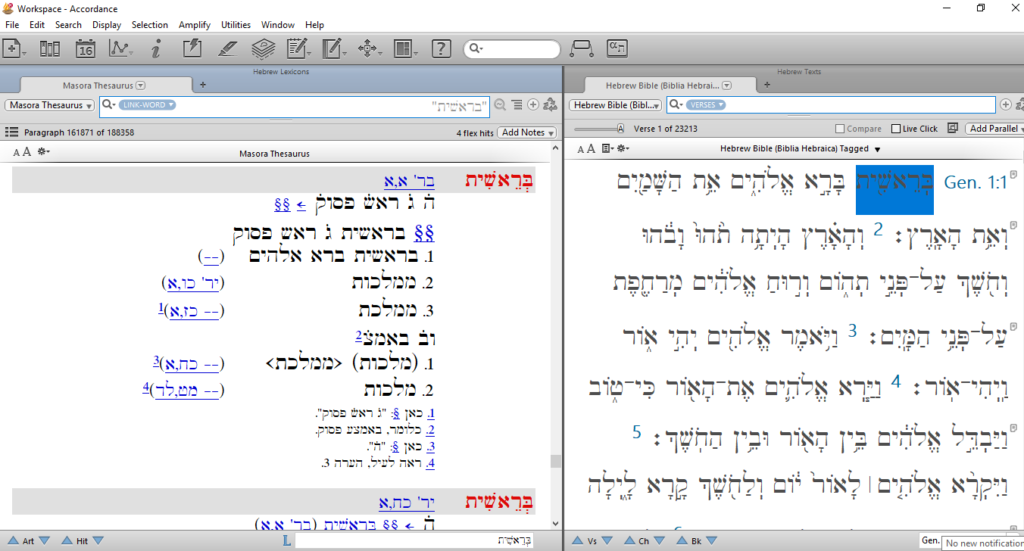
The Masorah Thesaurus has so much more than the printed Masora Magna of the BHS. Accordance database has the unedited Masorah Parva, the Masorah Magna of the Leningrad Codex(AND other manuscripts, too), as well cross-references to other Masoretic lists, notations, and texts (as well as much more). Accordance digital Masorah Thesaurus database is, of course, searchable in ways that neither the print edition of the BHS nor the standard digital edition of Gerard E. Weil’s Massorah Gedolah: Manuscrit B. 19a de Léningrad are.
So, that we can better appreciate the Masorah Thesaurus let’s first take a quick look at what the printed BHS offers.
In a printed edition of the BHS we turn to page one or to Genesis 1:1. Now, we notice the raised circle above בְּרֵאשִׁית . That circle in our printed BHS alerts us to the marginal notes called Masora Parva. To better illustrate what has just been said take a look at the following screenshot:
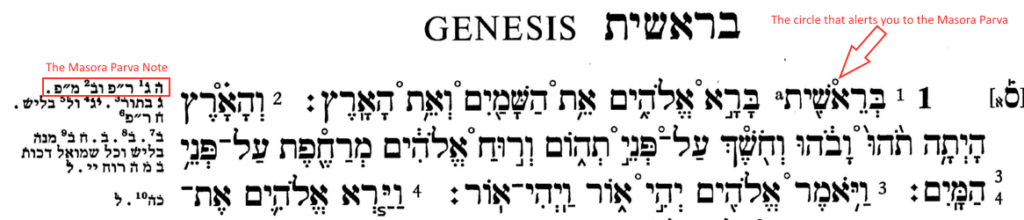
In the photo above (or in the BHS) we notice that the first letter of the note is the fifth letter of the Hebrew Alphabet ה̇. We also notice that the ה̇ has a small dot over it. When we see a dot over a letter that often tells us that the letter is meant to be read as a number. In this case, we read this as telling us that there are five occurrences of the word בְּרֵאשִׁית in the text of the Tanach/Hebrew Bible.
We also notice that there are two other Hebrew letters in the note with dots; both ג̇ and ב̇ followed by abbreviations or short hand notes. ג̇ being the third letter of the alphabet represents 3, and ב̇ being the second letter represents two (2 plus 3 is of course five). So, the Masora tells us that בְּרֵאשִׁית starts a stanza(ר״פ) three times (ג̇) , and is embedded in a stanza ( מ״פ) two times(ב̇).
This may help us understand the above abbreviations:
(Within, inside) מ = מצעא
(Head, start) רֹ =ראש
(verse/Stanza) פ = פסוקֹ, פסֹ, פסוֹ
Sometimes (or at least I have seen some use) קֹ in place of פסוקֹ
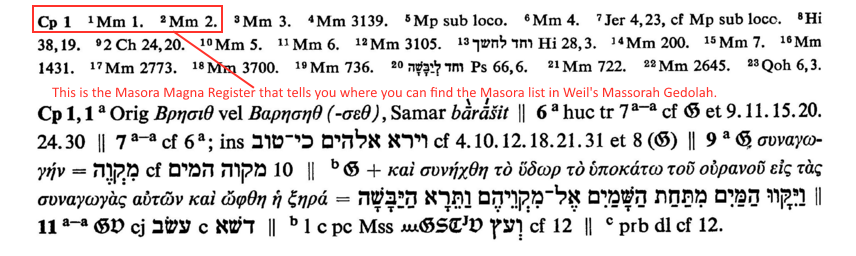
However, since the Masora Parva is brief it does not list those occurrences mentioned above. Before the advent of the Masorah Thesaurus, we would need to run a quick Accordance search, consult a paper concordance, or wade through Masoretic lists to find all of the occurrences mentioned in the BHS’ Masora Parva. The Masora Magna Register at the bottom of the printed BHS, however, does indicate where we can (or could in past time) quickly locate the list in Weil’s Massorah Gedolah. See:
At the time this post was written, Weil’s Massorah Gedolah was difficult to find in print, though a digital edition was available on another software platform. The Accordance Masorah Thesaurus was also priced at roughly $100, so I considered it the better value because it contained substantially more Masoretic material and search functionality.
Don't be shy leave a reply!