• Skip to primary navigation
  • Skip to main content
  • Skip to primary sidebar

Ad Fontes

  • About Ad Fontes
  • Blogroll & Resources

Mitchell

GENESIS 32:18

Not all printed or electronic Hebrew Bibles ( Mikra / Tanakh) are exactly the same in all details. For example the diacritical symbols used for vowels ( nekuddot) and cantillations marks (ta`amei ha-mikra) can sometimes vary from edition to edition. A good illustration of this is to be found in Genesis 32:18 see the picture below:
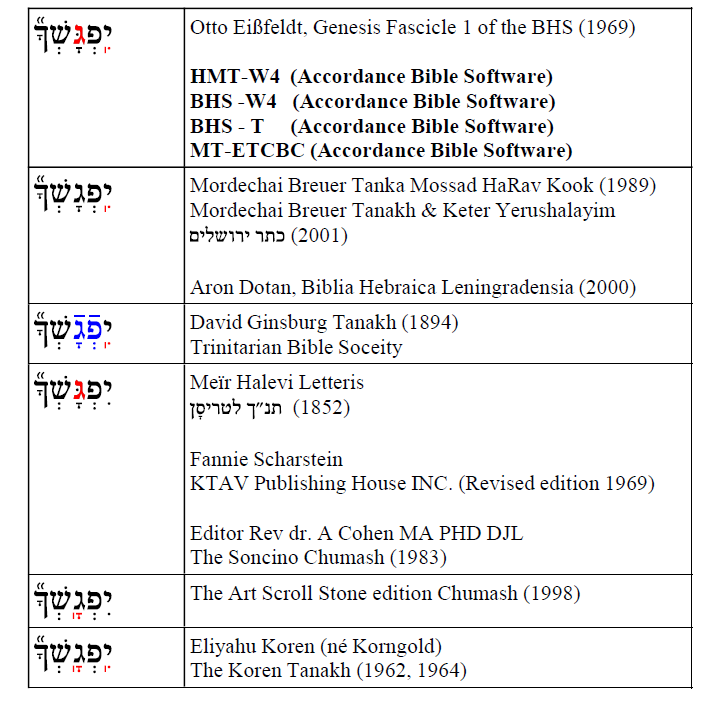
Hebrew text screenshot illustrating the Genesis 32:18 example discussed in the article

It should be noted that in the above example there is a slight change in vocalization and in maybe how the text is to be chanted but not in meaning. An interesting discussion on of this can be found in the archives of the Avodah Mailing List: http://www.aishdas.org/avodah/vol08/v08n090.shtml#03
Jeremiah 42:6 אֲנוּ VS אנו

The following widely used texts agree with having אֲנוּ
1)The Jerusalem Crown: Keter Yerushalayim (pg. 467)
(2) The Biblia Hebraica Stuttgartensia, (pg 867)
(3)Rabbi M. Breuer’s Tanakh( שנט or pg. 359 )
(4) Meïr Halevi (Letteris) Tanakh (pg. 812)
(5) Norman Henry Snaith’s Tanakh (pg. 776)


These five popular editions leave אנו unpointed
(1) C.D. Ginsburg Tanakh (pg. 912)
(2) Koren Tanach (pg. 430)
(3) Adi (A. Dotan) Tanakh (pg. 712)
(4) The Stone Edition of the Tanach (pg. 1172)
(5)The JPS Hebrew-English Tanakh (pg. 1115)


The Westminster Leningrad Codex explicitly marks a Qere/Ketiv distinction at this point: אֲנוּ is the Ketiv (the written form), while אֲנַ֜חְנוּ is the Qere (the traditional reading). TanakhML likewise displays both forms. Thus the difference among editions is not simply a choice between two competing spellings; editions may present the written form, the traditional reading, or both in different ways.

The Ethnachta Clause

While reading along in The Art of Torah Cantillation (link) one stumbles upon the claim ( page 13) that one is encountering a list of the five of the most common variations of the etnachta clause (or clauses ending with the ‘enachta’ cantillation mark) in the Torah/Pentateuch.

The first pattern of the clause given on page 13 is:
‘Mercha, Tipcha, Munach, Etnachta’

You might wonder just how common the above pattern is and should you spend your time committing this pattern to memory or not? Great question but how does one go about answering such a question. In time past you would need to simply trust the authors’ judgment, scan through the Bible counting count all the patterns, or consult a concordance of the accents. Today, however, there are two currently available commercial software programs Accordance and now Logos as of 2019) that are capable of running searches on the cantillation marks and their patterns and there used to be a third program (BibleWorks) but it is no longer available for purchase.

While the three programs mentioned above are capable of running such queries Accordance Bible Software is my program of choice for the following reasons:

(1) Searches in Accordance are visually intuitive and quick to set up. You simply open the ‘character keyboard’ and click on the accent or accent marks you want to search on. No need for codes or esoteric program like language to run searches. The first program I used to run such searches BibleWorks required me to type in codes for each accent on the command line making searches time and energy-consuming to set up. At the time I was very thankful to be able to run such searches. Then when I tried Accordance and it was like a breath of fresh air there was no turning back.

(2) budget-friendly. If you already have a Hebrew text in Accordance you can run accent searches. No need to buy extra modules, database or dataset to run searches.

(3) Mature support for accent searching. Accordance has supported exact searches involving accented and vocalized original-language forms since at least version 4.0, released in 1999, and its search capabilities have continued to develop over subsequent versions.
The Interface. Okay, I know this is very subjective! But I find the interface to be so intuitive that not only does it not get in my way, I almost completely forget about the interface while using the program.

Now, back to the question:

How common is the accent pattern: Mercha, Tipcha, Munach, Etnachta’ ?

in Accordance, the names are slightly different Merka, Tiphah, Munah, Atnah but it doesn’t matter as one does not need to type in the names all one needs to do is right-click on the visual representation of the accent(s) one desires to search on.

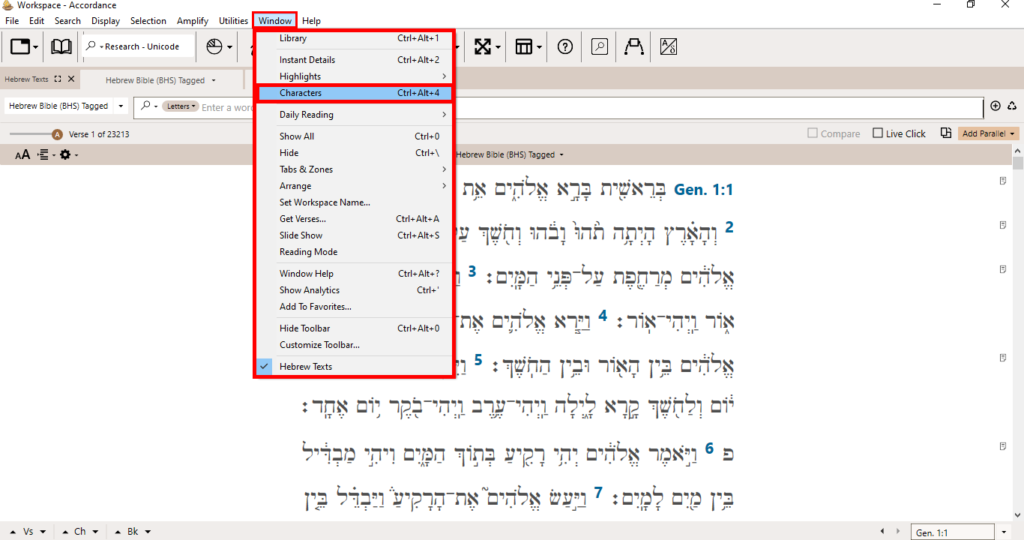
In Accordance Bible Software version 13 one would first need to open the program and a Hebrew Text of course. Then they would need to click on ‘Window‘ on the ‘menu bar‘ and on the drop-down menu select the option Characters.

Accordance Bible Software screenshot illustrating the Hebrew accent-search workflow described in the article

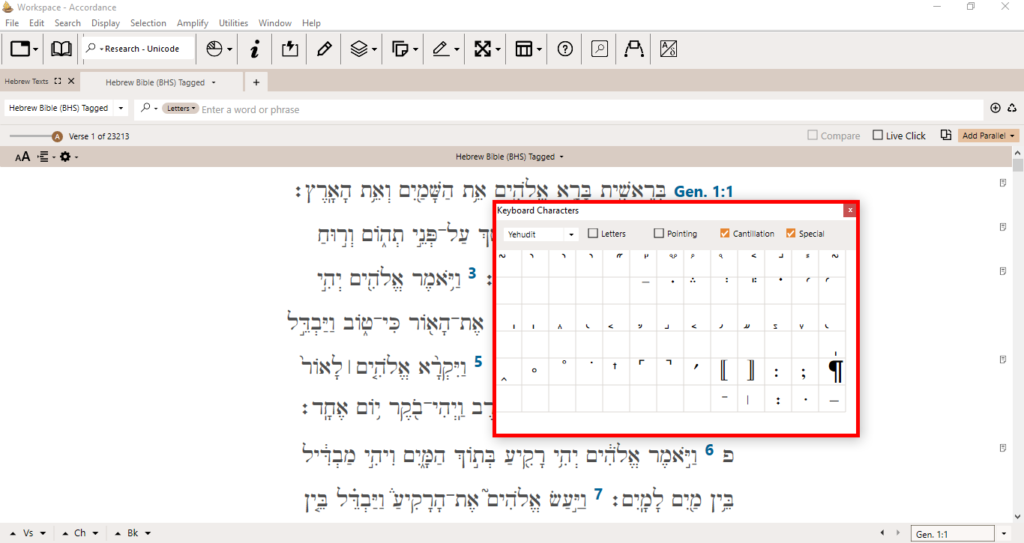
After which the ‘Character Keyboard‘ (formerly known as the Character palette ) should appear.

Accordance Bible Software screenshot illustrating the Hebrew accent-search workflow described in the article

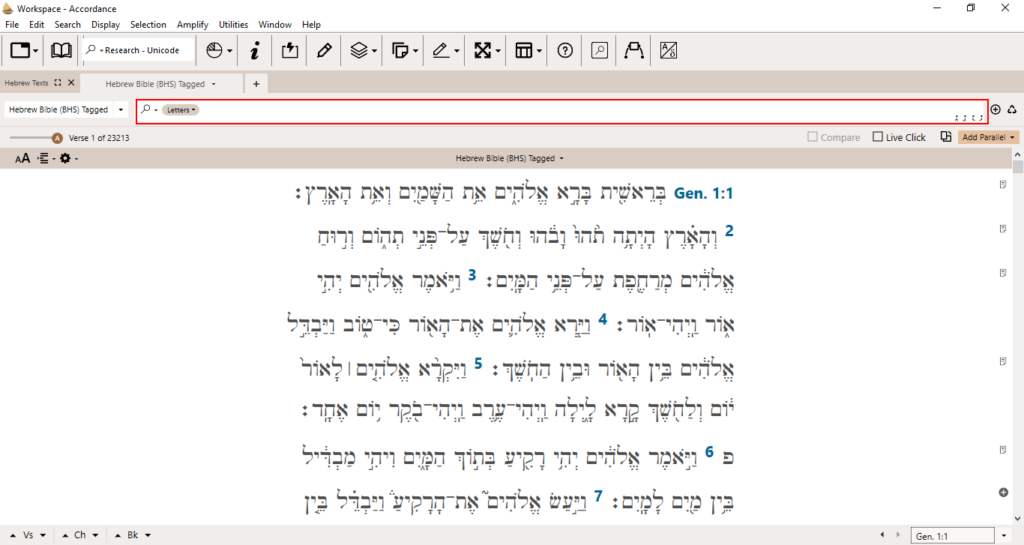
Then in the search entry area simply type in a period before each clicking on each accent you would like to run a search on. (The period acts as a wildcard or place holder for a character in this search). If one is searching for an accent clause or pattern one needs to click the space bar between each period accent combination.

Accordance Bible Software screenshot illustrating the Hebrew accent-search workflow described in the article

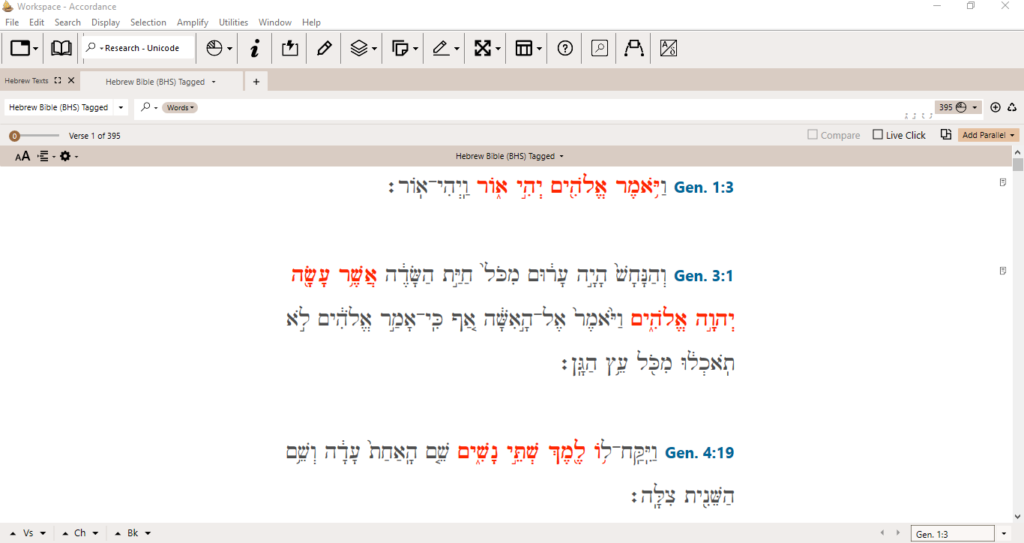
Then hit the enter button to run the search.

Accordance Bible Software screenshot illustrating the Hebrew accent-search workflow described in the article

This search returned with 395 verses.

Why Study Biblical Languages? (SAGU)

How the accents of the Hebrew Bible can change the meaning?

Does the study of the accents/cantillation marks of the Hebrew Bible aid one in understanding or interpreting the meaning of the text?

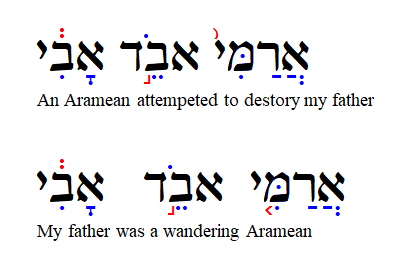
Yes, I believe so take Deuteronomy 26:5 for example. Below is an image of the text in Hebrew. Notice that the text of Deuteronomy has been mirrored. The Hebrew consonants’ of both texts colored in black as well as the ‘vowels’ colored in blue are identical. The accents/cantillation marks are colored red. However, to demonstrate how accents can radically change the meaning of the text one accent on the first word (on the right) has been substituted for another:

Hebrew text illustration showing the accent and reading comparison discussed in Deuteronomy 26:5
Disclaimer: Each of the translations above represent only one of the multiple ways each of the parallel lines of text could be understood or translated in English. You may find this reading in the haggadah which in turn was getting this from an interpretation of Mechilta or maybe from Reshi. There are no Bible manuscripts that have this reading. It is just that when you look at a Sefer Torah or any other text without vowel points the verse in question could be, in theory, interpreted this way.

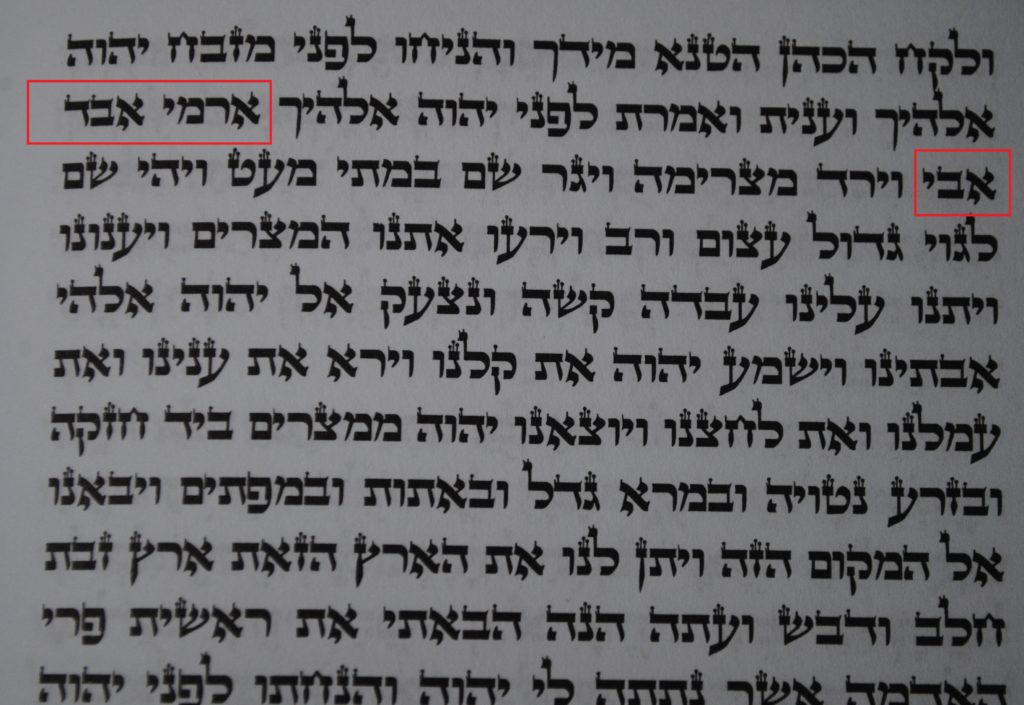
Now, examine how this same verse appears in a Torah scroll the verse appears neither with accents nor with vowel points. So a reader without these Masoretic notations would have had to decide from him or herself how to interpret this verse:

Hebrew text illustration showing the accent and reading comparison discussed in Deuteronomy 26:5

For more on the on the issue mentioned above check out:

https://www.thetorah.com/article/did-an-aramean-try-to-destroy-our-father

https://www.myjewishlearning.com/article/an-aramean-destroyed-my-father/

The above was originally posted back n 2018 on the Logos forums: https://community.logos.com/forums/p/135738/1008148.aspx#1008148

Here I have made a few minor changes and additions.

  • « Go to Previous Page
  • Page 1
  • Interim pages omitted …
  • Page 9
  • Page 10
  • Page 11
  • Page 12
  • Page 13
  • Interim pages omitted …
  • Page 15
  • Go to Next Page »

Primary Sidebar

SEARCH

Categories

Recent Posts

  • Miqra According to the Masorah: Manuscripts, Masorah, and the Editing of the Masoretic Text
  • Jude 5 The Textual Variant Ἰησοῦς / κύριος and the Agent of the Exodus
  • It Is Difficult to Know Oneself: Thales and the Byzantine Tradition
  • A Review of the Concise Dictionary of Classical Hebrew in Accordance Bible Software
  • Hebrew/Aramaic Quote #1: Search the Torah Carefully

Recent Comments

  • Mitchell on The Ethnachta Clause
  • Mitchell on Miqra According to the Masorah: Manuscripts, Masorah, and the Editing of the Masoretic Text
  • Mitchell on The Brown-Driver-Briggs Lexicon in Accordance
  • Ben Denckla on Miqra According to the Masorah: Manuscripts, Masorah, and the Editing of the Masoretic Text
  • Anonymous on The Brown-Driver-Briggs Lexicon in Accordance

136 PROUD SUBSCRIBERS

Copyright © 2026 · eleven40 Pro on Genesis Framework · WordPress · Log in