• Skip to primary navigation
  • Skip to main content
  • Skip to primary sidebar

Ad Fontes

  • About Ad Fontes
  • Blogroll & Resources

Mitchell

1 Kings 17:6 a Masoretic issue

It would seem that most (if not all) translators follow the ‘Ktiv Menuqad’ of the ‘Masoretic’ text when attempting to render 1 kings 17:6 into English. In doing so translators have either knowingly or unwittingly accepted the Masoretes’ interpretation of scripture. The text that lay before the Masoretes was probably the ambiguous והערבים . Without, the Neqqudot the word could be read either as ‘ravens’ or ‘Arabs’ depending on its literary context or on the interpreter’s decision. However, the Masoretes who added the Neqqudot had to decide whether to point the word with the ‘patach’ vowel under the letter ‘Ayin’ or a ‘Holam’ above the letter ‘Ayin’. A simple change of even a single vowel point can radically alter the meaning of a word in classical Hebrew and that actually is the only difference between the reading ‘ravens’ or ‘Arabs’. Examine the image below carefully. The vowel points are in red to make it easier to spot the difference between these two readings/vocalizations/interpretations:

https://web.archive.org/web/20190210085506if_/https://adfontes.mitchellbk.com/wp-content/uploads/2016/08/16a743b84c462aab.png

What’s your opinion or take on the above?  In the over all context of the narrative how do you think the word under consideration should be rendered and why?

“What Is Written, and How Do You Read?”: Interpretation and Eternal Life in Luke 10:25–28

Luke 10:25–28 is often read primarily as the introduction to the parable of the Good Samaritan. Yet the exchange that precedes the parable is itself a significant scene of scriptural interpretation. The central hermeneutical observation occurs in Jesus’ response to the legal expert in v. 26:

ἐν τῷ νόμῳ τί γέγραπται; πῶς ἀναγινώσκεις;
“What is written in the Law? How do you read?”

The juxtaposition of these two questions provides a useful framework for understanding the entire exchange. The first question concerns the textual datum: τί γέγραπται, “what has been written?” The second concerns the reader’s engagement with that text: πῶς ἀναγινώσκεις, “how do you read?” The narrative thus places the written Torah and the reading of the Torah alongside one another. The distinction is important because the legal expert’s answer in v. 27 is not simply the recitation of a single passage. It is already an act of interpretation: he selects, combines, and applies distinct Torah texts to a question—eternal life—that neither passage explicitly addresses.

This point should not, however, be overstated lexically. Older commentators such as Alfred Plummer noted that πῶς ἀναγινώσκεις could function like a Jewish formula requesting scriptural evidence—roughly, “What do you read?”—while Reiling and Swellengrebel suggest that ἀναγινώσκεις may even carry the sense “how do you recite?” The expression therefore need not constitute an abstract theory of hermeneutics in itself. Nevertheless, Plummer also allows that πῶς may imply something like “to what effect do you read?” and, more importantly, the narrative that follows demonstrates that more than simple quotation is taking place. The legal expert must determine which texts answer the question and how those texts relate to the question of eternal life. Thus, even if πῶς ἀναγινώσκεις was partly formulaic, Luke’s literary presentation makes the act of reading hermeneutically significant.

The Interpreter of the Torah

Luke identifies the questioner as a νομικός (10:25), an expert in the Mosaic Law (cf. BDAG, 676). This identification is significant. Jesus does not merely ask whether the man knows the Torah; he asks a professional interpreter of Torah to provide his own reading of it. The legal expert has asked:

διδάσκαλε, τί ποιήσας ζωὴν αἰώνιον κληρονομήσω;
“Teacher, what must I do to inherit eternal life?”

Jesus responds by returning the problem to the interpreter: the answer is to be sought in the Torah, but it must also be read from the Torah.

The expert responds by combining Deuteronomy 6:5 and Leviticus 19:18. From Deuteronomy he derives the command to love God with the entirety of one’s being; from Leviticus he derives the command to love one’s neighbor as oneself. The response is therefore synthetic rather than merely citational. No single Torah passage gives the answer in precisely this form.

Deuteronomy 6:5 is an unsurprising choice. It belongs to the Shema, one of the most foundational confessions and commands of Jewish piety, and its command to love God functions in Deuteronomy as a comprehensive description of covenant fidelity. The choice of Leviticus 19:18 is more striking. By placing the love of neighbor alongside the love of God, the expert identifies two geographically separated commandments as jointly expressing the fundamental demand of Torah. As Plummer observed, the addition of Leviticus 19:18 to the regularly recited Deuteronomic command is itself noteworthy.

Luke’s presentation is especially interesting when compared with the Synoptic parallels. In Matthew 22:34–40 and Mark 12:28–34, Jesus himself identifies Deuteronomy 6:5 and Leviticus 19:18 as the principal commandments. In Luke, by contrast, the νομικός produces the combination in response to Jesus’ question, “How do you read?” Luke thereby makes the Torah expert himself the interpreter whose reading is subsequently evaluated by Jesus.

The More Difficult Question: Where Does “Eternal Life” Come From?

The most intriguing aspect of the exchange is that the legal expert is not initially asking for a summary of the Torah. He is asking what he must do in order to inherit eternal life—ζωὴν αἰώνιον κληρονομήσω.

Neither Deuteronomy 6:5 nor Leviticus 19:18 contains the expression ζωὴ αἰώνιος. Indeed, the expression points toward a different cluster of Jewish scriptural and eschatological traditions.

The strongest Greek-scriptural parallel is Daniel 12:2. Significantly, both major ancient Greek forms of Daniel—the Old Greek and Theodotionic versions—contain the expression:

εἰς ζωὴν αἰώνιον
“unto eternal life.”

The verbal surroundings differ between the two Greek versions. The Old Greek reads that those sleeping in the earth ἀναστήσονται … εἰς ζωὴν αἰώνιον, while Theodotion has ἐξεγερθήσονται … εἰς ζωὴν αἰώνιον. Yet both connect precisely this expression with the resurrection of the dead. The Hebrew phrase לְחַיֵּי עוֹלָם in Daniel 12:2 is likewise exceptional: this is the clearest occurrence in the Hebrew Bible of “everlasting life” as the destiny of those raised in the eschatological resurrection.

Daniel 12:2 is therefore a considerably stronger background for Luke 10:25 than the Pentateuchal passages quoted in v. 27. John A. Davies, in a recent study of Luke 10:25–37, emphasizes precisely this point: the exact phrase ζωὴν αἰώνιον occurs in the Greek Scriptures in Daniel 12:2 within a resurrection context. Davies further observes that Luke himself clarifies the expression elsewhere. In Luke 18:30 Jesus speaks of receiving “in the age to come eternal life” (ἐν τῷ αἰῶνι τῷ ἐρχομένῳ ζωὴν αἰώνιον), while Luke 20:35 associates participation in “that age” with resurrection from the dead. On this reading, “eternal life” in Luke 10:25 should not primarily be understood as an abstract possession of endless existence but as participation in the eschatological life of the coming age—the resurrection life anticipated in Daniel 12.

Daniel 12:2 and Its Second Temple Reception

Daniel is not an isolated witness. The same vocabulary develops in subsequent Jewish literature, which demonstrates that by the late Second Temple period “eternal life” had become established language for the eschatological destiny of the righteous.

Particularly important is Psalms of Solomon 3:12:

οἱ δὲ φοβούμενοι τὸν κύριον ἀναστήσονται εἰς ζωὴν αἰώνιον
“those who fear the Lord will rise to eternal life.”

The verbal relationship with Daniel 12:2 is striking: ἀναστήσονται εἰς ζωὴν αἰώνιον. Here resurrection and eternal life are again explicitly joined. The text provides a useful conceptual bridge between Daniel and the world of Luke: “eternal life” has become a conventional way of describing the resurrection destiny of the righteous.

Second Maccabees 7:9 provides another important witness. The martyr expects God to raise those who die faithfully to an αἰώνιος ἀναβίωσις ζωῆς, an “everlasting renewal of life.” The wording is not identical to Luke, but the conceptual complex is the same: fidelity to God, death, resurrection, and everlasting life. Scholars have consequently detected the influence of Daniel 12:2 upon this Maccabean resurrection hope.

The point, therefore, is not necessarily that the lawyer is consciously “quoting Daniel 12:2.” Luke does not indicate a quotation. Rather, the terminology of his question belongs to a Jewish eschatological discourse whose most obvious scriptural fountainhead is Daniel 12:2. By the first century, ζωὴ αἰώνιος could function as shorthand for the life granted to the righteous in the resurrection and the age to come.

A Third Torah Text: Leviticus 18:5

At this point another text becomes crucial. Jesus answers the lawyer:

ὀρθῶς ἀπεκρίθης· τοῦτο ποίει καὶ ζήσῃ.
“You have answered correctly; do this and you will live” (Luke 10:28).

This statement probably echoes Leviticus 18:5, where the person who “does” God’s ordinances “will live” by them. The verbal combination of doing and living makes the connection particularly plausible, even though Luke does not provide a formal quotation. Modern scholarship frequently identifies this as an allusion rather than a direct citation. Eric Ottenheijm, for example, argues that the combination of doing and living is strongly reminiscent of LXX Leviticus 18:5 even though the wording is not precise enough to constitute a formal quotation.

This possibility considerably sharpens the hermeneutical character of the dialogue. At least four scriptural texts or traditions may be operating simultaneously:

  1. Daniel 12:2 supplies the eschatological category of “eternal life.”
  2. Deuteronomy 6:5 supplies wholehearted love for God.
  3. Leviticus 19:18 supplies love for the neighbor.
  4. Leviticus 18:5 provides the Torah principle that the one who “does” God’s commandments “will live.”

The conversation is therefore not merely a matter of locating an isolated prooftext. It represents a network of scriptural interpretation.

Was Leviticus 18:5 Already Being Read Eschatologically?

This raises a further question. In its Pentateuchal context, Leviticus 18:5 does not explicitly say “eternal life.” How, then, could “the one who does these things will live” answer a question about resurrection or life in the coming age?

Here the evidence from early Judaism becomes particularly illuminating.

Simon Gathercole has argued that Leviticus 18:5 underwent significant eschatological interpretation in Second Temple Jewish literature. His study, “Torah, Life, and Salvation: Leviticus 18:5 in Early Judaism and the New Testament,” draws attention to Jewish texts in which the “life” promised by Torah becomes associated with final or eschatological life. Preston Sprinkle’s later monograph, Law and Life: The Interpretation of Leviticus 18:5 in Early Judaism and in Paul, develops this reception history in detail, examining the Damascus Document, Psalms of Solomon, Philo, and other witnesses.

The Damascus Document is particularly significant because it demonstrates that such interpretation cannot simply be attributed to later rabbinic Judaism. In CD 3:15–16 language derived from Leviticus 18:5—God’s ordinances that a person should “do” and “live by”—appears in a context that culminates in the promise that those who hold fast will attain “eternal life.” Whatever one makes of the exact exegetical relationship, the document demonstrates that a Jewish community in the Second Temple period could read the Torah’s promise of “life” eschatologically.

Psalms of Solomon 14:2–3 provides comparable Greek evidence. It speaks of those who walk according to God’s commandments “in the law which he commanded us for our life” (εἰς ζωὴν ἡμῶν) and then says:

ὅσιοι κυρίου ζήσονται ἐν αὐτῷ εἰς τὸν αἰῶνα
“The holy ones of the Lord will live by it forever.”

Preston Sprinkle and others regard this passage as an interpretation or echo of Leviticus 18:5 in which the life promised by Torah has acquired an explicitly enduring or eschatological dimension.

Later Jewish witnesses make the interpretation even more explicit. Targum Onqelos renders Leviticus 18:5 so that the person who performs the commandments lives by them “in eternal life,” while the Sifra interprets “he shall live by them” as referring to the world to come. Because the final forms of these sources are later than Luke, they should not be used as direct proof that Luke or Jesus depended upon them. They are, however, valuable witnesses to an interpretive trajectory whose antiquity is independently confirmed by the Damascus Document and Psalms of Solomon.

A Scholarly Debate over “Life” in Leviticus 18:5

Not all scholars construe this material in precisely the same way. James D. G. Dunn has emphasized that “life” in Leviticus 18:5 originally concerns life lived within the covenant rather than a reward of eschatological salvation yet to be attained. Gathercole, by contrast, argues that even if the original Pentateuchal context is not explicitly eschatological, significant strands of early Jewish interpretation did read the verse soteriologically and eschatologically. The evidence from the Damascus Document and Psalms of Solomon weighs heavily in this discussion.

This distinction is important for interpreting Luke. It is unnecessary to claim that the original historical meaning of Leviticus 18:5 was resurrection life. The more historically relevant question is how Torah was being read within Second Temple Judaism. Luke 10 itself is concerned precisely with such a question: “What is written?” is not identical to “How do you read?”

What Is Written? How Do You Read?

This returns us to Jesus’ two questions.

τί γέγραπται; asks about the scriptural text.

πῶς ἀναγινώσκεις; asks, at least within the logic of Luke’s narrative, how that text is construed in relation to the theological question under discussion.

The Torah expert’s response illustrates the distinction. What is “written” is Deuteronomy 6:5 and Leviticus 19:18. But his reading involves considerably more. He places the two commandments together; treats them as a synthetic summary of covenant obligation; and applies them to the eschatological question of ζωὴ αἰώνιος. Jesus then responds with language that appears to evoke still another Torah text, Leviticus 18:5: “Do this, and you will live.”

The remarkable feature of the exchange is therefore not simply that Jesus agrees with two Torah quotations. Jesus says, ὀρθῶς ἀπεκρίθης—“you have answered correctly.” He affirms an interpretive construction in which texts concerning love of God and neighbor answer a question concerning participation in eschatological life.

One may therefore describe the hermeneutic of Luke 10:25–28 as intertextual and synthetic. The interpreter does not derive every theological proposition from the explicit vocabulary of a single passage. Instead, texts are read within a larger scriptural and theological framework. Deuteronomy 6:5 and Leviticus 19:18 are read in relation to Torah’s promise that the one who does God’s commandments will live (Lev 18:5), while “life” itself is understood within the eschatological horizon represented most clearly by Daniel 12:2 and developed in subsequent Jewish tradition.

This may be precisely the theological significance of the distinction between “What is written?” and “How do you read?” The written words establish the textual parameters of the discussion, but interpretation involves recognizing relationships among those words, assigning theological significance to them, and applying them to questions that the individual passages do not formulate explicitly.

Questions for Further Study

The passage consequently raises several hermeneutical questions.

1. Why does the legal expert select Deuteronomy 6:5 and Leviticus 19:18?
Is their combination already part of a wider Jewish tendency to summarize Torah, or does Luke portray the expert as making a particularly insightful interpretive synthesis?

2. What scriptural tradition stands behind ζωὴ αἰώνιος?
Given the exact Greek expression and its resurrection context, should Daniel 12:2 be regarded as the principal scriptural background for the lawyer’s terminology? What role might texts such as Psalms of Solomon 3:12 and 2 Maccabees 7 play in demonstrating the subsequent development of this language?

3. Does Luke 10:28 deliberately evoke Leviticus 18:5?
If “do this and you will live” invokes the Torah’s promise that the one who does God’s commandments will live by them, then Leviticus 18:5 may provide the missing exegetical bridge between the commandments cited in v. 27 and the eternal life requested in v. 25.

4. What kind of interpretation is taking place?
The expert’s method cannot be reduced to literal citation. It involves selection, juxtaposition, synthesis, and eschatological application. Luke may therefore be depicting a recognizably Jewish form of scriptural reasoning in which one Torah text is interpreted through other scriptural texts and through inherited theological convictions.

The exchange in Luke 10:25–28 is consequently more than a preface to the Good Samaritan. It is a compact scene of Jewish hermeneutics. Jesus begins not by giving the expert another text but by placing two questions before him: What is written? How do you read? The distinction between those questions governs what follows. The text of Torah remains authoritative, but its significance emerges through interpretation—and the lawyer’s answer, remarkably, is an interpretation Jesus initially declares to be correct.

Selected Scholarship

Davies, John A. “The Good Samaritan and the Hope for Kingdom Restoration (Luke 10:25–37).” Tyndale Bulletin(2025).

Gathercole, Simon J. “Torah, Life, and Salvation: Leviticus 18:5 in Early Judaism and the New Testament.” In From Prophecy to Testament: The Function of the Old Testament in the New, edited by Craig A. Evans, 126–145. Peabody, MA: Hendrickson, 2004.

Green, Joel B. The Gospel of Luke. New International Commentary on the New Testament. Grand Rapids: Eerdmans, 1997.

Ottenheijm, Eric. “‘Which If a Man Do Them He Shall Live by Them’: Jewish and Christian Discourse on Lev 18:5.” In The Scriptures of Israel in Jewish and Christian Tradition: Essays in Honour of Maarten J. J. Menken, 303–316. Leiden: Brill, 2013.

Plummer, Alfred. A Critical and Exegetical Commentary on the Gospel according to S. Luke. International Critical Commentary. Edinburgh: T&T Clark.

Reiling, J., and J. L. Swellengrebel. A Handbook on the Gospel of Luke. UBS Handbook Series. New York: United Bible Societies, 1971.

Sprinkle, Preston M. Law and Life: The Interpretation of Leviticus 18:5 in Early Judaism and in Paul. Wissenschaftliche Untersuchungen zum Neuen Testament 2/241. Tübingen: Mohr Siebeck, 2008.

The Masora Thesaurus (part two)

I originally posted the following as a series of replies on the Accordance forums in December of 2015.

The printed BHS only contains the Masora Parva, Masora finalis (and a highly edited form of that). The editors of the BHS put theMasora Magna in a separate volume that is now out of print (although a digital edition of that does exist).

The  Masorah Thesaurus has so much more. It has the unedited Masorah Parva, the Masorah Magna of the Leningrad Codex(and other sources, too), as well as cross-references to other Masoretic lists, notations, and texts (as well as more). The Masorah Thesaurus is of course searchable in ways that neither the print edition of the BHS nor the digital edition of Gerard E. Weil’s Massorah Gedolah: Manuscrit B. 19a de Léningrad are.

MP notes

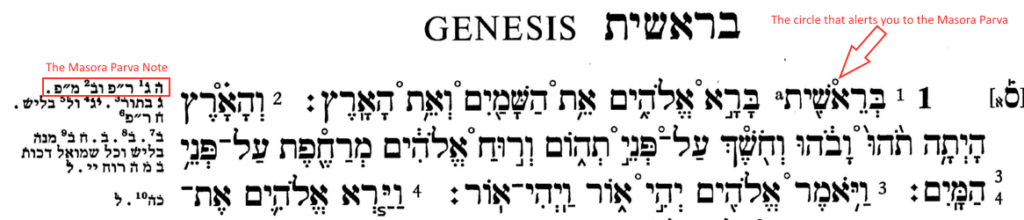
In a printed edition of the BHS we turn to page one or to Genesis 1:1. Now, we notice the raised circle above  בְּרֵאשִׁית . That circle in our printed BHS alerts us to the marginal notes called Masora Parva. To better illustrate what has just been said take a look at the following: 

In the photo (or in the BHS) we notice that the first letter of the note is the fifth letter of the Hebrew Alphabet  ה̇.  We also notice that the  ה̇ has a small dot over it. When we see a dot over a letter that often tells us that the letter is meant to be read as a number. In this case, we read this as telling us that there are five occurrences of the word  בְּרֵאשִׁית in the text of the Tanach/Hebrew Bible.

We also notice that there are two other Hebrew letters in the note with dots; both ג̇ and ב̇ followed by abbreviations or shorthand notes.   ג̇ being the third letter of the alphabet represents 3, and ב̇ being the second letter represents two (2 plus 3 is, of course, five). So, the Masora tells us that בְּרֵאשִׁיתstarts a stanza(ר״פ)   three times (ג̇) , and is embedded in a stanza ( מ״פ)   two times(ב̇).

This may help us understand the above abbreviations:

(Within, inside) מ = מצעא

(Head, start)      רֹ =ראש

(verse/Stanza)  פ  = פסוקֹ, פסֹ, פסוֹ

Sometimes (or at least I have seen some use) קֹ in place of פסוקֹ

However, since the Masora Parva is brief it does not list those occurrences mentioned above. Before the advent of the Masorah Thesaurus, we would need to run an Accordance search, consult a paper concordance, or work through Masoretic lists to locate all of the occurrences mentioned in the BHS’ Masora Parva.

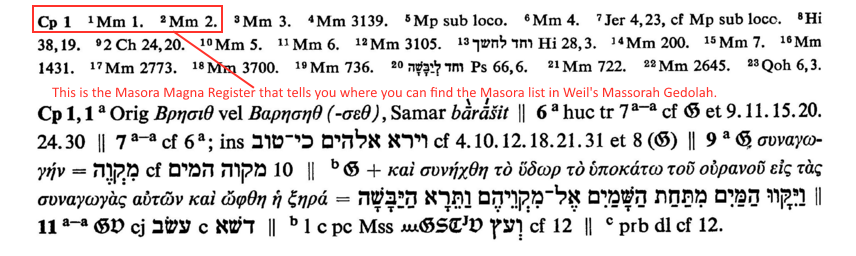
The Masora Magna Register at the bottom of the printed BHS, however, does indicate where we can (or could in past time) quickly locate the list in Weil’s Massorah Gedolah.

Unfortunately, the Massorah Gedolah is out of print, but as mentioned before, there is a digital version of it in another software platform. Before I got access to the Masorah Thesaurus module I will admit, I used to use the digital version of Weil’s Massorah Gedolah a fair bit and it still has its place. However, the  Masorah Thesaurus module  offers much more than what Weil’s Massorah Gedolah does.

Now, turn to Genesis 43:8 in a printed edition of the BHS (page 71). Let’s look at a rather famous example:

וַיֹּ֨אמֶר יְהוּדָ֜ה אֶל־יִשְׂרָאֵ֣ל אָבִ֗יו שִׁלְחָ֥ה הַנַּ֛עַר אִתִּ֖י וְנָק֣וּמָה וְנֵלֵ֑כָה וְנִֽחְיֶה֙ וְלֹ֣א נָמ֔וּת גַּם־אֲנַ֥חְנוּ גַם־אַתָּ֖הגַּם־טַפֵּֽנוּ׃

Take a look at the Masora Parva note for Genesis 43:8 : י̇ב̇ פסוק̇ גם גם גם

י̇ב̇ = 12

Verses =פסוק̇

גם גם גם = a construction/string גם

The meaning = There are 12 verses in the Tanach where גם occurs three times.

The Mm register for Genesis 43:8 only has Mm index numbers for the following words:

שִׁלְחָה= Mm index number 2915

וְנָקוּמָה = Mm Index number 3078

In other words neither the BHS nor its companion volume Weil’s Masorah Gedolah can help you in finding the list or references for the 12 occurrences of the גם גם גם construction.

Also, in this case, a paper concordance will be of little help since

גם appears something like 769 times in the Tanach/Hebrew Bible.

Click-searching on גם will similarly not help you much.

(However, Accordance’s construction search can find examples of the structure and depending on how many intervening words you select between each of the גם your results will vary).

However, since we have the Masorah Thesaurus we can easily find everything the Masora Parva note of the BHS was alluding to:

(1) Open the Masorah Thesaurus

(2) Open the Table of Contents

(3) Type in גם and search

(4) Now, we will find the information we wanted to know at:

Paragraph 43839 of 188291

Paragraph 43844 of 188291

Paragraph 43850 of 188291

As we can see there simply isn’t enough space in the printed/paper BHS to provide that type of detailed information for every Masorah Parva note. This is one reason (there are many more) why the Masorah Thesaurus is indispensable for Masoretic studies.

Differences underlying Morphologically Tagged Texts

The following is dated, but information on issues that still apply to morphological tagging:

(Warring: the Bible Software programs mentioned below have evolved, and have a lot more morphological tagged texts than they did back in the 90’s when this was written. Bible Works version 3 and Logos version 2 are discussed below, but both been replaced and updated by newer and more advance versions of their respective programs, several times, throughout the last decade and half. Now, BibleWorks is in it’s 9th version and Logos is in it’s 6th version) 


Researchers who use these tools should be aware of how these potential pitfalls can affect the accuracy of their analysis.

The following discussion focuses on the Greek New Testament, but the principles are applicable to searching the Hebrew Bible and Septuagint.

Differences in the Underlying Biblical Texts

  1. Different Morphologically Tagged TextsAs has been shown, there is a considerable variation in the tagging schemes used in Greek New Testament texts. The Friberg texts use a more functional classification method than other texts. Even the Friberg 2 text still has many functional and unusual classifications. The Gramcord and CCAT texts use largely formal classifications.Unfortunately, except for Gramcord, the manuals for popular Bible-search programs rarely discuss the assumptions used in the classification of words. Yet it is essential that researchers understand the nature of the underlying machine-readable biblical text if their analysis of the text is to be meaningful.The print edition of the Friberg 1 text has an appendix outlining the criteria used for the tags (Barbara and Timothy Friberg, eds., Analytical Greek New Testament, Grand Rapids: Baker, 1981). Unfortunately there is no similar book explaining the classification philosophy of the revised Friberg text. In many instances TheWord deviates from the Friberg 1 tags, without documenting the differences. No program makes use of more than one of the Friberg multiple classifications of ambiguous words and no program documents the selection criteria…
  2. Many tagged texts have some functional or unusual classifications of words which can produce unexpected search results.In Gramcord, many foreign words such a hosanna are classified as interjections. However, foreign proper nouns are classified as nouns and parsed by function in context. By contrast, Bible Windows and Bible Works classify hosanna as a particle.Conjunctions and particles are particularly difficult words to classify. A beginning user might miss many occurrences of kai if he only searches for the word as a conjunction. Since kai also functions as an adverb in some cases, most programs will sometimes classify it as an adverb. However, as the following chart shows, the classification choices in individual instances vary considerably:
  1. Bible Windows was unable to report the total number of occurrences of kai, because it only allows 750 matches in a search. Since it is hard to predict how a program will classify the word in any given passage, the safest approach is to search for all possible classifications and manually eliminate invalid matches. The Gramcord manual documents how many times each word is classified as a conjunction, particle or adverb, which makes it easier to define searches that will find all occurrences of such words.Since the Friberg text (Bible Works and TheWord) attempts to classify many words by function based on discourse analysis, some classifications may be surprising to users. Friberg 1 uses the category of “substantive adjective” to refer to adjectives which are used as nouns in context. For example, agathos (“good”) is classified as a substantive adjective in Mt 5:45 (“he makes the sun shine on the evil and the good). This type of classification affects 4131 occurrences of 1068 words in 3009 verses! While adjectives can certainly function as substantives, the term “substantive adjective” is not a part of speech used by most Greek grammars. It would be easy for a user to accidentally miss many important occurrences of adjectives unless he searches both for “adjectives” and “substantive adjectives”. The Friberg 2 text eliminates the substantive adjective classification, but it introduces other surprising functional classifications. For example, in most cases Friberg 2 classifies relative pronouns as adjectives, with an adjective subtype of “relative.” It introduces a category of participial imperative (168 occurrences of 120 words in 135 verses) and (7813 occurrences of 1726 words in 4792 verses).Functional classifications such as those frequently used in Friberg’s text are more subjective than formal classifications. Their value depends largely on the accuracy of the classifier’s interpretation of the text. While they appear to be objective raw data, in fact they contain the prior conclusions of another researcher, which tends to skew the search results to fit the classifier’s own viewpoint.
  2. Treatment of Classification AmbiguitiesEven the strictest formal classification method must classify certain words by function in context, since the morphology of these words is inconclusive. While in most cases the meaning is clear in the context, in some instances the grammatical classification is subject to scholarly debate. For example, the gender of potamou could be either neuter or masculine. In Mt 6:13 the meaning is debated: Does the Lord’s Prayer ask for deliverance from “evil” (neuter) or “the evil one” (masculine)? Since Bible Windows 2, Gramcord and Accordance classify potamou in Mt 6:13 as neuter, a search for masculine adjectives will not find the verse. By contrast, TheWord and Bible Works classify the word as masculine and do not allow the word to be found in a search for masculine adjectives! Only Bible Windows 3 acknowledges both possible parsings and allows the word to be found with either search.Bible-search programs would be more useful if they marked such words as ambiguous and allowed searching on the multiple classifications. The print version of the Friberg text includes multiple classifications in many instances. However, at this time only Bible Windows 3 allows searching on Friberg’s multiple classifications. Although Bible Works and TheWord both remove the multiple parsings in Friberg 1, the documentation does not explain the criteria used to make these choices.Gramcord makes a good attempt at handling ambiguous classifications. In many cases, it tags words in multiple ways and flags the ambiguous classification in the resulting concordance. The documentation lists all ambiguous classifications which are used. However, even Gramcord could be improved in this area. For example, it does not include the ambiguous classification ofpotamou in Mt 6:13.
http://www.balboa-software.com/semcomp/scbible2.htm#VARIATIONS

The Masorah Thesaurus

Yet, another reason to get excited about Accordance for Windows and the original Mac OS version as well! Accordance has just released the first part of the Masora Thesaurus. When completed this encyclopedic like volume will contain the complete text of the Masorah Gedolah, Masorah Ketanah, and the Masorah Finalis of the oldest complete codex of the Hebrew Bible/Tanakh known as the Leningrad Codex B19a. This work will also include 30 years worth of Aron Dotan’s notes on the Masora. Aron Dotan is chair of the International Organization for Masoretic Studies and editor of the Biblia Hebraica Leningradensia. Now, this begs the question of what is the Masora?

The term Masorah is ordinarily used in modern biblical studies to refer to the body of marginal notes (i.e., Masoretic notes) which are transmitted with the text, either in a manuscript or in a printed edition. However, this is the narrow sense of the word. In its broadest sense, Masorah refers to traditions and rules, passed down in Judaism for generations, which regulate all aspects of the copying and use of Bible manuscripts…

The Masorah can be divided into several subdivisions. The Masorah Parva (Mp) consists of the Masoretic notes in the side margins of manuscripts (cf. BHS). The Masorah Magna (Mm) includes the notes in the upper and lower margins of the manuscripts…

The Masorah Finalis (Mf) refers to the material collected at the end of a particular book, section (e.g., Torah) or manuscript. In manuscripts, the Mf consists of summary lists, such as the number of verses, sedarim, etc., and information of this type is included in BHS at the end of books.

Kelley, Page H., Daniel S. Mynatt, and Timothy G. Crawford. The Masorah of Biblia Hebraica Stuttgartensia: Introduction and Annotated Glossary. Grand Rapids, MI: William B. Eerdmans Publishing Company, 1998.

The Biblia Hebraica Stuttgartensia (BHS) the longtime popular edition of the Hebrew Bible. only contains the Masora Parva, Masora Finalis (and a highly edited form of that). The Masora not unlike the annotations one finds in a reference Bible. However, the Masora goes further, noting issues like grammar, syntax, spelling, unusual/rare words, word counts, and even typography. The editors of the BHS put the Masora Magna in a separate volume that is now out of print (although a digital edition of that does exist) and hard to find. The Masorah Thesaurus makes the Masoretic information associated with Codex Leningradensis available in a searchable electronic format and supplements it with cross-references to other important Masoretic resources.

Enter Accordance Bible Software‘s Masorah Thesaurus database.

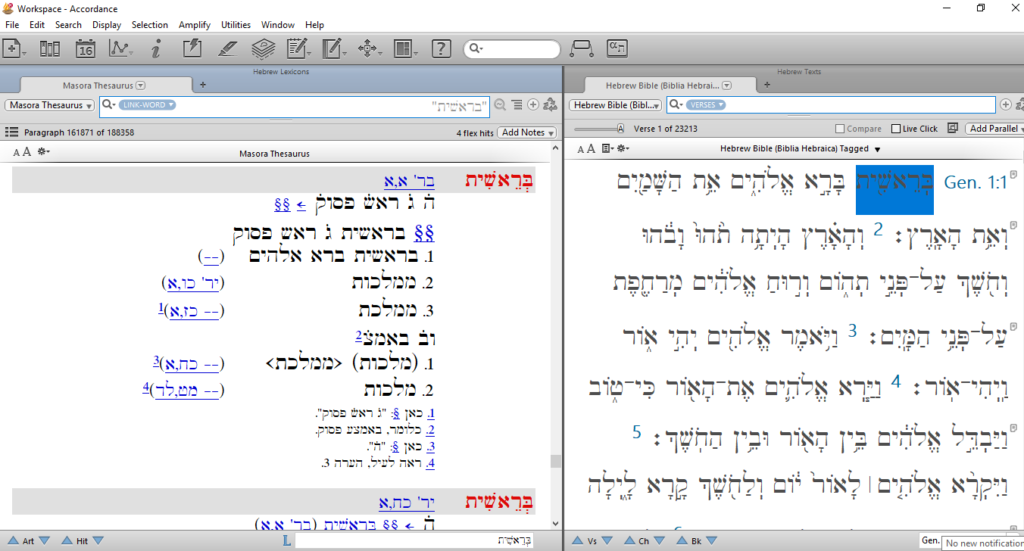
Screenshots illustrating the Masorah Thesaurus and BHS Masoretic notes discussed in the article

The Masorah Thesaurus has so much more than the printed Masora Magna of the BHS. Accordance database has the unedited Masorah Parva, the Masorah Magna of the Leningrad Codex(AND other manuscripts, too), as well cross-references to other Masoretic lists, notations, and texts (as well as much more). Accordance digital Masorah Thesaurus database is, of course, searchable in ways that neither the print edition of the BHS nor the standard digital edition of Gerard E. Weil’s Massorah Gedolah: Manuscrit B. 19a de Léningrad are. 

So, that we can better appreciate the Masorah Thesaurus let’s first take a quick look at what the printed BHS offers. 

In a printed edition of the BHS we turn to page one or to Genesis 1:1. Now, we notice the raised circle above  בְּרֵאשִׁית . That circle in our printed BHS alerts us to the marginal notes called Masora Parva. To better illustrate what has just been said take a look at the following screenshot: 

Screenshots illustrating the Masorah Thesaurus and BHS Masoretic notes discussed in the article

In the photo above (or in the BHS) we notice that the first letter of the note is the fifth letter of the Hebrew Alphabet  ה̇.  We also notice that the ה̇ has a small dot over it. When we see a dot over a letter that often tells us that the letter is meant to be read as a number. In this case, we read this as telling us that there are five occurrences of the word  בְּרֵאשִׁית in the text of the Tanach/Hebrew Bible.

We also notice that there are two other Hebrew letters in the note with dots; both ג̇ and ב̇ followed by abbreviations or short hand notes.   ג̇ being the third letter of the alphabet represents 3, and ב̇ being the second letter represents two (2 plus 3 is of course five). So, the Masora tells us that בְּרֵאשִׁית starts a stanza(ר״פ)   three times (ג̇) , and is embedded in a stanza ( מ״פ)   two times(ב̇).

This may help us understand the above abbreviations:

  (Within, inside) מ = מצעא

  (Head, start)      רֹ =ראש

  (verse/Stanza)  פ  = פסוקֹ, פסֹ, פסוֹ 

Sometimes (or at least I have seen some use) קֹ in place of פסוקֹ

However, since the Masora Parva is brief it does not list those occurrences mentioned above. Before the advent of the Masorah Thesaurus, we would need to run a quick Accordance search, consult a paper concordance, or wade through Masoretic lists to find all of the occurrences mentioned in the BHS’ Masora Parva. The Masora Magna Register at the bottom of the printed BHS, however, does indicate where we can (or could in past time) quickly locate the list in Weil’s Massorah Gedolah. See:

Screenshots illustrating the Masorah Thesaurus and BHS Masoretic notes discussed in the article

At the time this post was written, Weil’s Massorah Gedolah was difficult to find in print, though a digital edition was available on another software platform. The Accordance Masorah Thesaurus was also priced at roughly $100, so I considered it the better value because it contained substantially more Masoretic material and search functionality.

  • « Go to Previous Page
  • Page 1
  • Interim pages omitted …
  • Page 12
  • Page 13
  • Page 14
  • Page 15
  • Go to Next Page »

Primary Sidebar

SEARCH

Categories

Recent Posts

  • Miqra According to the Masorah: Manuscripts, Masorah, and the Editing of the Masoretic Text
  • Jude 5 The Textual Variant Ἰησοῦς / κύριος and the Agent of the Exodus
  • It Is Difficult to Know Oneself: Thales and the Byzantine Tradition
  • A Review of the Concise Dictionary of Classical Hebrew in Accordance Bible Software
  • Hebrew/Aramaic Quote #1: Search the Torah Carefully

Recent Comments

  • Mitchell on The Ethnachta Clause
  • Mitchell on Miqra According to the Masorah: Manuscripts, Masorah, and the Editing of the Masoretic Text
  • Mitchell on The Brown-Driver-Briggs Lexicon in Accordance
  • Ben Denckla on Miqra According to the Masorah: Manuscripts, Masorah, and the Editing of the Masoretic Text
  • Anonymous on The Brown-Driver-Briggs Lexicon in Accordance

136 PROUD SUBSCRIBERS

Copyright © 2026 · eleven40 Pro on Genesis Framework · WordPress · Log in