• Skip to primary navigation
  • Skip to main content
  • Skip to primary sidebar

Ad Fontes

  • About Ad Fontes
  • Blogroll & Resources

Mitchell

Miqra According to the Masorah: Manuscripts, Masorah, and the Editing of the Masoretic Text

Introduction

What exactly do we mean when we speak of “the Masoretic Text” of the Hebrew Bible?

The phrase can easily suggest that there exists—or once existed—a single manuscript called the Masoretic Text, from which modern editions simply reproduce the consonants, vowels, and accents. In actual scholarly usage, “Masoretic Text” can refer in somewhat different ways to the received Hebrew textual tradition, to its Tiberian form, or to particular medieval witnesses that transmit it. No single surviving codex, however, is simply identical with the Masoretic tradition as a whole.

For the purposes of Miqra According to the Masorah (Miqra ʿal pi ha-Masorah, מקרא על פי המסורה), commonly abbreviated MAM, the Masoretic Text is best approached as the mature product of a tradition of textual and oral transmission. This conception reflects above all the research and editorial work of Seth (Avi) Kadish, the principal scholar behind MAM and its extensive Introduction. Kadish and Ben Denckla present many aspects of this conception together in their jointly authored Ḥakirah article, but Denckla has emphasized that the great majority of the underlying research in MAM, its Introduction, and that article is Kadish’s work.[25]

Denckla’s contribution to MAM has been concentrated primarily in its computational development during roughly the past six years: programming, data processing, and computational analyses that have at times revealed places requiring correction or refinement. He has also contributed to particular scholarly questions, including aspects of the Introduction’s treatment of the secondary merkha in the poetic accentuation system, and has helped sharpen the conception of MAM as a dataset that can have editions, rather than simply being a single edition.[25]

In the account developed by Kadish and presented in MAM and the joint Ḥakirah article, the Masoretic tradition includes the consonantal text copied by scribes, the vocalization and accentuation that give written expression to the received reading, textual divisions and poetic arrangement, and the extensive body of Masoretic notes intended to describe, regulate, and safeguard the text.[1]

This conception is important because MAM is not simply a transcription of a medieval manuscript. It describes itself as an open digital reader’s edition, based primarily on the Aleppo Codex and related manuscripts and accompanied by unusually extensive documentation of its editorial decisions.[2]

The difference may be expressed in terms of editorial purpose. A strictly diplomatic edition asks:

What is written in this particular manuscript?

MAM asks a broader question:

What form of the mature Masoretic written-and-reading tradition is best supported by the Aleppo Codex, related manuscripts, the Masorah, and the history of transmission—and how can that tradition be represented clearly for modern readers?

These questions frequently produce the same result. But they are not identical. The distinction explains why MAM can depart from the Leningrad Codex and, in a very small number of cases, make an editorial judgment about a physical mark in the surviving Aleppo Codex itself.

Miqra: Written Text and Reading Tradition

Kadish’s account of the transmission of the Hebrew Bible distinguishes between two parallel but interacting traditions: the tradition of the scribes and the tradition of the readers. Kadish and Denckla present this framework in their jointly authored Ḥakirah article.[3]

The scribal tradition concerned the written form of the biblical books: consonantal letters, orthography, word division, sections, and other features proper to written scrolls.

The reading tradition concerned the vocal realization of that text: pronunciation, vowels, stress, cantillation, and related features conveyed by trained readers.

The Masoretic codex brought these traditions together. A consonantal text representing the scribal tradition could be supplied with graphic signs that recorded aspects of an inherited oral reading tradition, together with notes describing exceptional or easily corrupted details.

This is central to Kadish’s interpretation of the word miqra itself, presented jointly with Denckla in their Ḥakirah article. The ancient sense of the Hebrew root q-r-ʾ, they argue, involved calling out or vocalizing a text rather than merely inspecting it silently. Whatever qualifications may be required in a broader history of ancient reading practices, their point for the Masoretic project is clear: biblical miqra cannot be reduced to consonants alone. It involves the received way in which those consonants are read.[4]

MAM therefore concerns itself not only with letters but also with niqqud, teʿamim, gaʿayot or meteg, textual divisions, poetic layout, qere and ketiv phenomena, and other details relevant to the reading tradition.

From this perspective, the mature Tiberian Masoretic text is not simply a sequence of consonants. It is a highly structured system in which written text, reading tradition, and Masoretic description interact.

The Aleppo Codex as MAM’s Principal Witness

Where the Aleppo Codex survives, it is MAM’s principal manuscript witness for the Prophets and Writings.

Its importance is not merely a consequence of its fame. The surviving codex exhibits an extraordinary level of consistency and sophistication in its consonantal text, vocalization, accentuation, and Masorah. Israel Yeivin’s foundational study documented its system of vocalization and accentuation in extraordinary detail, while Mordecai Breuer showed how the regularity of the surviving portions could be used, together with independent Masoretic evidence, to reconstruct much of what has been lost.[5]

MAM states its policy directly: where the Aleppo Codex is extant in the Prophets and Writings, the edition bases its paragraph divisions and poetic forms, letters and words, vocalization, accents, and gaʿayot upon the codex.[6]

This does not mean that MAM assumes every physical mark in Aleppo to be incapable of error.

MAM’s documentation notes that, among more than a million relevant letters and signs in the surviving portions of the Prophets and Writings, fewer than two hundred places require comment concerning the establishment of a particular sign or reading. Only some of those require an actual editorial judgment about an ambiguous mark or a possible error.[7]

The distinction is conceptually important:

The Aleppo Codex is an exceptionally authoritative witness to the Masoretic tradition, but the physical manuscript and the tradition to which it bears witness are not logically identical.

Even an outstanding scribe or Masorete could occasionally omit a point, misplace a sign, or leave an ambiguous form. Recognizing such a possibility does not diminish the codex’s authority; rather, it distinguishes the historical artifact from the textual and reading tradition it was intended to preserve.

Why Not Simply Use the Leningrad Codex?

The Leningrad Codex is indispensable to modern biblical scholarship. Produced in the early eleventh century, it is the oldest complete surviving codex of the Hebrew Bible in the Tiberian Masoretic tradition. Paul Kahle used it as the manuscript base for the third edition of Biblia Hebraica; it subsequently underlay Biblia Hebraica Stuttgartensia and the Leningrad-based Biblia Hebraica Quinta project.[8]

It has also stood behind many modern electronic Hebrew Bible texts.

For many purposes this is entirely appropriate. If the editorial objective is to reproduce the text of Leningrad B19a, the manuscript itself should naturally govern the edition.

MAM has a different objective.

A manuscript can contain a copying error or anomalous spelling. More significantly for the present discussion, the biblical text in the main column of a Masoretic codex can sometimes conflict with the Masoretic notes attached to that same manuscript.

In such a case, mechanically reproducing the biblical column may preserve the error of a particular scribe rather than the form of the text described by the Masoretic apparatus surrounding it.

This is one reason the Masorah matters.

Yosef Ofer has memorably described one function of the Masoretic apparatus as analogous to an “error correcting code.” Through lists, counts, classifications, and observations about exceptional forms, the Masorah could expose an erroneous spelling or other defect even when that defect had entered the biblical text of an otherwise excellent manuscript.[9]

The text in the main column and the Masoretic notes surrounding it are therefore related bodies of evidence, but they need not agree in every instance.

Where Aleppo Is Missing

Large portions of the Aleppo Codex are no longer extant, including almost the entire Torah and substantial portions elsewhere.

MAM therefore cannot simply “follow Aleppo” throughout the Bible.

For the portions of the Prophets and Writings where Aleppo is missing, MAM takes the Leningrad Codex as its base text or point of departure, but it does not accept Leningrad mechanically. The consonantal text is evaluated in light of the Masorah and related Tiberian manuscripts, while anomalies in such areas as vocalization and accentuation may be corrected toward the system established by the surviving Aleppo Codex.[10]

Leningrad is particularly valuable for vocalization because its system is remarkably close to that of Aleppo. The relevant scholarship, summarized in the jointly authored Ḥakirah article, shows that when Leningrad is used critically it provides a strong basis for reconstructing the vocalization of Aleppo’s missing portions. Its occasional anomalies are often identifiable precisely because they stand against the greater regularity visible in Aleppo and related Tiberian sources.[11]

The procedure is therefore comparative rather than simply substitutive. Depending upon the feature being reconstructed, relevant evidence may include the Leningrad Codex, Masoretic notes, related Tiberian manuscripts, testimony concerning the lost portions of Aleppo, patterns visible in Aleppo’s surviving portions, and the reconstructional work of scholars such as Yeivin, Breuer, Jordan Penkower, and Yosef Ofer.

This approach owes a great deal to Mordecai Breuer.

Breuer argued that the text associated with the Aleppo Codex could often be reconstructed with a very high degree of confidence by comparing independent Masoretic witnesses and identifying the reading toward which their evidence converged. Reconstruction, in this sense, is not simply a matter of choosing a “second-best manuscript” when Aleppo is unavailable. It attempts to recover the underlying Masoretic form through the convergence of multiple kinds of evidence.[12]

MAM works broadly within this reconstructional tradition, while documenting its own decisions independently.

The Torah Presents a Special Problem

The Torah requires special treatment because almost its entire text is missing from the Aleppo Codex.

MAM therefore distinguishes carefully between the evidence used for the consonantal text and the evidence used for vocalization and accentuation.

For the Torah, MAM states that its letter-text and section divisions are determined from Torah scrolls, while its orthography follows the Yemenite Torah-scroll tradition. By contrast, the Leningrad Codex provides the principal base for vowels, accents, and gaʿayot, subject to corrections intended to bring anomalous readings into conformity with the Masoretic system represented by Aleppo and related evidence.[13]

This policy requires careful interpretation.

MAM is not arguing that a tradition deserves priority merely because it is geographically or ethnically Yemenite. The argument is textual. Breuer’s investigations indicated that Yemenite Torah scrolls preserve an extraordinarily close correspondence to the consonantal text demanded by Masoretic evidence. Kadish’s treatment of the evidence in MAM, also summarized in the joint Ḥakirah article, accordingly regards the Yemenite scribal tradition as preserving exceptionally strong evidence for the Masoretic letter-text of the Torah.[14]

The history may be even more interesting than simple preservation.

Kadish, drawing on Breuer, Ofer, and Penkower, notes the possibility—also presented in the joint Ḥakirah article—that Yemenite scribes occasionally corrected the inherited letter-text by means of explicit Masoretic information. If so, their Torah text could in a very small number of cases preserve the Masoretic target slightly more accurately than the actual spelling once written in the Aleppo Codex itself.[15]

MAM’s own Torah documentation discusses a handful of cases in which evidence points in precisely this direction.

The governing principle is therefore not automatic fidelity to one physical manuscript. It is fidelity to the Masoretic textual tradition as reconstructed from the available evidence.

The Approximately 127 Differences between Leningrad and the Yemenite Torah Tradition

MAM’s detailed comparison of Leningrad with the Yemenite Torah-scroll tradition provides an unusually concrete illustration of this principle.

Its documentation identifies about 127 places in the Torah—one of them uncertain—where the orthography in the main biblical text of the Leningrad Codex differs from the Yemenite Torah-scroll tradition, which MAM regards in these cases as reflecting the Masoretic evidence and the dominant manuscript tradition.[16]

Even more strikingly, MAM states that in the overwhelming majority of these locations the spelling in Leningrad’s main text contradicts Masoretic notes contained in Leningrad itself.[17]

There are exceptions and complications. In a few places Leningrad’s unusual spelling receives some support from its own Masorah, and occasionally its Masoretic notes themselves are internally divided. The point is therefore not that Leningrad is careless or textually worthless. On the contrary, its Masorah remains an extremely important witness.

The significance is methodological.

“The Leningrad Codex” and “the Masoretic Text” should not simply be treated as interchangeable expressions.

Leningrad is a manuscript witness to the Masoretic tradition—an extraordinarily important one—but it remains a manuscript produced and transmitted by human agents.

Exodus 14:22: חומה or חמה?

One particularly clear example occurs in Exodus 14:22, in the account of Israel’s passage through the sea:

וְהַמַּיִם לָהֶם חוֹמָה
“and the waters were a wall for them.”

The issue is the consonantal spelling of חוֹמָה, “wall.”

MAM and the Torah-scroll tradition represented here write the word plene:

חומה

with vav.

The Leningrad Codex has the defective spelling:

חמה

without vav, vocalized חֹמָה.

MAM explicitly lists Exod 14:22 among the places where Leningrad’s spelling differs from the Torah-scroll/Masoretic form, and it marks the Leningrad form as conflicting with its own Masoretic evidence.[18]

No semantic difference depends upon the additional letter. Both spellings represent the same word and the same traditional reading.

Precisely for that reason, however, the example neatly illustrates the nature of Masoretic textual work.

If the question is:

“What consonants stand in the biblical column of Codex Leningrad at Exod 14:22?”

the answer is חמה.

If the question is:

“What spelling should an edition representing the Masoretic Torah-scroll tradition print here?”

MAM answers חומה.

Those are distinct editorial questions.

Numbers 1:17: When the Evidence Is Genuinely Divided

Not every disagreement can be classified so easily as the scribal error of a single manuscript.

Numbers 1:17 provides an important counterexample:

אֲשֶׁר נִקְּבוּ בְּשֵׁמֹת
“who were designated by name.”

MAM prints:

בְּשֵׁמֹת

without vav in the consonantal text.

This agrees with Yemenite Torah scrolls.

Leningrad instead has:

בְּשֵׁמוֹת

with vav, agreeing here with the Sephardi and Ashkenazi Torah-scroll traditions.[19]

MAM’s documentation treats this example much more cautiously than Exod 14:22.

It belongs to the small group of places where Breuer’s usual reconstructional method does not produce a wholly unambiguous result. In MAM’s discussion, these difficult cases may reflect not a simple inattentive copying error but a genuine difference between inherited traditions.[20]

That qualification matters.

MAM is an edited text, and an edited text must occasionally choose among competing forms. Its scholarly value therefore does not depend upon pretending that all uncertainty has disappeared. On the contrary, one of its strengths is its attempt to document the uncertainty and make the editorial judgment inspectable.

Breuer as Method, Not Merely Authority

It would therefore be misleading to summarize MAM’s editorial procedure as a permanent hierarchy such as:

Aleppo → Breuer → Leningrad → Yemenite manuscripts.

Breuer is not another manuscript witness.

His importance lies primarily in method: determining which kinds of evidence bear most directly upon a particular Masoretic feature and asking where independent evidence converges.

For surviving portions of the Prophets and Writings, the Aleppo Codex is the principal witness.

For reconstruction of vocalization where Aleppo is missing, Leningrad is exceptionally valuable.

For the consonantal orthography of the Torah, the received Torah-scroll tradition—and especially its Yemenite form—becomes crucial.

Masoretic notes can sometimes reveal an error in the main biblical text of a codex.

Closely related Tiberian manuscripts can confirm patterns or individual readings.

Historical testimony concerning lost portions of Aleppo can supplement the physical manuscript.

The editor’s task is therefore not to devise one immutable ranking of manuscripts but to determine which evidence is most relevant to the Masoretic feature being established.

That is one of the most important methodological legacies of Breuer’s work.

MAM Is Not a Diplomatic Edition

This distinction also explains why MAM should not be confused with projects whose primary purpose is to transcribe the Leningrad Codex—or any other single manuscript—as faithfully as possible.

A diplomatic edition preserves manuscript phenomena because those phenomena are themselves the object of study. If the exemplar contains an anomalous spelling, unusual mark, or probable scribal error, a diplomatic transcription normally has good reason to preserve it.

MAM has another objective.

It describes itself as a reader’s edition, a tiqqun qorʾim in a broad sense, and intentionally makes certain distinctions more systematic or more visually transparent than they are in individual medieval codices.[21] At the same time, it attempts to document the editorial decisions by which its text has been established.

That documentation reaches remarkably fine levels of detail. MAM provides local notes for decisions concerning letters, vowel signs, accents, and even individual occurrences of gaʿya or meteg.[22]

The underlying principle is transparency.

Any printed or digital Hebrew Bible necessarily embodies many editorial decisions: which manuscript to follow, how to normalize or preserve anomalous forms, how to encode accents, how to represent qere and ketiv, how to distinguish similar signs, and what to do when witnesses disagree. Most readers rarely see the reasoning behind those decisions.

MAM attempts to make that process open to inspection.

From Masoretic Codex to Digital Dataset

MAM’s digital form is therefore more than a convenient means of distributing a Hebrew Bible.

Here it is useful to distinguish the respective contributions of Kadish and Denckla. The textual scholarship, editorial methodology, manuscript research, and great majority of the research embodied in MAM and its Introduction are principally Kadish’s work. Denckla’s contribution during roughly the past six years has been primarily computational: writing software, structuring and processing the data, and using programmatic analysis to test the text. Such analyses have occasionally led to corrections in MAM itself.[25]

Denckla has also influenced particular aspects of the underlying scholarship. One example is the Introduction’s treatment of the relatively obscure phenomenon of the secondary merkha in the poetic accentuation system. More broadly, he has helped sharpen the conceptual distinction between MAM as a single edition and MAM as an underlying dataset capable of supporting editions.[25]

That distinction is important. A dataset is not identical with any one visual or editorial realization of it. MAM may be presented as a particular reader’s edition, but its structured digital representation can also underlie other displays and editions designed for different purposes.

The joint Ḥakirah article develops the broader claim that the mature Masoretic tradition is especially suited to representation as a structured dataset because it contains multiple interacting categories of information: written forms, vocalization, accentuation, textual structure, exceptional phenomena, and relationships among them.[23]

The claim is deliberately stronger than the assertion that digital text is convenient. An effective dataset can in some respects express the mature Masoretic product more systematically and completely than the fixed typography of an ordinary printed Bible.

A digital representation can, for example, distinguish data from presentation. The same underlying textual information can be rendered differently for a scholar, a synagogue reader, a student of cantillation, or a computer program. Features that were represented inconsistently or only sporadically in medieval manuscripts can be encoded explicitly and then displayed according to the needs of a particular edition.

MAM is therefore best understood not simply as an edition that happens to exist digitally, but as a structured body of Masoretic data from which different editions and presentations can be generated.

MAM is maintained not only as displayed text but also through structured digital resources, including spreadsheet-based data and parsed machine-readable files. Its open licensing has allowed the text to be reused and corrected cooperatively. It has been adopted as the Hebrew Tanakh text in major digital Torah-study environments, including Sefaria and AlHaTorah.[24]

This openness is consistent with Kadish’s larger conception of the Masoretic project and with the digital distinction sharpened by Denckla. Preservation is not merely the freezing of one artifact. It is an ongoing process of copying, comparing, correcting, documenting, and transmitting.

Digital technology changes the medium, but not necessarily the underlying impulse.

What, Then, Is “the Masoretic Text”?

MAM ultimately forces a useful clarification of what an editor means by “the Masoretic Text.”

The following alternatives are editorial objectives rather than mutually exclusive definitions accepted by every scholar.

If the purpose is to reproduce:

the text physically written in the Leningrad Codex,

then a diplomatic transcription of Leningrad is the appropriate kind of edition.

If the purpose is to reproduce:

the form of the Aleppo Codex wherever that manuscript survives,

then an Aleppo-based diplomatic or near-diplomatic edition is appropriate.

But if the editorial purpose is to represent:

the mature Tiberian textual and reading tradition preserved through the combined evidence of scribes, readers, Masoretes, codices, Torah scrolls, and Masoretic annotations,

then no single surviving manuscript necessarily exhausts the evidence.

MAM belongs principally to this third category.

It treats manuscripts as witnesses to a tradition, rather than simply identifying the tradition with one manuscript.

That is why a Masoretic note can occasionally outweigh the main text of Leningrad.

It is why an omitted vowel point or accent need not become normative merely because it occurs in an excellent codex.

It is why the Yemenite Torah-scroll tradition becomes particularly important when reconstructing the Torah’s consonantal spelling.

And it is why seemingly microscopic distinctions—a vav present or absent, a vowel point, an accent, a gaʿya, an open or closed section—can become editorially significant.

Such details were among the very objects that the Masoretic enterprise sought to preserve and describe.

Conclusion

The title Miqra According to the Masorah should therefore be taken seriously.

It is not Miqra According to the Leningrad Codex.

Nor, despite the extraordinary authority assigned to Aleppo, is it simply Miqra According to the Aleppo Codex.

Its governing concern is the Masorah in the broad sense of a transmitted textual and reading tradition, reconstructed and represented through the witnesses that preserve it.

A diplomatic edition of Leningrad asks:

What does Leningrad B19a contain?

Breuer’s reconstructional project asks:

What form of the Masoretic text associated with the Ben Asher/Aleppo tradition can be recovered from the surviving codex and the larger body of Masoretic evidence?

MAM adopts much of that reconstructional logic while adding a further editorial problem:

How can the complete written-and-reading tradition of the Masoretes be represented transparently and usefully in a modern digital text?

The digital form adds a further distinction. MAM is not merely one electronic edition of the Tanakh. It is also a dataset from which editions can be produced. That conception allows the underlying textual information to be separated from any single presentation of it and makes possible multiple renderings, computational analyses, and future corrections without reducing MAM to one fixed digital page.

Seen in this way, MAM embodies a particular—and explicitly articulated—theory of what it means to edit the Masoretic Text.

The Masoretic Text is not, in this conception, merely a manuscript.

It is a transmitted system: written, read, annotated, checked, corrected, and preserved across generations.

MAM is an attempt to make that system visible, usable, and inspectable in digital form.


Bibliography

Breuer, Mordecai. Keter Aram Tsovah veha-Nusaḥ ha-Mequbbal shel ha-Miqra [The Aleppo Codex and the Accepted Text of the Bible]. Jerusalem: Mossad Harav Kook, 1976. Hebrew.

Denckla, Ben. “The Encoding of MAM for Sefaria.” Revised June 26, 2025.

Jerusalem Crown: The Bible of the Hebrew University of Jerusalem. Pentateuch, Prophets, and Writings according to the text and Masorah of the Aleppo Codex and related manuscripts, following the method of Mordecai Breuer. Scientific supervision by Yosef Ofer. Jerusalem: N. Ben-Zvi Printing Enterprises, 2000.

Kadish, Seth (Avi), and Ben Denckla. “Miqra as Oral Torah, Written Torah, and Digital Torah.” Ḥakirah: The Flatbush Journal of Jewish Law and Thought 36 (2025): 39–77.

Miqra According to the Masorah (מקרא על פי המסורה). Hebrew Wikisource. Continuously revised digital edition. Especially introduction, chap. 3, “Establishing the Text of the Torah”; chap. 4, “Establishing the Text of Neviʾim and Ketuvim: Places Missing in the Aleppo Codex”; chap. 5, “Establishing the Text of Neviʾim and Ketuvim: Places Extant in the Aleppo Codex”; and “About This Edition: English Abstract.” Accessed September 14, 2026.

Ofer, Yosef. The Masora on Scripture and Its Methods. Translated by Michael Glatzer. Berlin: De Gruyter, 2019.

Penkower, Jordan S. Nusaḥ ha-Torah be-Keter Aram Tsovah: ʿEdut Ḥadashah [New Evidence for the Pentateuch Text in the Aleppo Codex]. Ramat Gan: Bar-Ilan University Press, 1992. Hebrew.

Yeivin, Israel. Keter Aram Tsovah: Niqqudo u-Teʿamav [The Aleppo Codex of the Bible: A Study of Its Vocalization and Accentuation]. Jerusalem: Magnes Press, Hebrew University, 1968. Hebrew.

Footnotes

  1. Seth (Avi) Kadish and Ben Denckla, “Miqra as Oral Torah, Written Torah, and Digital Torah,” Ḥakirah: The Flatbush Journal of Jewish Law and Thought 36 (2025): 39–43. The article is jointly authored; the attribution of the underlying MAM research principally to Kadish follows Denckla’s own clarification; see n. 25.
  2. Miqra According to the Masorah (hereafter MAM), “About This Edition: English Abstract,” Hebrew Wikisource, accessed September 14, 2026.
  3. Kadish and Denckla, “Miqra,” 39–47. The framework is presented jointly in the article; on the division of research responsibility, see n. 25.
  4. Kadish and Denckla, “Miqra,” 40–44. Their argument connects the older sense of q-r-ʾ as “calling out” with the professional and communal role of the reader (qoreʾ). Their broader statement concerning the absence of silent reading as an independent cultural activity should be understood as part of their historical framing rather than as a premise required by MAM’s editorial method.
  5. Israel Yeivin, Keter Aram Tsovah: Niqqudo u-Teʿamav [The Aleppo Codex of the Bible: A Study of Its Vocalization and Accentuation] (Jerusalem: Magnes Press, Hebrew University, 1968), Hebrew; Mordecai Breuer, Keter Aram Tsovah veha-Nusaḥ ha-Mequbbal shel ha-Miqra [The Aleppo Codex and the Accepted Text of the Bible] (Jerusalem: Mossad Harav Kook, 1976), Hebrew. See also Kadish and Denckla, “Miqra,” 52–56.
  6. MAM, “Establishing the Text of Neviʾim and Ketuvim: Places Extant in the Aleppo Codex,” introduction, chap. 5, Hebrew Wikisource, accessed September 14, 2026.
  7. MAM, “Places Extant in the Aleppo Codex,” chap. 5. MAM describes fewer than two hundred locations, out of more than a million relevant letters and signs, as requiring comment in connection with establishing a particular sign; only a portion of these involve a genuine editorial decision.
  8. Kadish and Denckla, “Miqra,” 54–55. On the relationship between Leningrad, BHK3, BHS, and BHQ, see esp. 55 and n. 34.
  9. Yosef Ofer, The Masora on Scripture and Its Methods, trans. Michael Glatzer (Berlin: De Gruyter, 2019), 108–30, esp. chap. 7, “The Masora on Scripture as an ‘Error Correcting Code.’”
  10. MAM, “Establishing the Text of Neviʾim and Ketuvim: Places Missing in the Aleppo Codex,” introduction, chap. 4, Hebrew Wikisource, accessed September 14, 2026. The chapter summarizes the missing portions as based on Leningrad while describing the consonantal reconstruction as proceeding through the Masorah and the majority evidence of relevant Tiberian manuscripts.
  11. Kadish and Denckla, “Miqra,” 55 n. 34; see also Breuer, Keter Aram Tsovah, 46–51, 67, 91–94.
  12. Kadish and Denckla, “Miqra,” 55–56; Breuer, Keter Aram Tsovah, 46–51, 67, 91–94.
  13. MAM, “Establishing the Text of the Torah,” introduction, chap. 3, Hebrew Wikisource, accessed September 14, 2026. MAM states explicitly that the Torah’s letters and section divisions are determined according to Torah scrolls, its orthography according to Yemenite scrolls, and its vocalization, accents, and gaʿayot from a Leningrad base subject to correction.
  14. Kadish and Denckla, “Miqra,” 52–53; Breuer, Keter Aram Tsovah, 87–89. The joint article presents this conclusion; the underlying MAM research is principally Kadish’s according to Denckla’s clarification.
  15. Kadish and Denckla, “Miqra,” 53 n. 29; Jordan S. Penkower, Nusaḥ ha-Torah be-Keter Aram Tsovah: ʿEdut Ḥadashah [New Evidence for the Pentateuch Text in the Aleppo Codex] (Ramat Gan: Bar-Ilan University Press, 1992), 67–71, 77–80, 90, Hebrew. The article raises the possibility that Yemenite scribes corrected the Torah’s letter-text through Masoretic notes and thereby reached a text “slightly more accurate” in a few details than Aleppo itself.
  16. MAM, “Establishing the Text of the Torah,” chap. 3. MAM gives the figure as “about 127,” with one case doubtful.
  17. MAM, “Establishing the Text of the Torah,” chap. 3. Its wording is that in the “overwhelming majority” of these places, the spelling in Leningrad’s main text contradicts Masoretic notes in Leningrad itself.
  18. MAM, “Establishing the Text of the Torah,” chap. 3, entry for Exod 14:22. MAM gives חוֹמָה against Leningrad חֹמָה and marks the Leningrad reading as conflicting with Masoretic evidence.
  19. MAM, “Establishing the Text of the Torah,” chap. 3, entry for Num 1:17. MAM records בְּשֵׁמֹת for the Yemenite tradition and בְּשֵׁמוֹת for Leningrad and the Sephardi-Ashkenazi scroll tradition.
  20. MAM, “Establishing the Text of the Torah,” chap. 3. In its discussion of the six letters for which Breuer’s general method does not independently yield a fully decisive result, MAM suggests that the problem may reflect a disagreement between traditions rather than an ordinary inattentive scribal error.
  21. MAM, “About This Edition: English Abstract.” MAM describes itself as a reader’s edition and explains that it uses formatting and reading aids not always represented systematically in the manuscripts.
  22. MAM, “About This Edition: English Abstract.” The project specifically describes local documentation for decisions involving letters, vowels, accents, and individual gaʿayot.
  23. Kadish and Denckla, “Miqra,” 64–74, esp. 68–74. Their abstract states the stronger thesis that the mature Masoretic product can be fully expressed only through an effective dataset. On Denckla’s role in sharpening the distinction between MAM as a dataset and its particular editions, see n. 25.
  24. Kadish and Denckla, “Miqra,” 73–75; Ben Denckla, “The Encoding of MAM for Sefaria,” rev. June 26, 2025; see also MAM, “About This Edition: English Abstract.” Denckla describes MAM as Sefaria’s default Tanakh text and explains the structured data used for its Sefaria implementation.
  25. Ben Denckla, personal communication to the author. Denckla emphasized that Seth (Avi) Kadish deserves credit for the great majority of the research underlying MAM, MAM’s Introduction, and their jointly authored Ḥakirah article. He described his own contribution to MAM as primarily the computer programming of roughly the past six years, including programmatic analyses that have sometimes resulted in corrections; he also identified contributions to particular topics, including the treatment of the secondary merkha in the poetic system, and to the conception of MAM as a dataset that has editions rather than merely constituting a single edition.
Jude 5 The Textual Variant Ἰησοῦς / κύριος and the Agent of the Exodus

Jude 5 contains one of the most difficult textual problems in the Catholic Epistles and, by Tommy Wasserman’s estimation, one of the most difficult in the New Testament. The problem is sometimes reduced to a choice between Ἰησοῦς (“Jesus”) and κύριος (“Lord”), but the textual tradition is considerably more complex. At least two related questions must be distinguished: first, the identity of the subject who delivered Israel from Egypt and subsequently destroyed the unbelieving generation; and second, the position and syntactical function of ἅπαξ (“once,” “once for all”). The surviving witnesses preserve Ἰησοῦς, κύριος / ὁ κύριος, θεός / ὁ θεός, the remarkable θεὸς Χριστός in 𝔓72, and several expanded forms, while the surrounding words likewise occur in numerous arrangements. The ECM accordingly treats a considerably larger variation unit than the disputed noun alone.¹

In what follows, “initial text” is used in the ECM sense of Ausgangstext: the reconstructed text standing at the outset of the recoverable transmission history, without presupposing that every reconstructed reading can simply be equated with the authorial autograph. This terminology is particularly appropriate in a discussion engaging the Editio Critica Maior and the Coherence-Based Genealogical Method (CBGM).²

The NA28 text reads, in the relevant portion, … ἅπαξ πάντα ὅτι Ἰησοῦς λαὸν ἐκ γῆς Αἰγύπτου σώσας …, approximately, “… once for all, that Jesus, having saved a people out of the land of Egypt….” Here ὅτι is the conjunction introducing the content of Jude’s reminder; it is not an alternative to either “Jesus” or “Lord.” The substantive question concerning the subject is which noun stood before λαόν and governed the subsequent verbal sequence.

The position of ἅπαξ, however, is a genuine component of the textual problem. Some witnesses place it before πάντα, yielding forms corresponding to ἅπαξ πάντα ὅτι …; others transmit forms in which ἅπαξ follows the subject clause; still others associate it with τοῦτο. These arrangements affect whether ἅπαξ is read primarily with the addressees’ knowledge or in closer relation to the saving action and the following τὸ δεύτερον. The problem therefore concerns not only who saved Israel but also how Jude structured the relationship between prior knowledge, deliverance, and subsequent judgment.³ Timo Flink’s reconstruction, ἅπαξ πάντα ὅτι Ἰησοῦς, must be understood against this larger word-order problem.

Editorial History: UBS2, ECM¹, NA27, ECM², and NA28

The editorial history of Jude 5 is unusually instructive. NA27 and UBS4 printed [ὁ] κύριος, whereas NA28 prints Ἰησοῦς. The Textus Receptus likewise reads ὁ κύριος and thus stands behind the form represented in the KJV. Yet the history is not a simple progression from an older consensus for “Lord” to a newly discovered reading “Jesus.” UBS2 had already printed Ἰησοῦς; UBS3 and UBS4 subsequently adopted [ὁ] κύριος; and the first-edition ECM treatment of Jude again placed Ἰησοῦς in the primary line while marking [ὁ] κύριος as a serious alternative. Wasserman points to this movement as evidence of the exceptional difficulty of the passage.⁴

A chronological qualification is necessary. The relevant first-edition ECM installment containing Jude appeared in 2005. The revised ECM Catholic Letters appeared in 2013, whereas NA28 had already been published in 2012. The published ECM² therefore did not simply precede and supply the text of NA28. Rather, the revised text of the Catholic Epistles was prepared in connection with the ECM revision and incorporated into NA28 while that editorial work was still being completed.⁵

The appearance of Ἰησοῦς in NA28 thus reflects a renewed assessment of known evidence rather than the discovery of a previously unknown reading. The CBGM contributed coherence and genealogical information to that reassessment, but it did not mechanically determine that Ἰησοῦς should be printed. Local stemmata and judgments of priority still require philological and transcriptional evaluation. The method informs editorial reasoning; it does not replace it.⁶

This distinction is important when Bruce M. Metzger’s Textual Commentary is consulted. Metzger explains the committee decision associated with UBS4 and NA27 and therefore should not be read as an explanation of the later NA28 text.

Metzger, Wikgren, and the UBS Committee

The majority of the UBS committee preferred [ὁ] κύριος, assigning the decision a D rating. The majority regarded Ἰησοῦς as especially difficult because Jude elsewhere characteristically uses fuller designations such as Ἰησοῦς Χριστός rather than the personal name Ἰησοῦς alone. Possible confusion among abbreviated sacred names (nomina sacra) also supplied a transcriptional explanation for the rise of “Jesus.”⁷

Metzger himself, however, should not simply be described as rejecting Ἰησοῦς. The bracketed minority discussion in the Textual Commentary records the dissenting judgment of Bruce M. Metzger and Allen Wikgren, who argued that ordinary principles of textual criticism favored Ἰησοῦς. In their judgment, the very difficulty of the reading could explain the emergence of more expected alternatives such as κύριος and θεός.⁸

The most precise account is therefore that UBS4/NA27 printed [ὁ] κύριος by majority committee decision, while Metzger and Wikgren dissented in favor of Ἰησοῦς. Their minority judgment anticipated, at least with respect to the identity of the subject, the reading later given greater prominence in the ECM tradition and adopted in NA28. Wikgren had already developed his position more fully in “Some Problems in Jude 5.”⁹

Roger L. Omanson’s A Textual Guide to the Greek New Testament presents the majority committee’s reasoning in a form designed particularly for translators. Omanson distinguishes the two principal questions in Jude 5—the identity of the subject and the location of ἅπαξ—and summarizes both Jude’s usual preference for “Jesus Christ” and the possible confusion of abbreviated forms of “Lord” and “Jesus.” His work is an adaptation and expansion of Metzger rather than an independent critical edition or fresh collation.¹⁰

The External Evidence

The present study concentrates primarily on the Greek manuscript tradition. Versional and patristic evidence is relevant to the wider reconstruction of Jude 5 but is not treated exhaustively here. The following conclusions concerning external support therefore refer primarily to the Greek evidence.

In Wasserman’s presentation, simple Ἰησοῦς is represented by 02 (Alexandrinus), 03 (Vaticanus), 33ᶜ, 81, 323, 424ᶜ, 665, 1739, and other witnesses, while ὁ Ἰησοῦς occurs in 88 and 915. The anarthrous κύριος is represented by 01 (Sinaiticus), 044, 1875, and others, while ὁ κύριος appears in a substantial group of witnesses and became numerically dominant in the later Greek tradition. Forms of θεός also occur, and 𝔓72 preserves the singular θεὸς Χριστός. Wasserman concludes that (ὁ) Ἰησοῦς has the strongest manuscript support, even though he ultimately rejects it in favor of κύριος on internal grounds.¹¹

A small selection of important witnesses makes the early plurality immediately visible:

WitnessApproximate DateSubject Reading
𝔓72III/IVθεὸς Χριστός
01 SinaiticusIVκύριος
03 VaticanusIVἸησοῦς
02 AlexandrinusVἸησοῦς
1739XἸησοῦς

The table abstracts the disputed subject from the larger variation unit; the witnesses do not necessarily agree in the surrounding words or the placement of ἅπαξ. Nevertheless, the plurality is already evident among the earliest surviving witnesses. It would therefore be misleading to say simply that “the earliest manuscripts read Jesus.”

Statements such as “most manuscripts read Lord” or “the best manuscripts read Jesus” are likewise inadequate. κύριοςbecame numerically dominant in the later Greek tradition, but numerical predominance is not equivalent to textual priority. Conversely, the presence of Ἰησοῦς in Alexandrinus and Vaticanus cannot by itself settle the question. Date, genealogical relationships, the relative independence of witnesses, transcriptional probability, and intrinsic probability must be weighed together.

For the same reason, “early and textually significant support” is preferable to the looser phrase “early and diverse support.” A manuscript list can establish early and important attestation; it does not by itself demonstrate geographical independence or genealogical dispersion. The safest conclusion is that Ἰησοῦς possesses early and textually significant support and, in Wasserman’s judgment, the strongest Greek manuscript support.

CNTTS and the Verification of Individual Witnesses

The CNTTS apparatus is valuable because it permits individual readings and manuscript witnesses to be searched in greater detail than is possible in the compact apparatus of a hand edition. The third edition, released in 2021, represents a major revision of the database.¹²

Database evidence, however, should function as a tool for locating and comparing witnesses rather than as a substitute for verification. This is particularly important in a variation unit as complex as Jude 5, where database categories may abstract from combinations of subject, article, pronoun, word order, and correction.

The present argument therefore does not depend on an unreproduced CNTTS classification of 𝔓72. Published critical sources identify the papyrus’s distinctive reading as θεὸς Χριστός, and that reading should be used unless a contrary database classification can be documented by exact release, query or variation-unit identifier, access date, and, where permitted, an archived display. The larger methodological principle is straightforward: when a database classification appears to conflict with established apparatus evidence concerning an important early witness, the manuscript or a reliable transcription should be checked before the database coding is incorporated into an argument.

The witness itself remains the evidence; the apparatus or database is a representation of that evidence.

Wasserman and the Comprehensive Greek Tradition

Wasserman’s The Epistle of Jude: Its Text and Transmission is indispensable because its evidentiary base extends far beyond an ordinary abbreviated apparatus. His study gathered evidence from 560 Greek manuscripts of Jude, including dozens of lectionaries, with the aim of collecting and analyzing the Greek textual evidence of the epistle.¹³

Despite acknowledging that Ἰησοῦς possesses the strongest manuscript support, Wasserman reconstructs the passage with the anarthrous κύριος. His position is important precisely because it demonstrates that a preference for “Lord” need not arise from neglect of the external evidence. His decision turns instead on his evaluation of the internal probabilities.

The stylistic argument can be stated quantitatively. In the undisputed text of Jude, every occurrence of the personal name Ἰησοῦς appears with Χριστός. The combination occurs in vv. 1, 4, 17, 21, and 25, with v. 1 containing it twice. By contrast, simple κύριος occurs in vv. 9 and 14. Thus, if Ἰησοῦς is initial in v. 5, a bare use of the personal name for the preincarnate Christ would indeed be exceptional within the epistle.

Two qualifications are necessary. First, Jude is extremely short, so the sample is small. Second, the occurrences of κύριος in vv. 9 and 14 are not exact stylistic parallels. Jude 9 gives the traditional or scriptural formula ἐπιτιμήσαι σοι κύριος, while Jude 14 places κύριος within the Enochic prophecy ἰδοὺ ἦλθεν κύριος. The evidence therefore supports the claim that bare Ἰησοῦς would be anomalous without establishing simple κύριος as an unqualified authorial norm in the same kind of discourse.

For Wasserman, however, the internal case extends beyond frequency. He judges κύριος capable of explaining the competing forms: its ambiguity could invite scribes either to clarify it as θεός or identify it explicitly as Ἰησοῦς, while confusion involving nomina sacra could contribute further variation. He therefore concludes that, although Ἰησοῦς has the strongest manuscript support, internal considerations favor κύριος.¹⁴

Flink’s Reassessment

Timo Flink reaches the opposite conclusion while conceding much of Wasserman’s internal case. He agrees that intrinsic probability favors κύριος, since the unqualified Ἰησοῦς would be exceptional within Jude’s normal style. He also argues that plausible transcriptional scenarios can be proposed in both directions. Confusion between the nomina sacra ΚΣ and ΙΣ could operate either way, while intentional clarification could produce either Ἰησοῦς from an ambiguous κύριος or κύριος from a difficult Ἰησοῦς. Flink therefore regards transcriptional probability as substantially inconclusive.¹⁵

His decisive difference from Wasserman lies in the weight assigned to the external evidence. In Flink’s judgment, the manuscript evidence for Ἰησοῦς is strong enough to override the intrinsic preference for κύριος. He consequently accepts Ἰησοῦς as initial.

Flink also insists that the disputed noun should not be isolated from the larger variation unit. His reconstruction is:

ἅπαξ πάντα ὅτι Ἰησοῦς

and he identifies this entire sequence as the initial text of Jude 5.

This point clarifies his relationship to the first-edition ECM. Flink did not disagree with that ECM over the noun Ἰησοῦς as such. The ECM already placed Ἰησοῦς in the primary line, with [ὁ] κύριος marked as a serious alternative. Flink’s distinctive proposal concerns the larger reconstruction of the variation unit, especially the placement of ἅπαξ and the sequence of the surrounding words.

The Wasserman–Flink disagreement is therefore more instructive than a simple opposition between “Lord” and “Jesus.” Both recognize the external strength of Ἰησοῦς, and both recognize a genuine intrinsic difficulty in the bare personal name. Their disagreement concerns the relative weight of those considerations and which reading best explains the surviving variation.

Philipp F. Bartholomä likewise reconsiders the traditional preference for κύριος and argues that Ἰησοῦς deserves serious consideration as the initial reading, particularly because of the strength of its external support and the explanatory force of its difficulty.¹⁶

Nomina Sacra and Transcriptional Probability

One possible factor in the development of the variants is the early Christian convention of nomina sacra. In manuscripts, the competing readings might appear not as fully written words but in contracted forms such as ΚΣ for κύριος, ΙΣ for Ἰησοῦς, and ΘΣ for θεός. Their graphical similarity provides a plausible mechanism for accidental confusion.

The existence of nomina sacra, however, establishes only a mechanism by which variation could arise, not the direction of variation. A scribe might have misread ΚΣ as ΙΣ, but an unexpected ΙΣ could equally have been replaced, consciously or inadvertently, by the more contextually predictable ΚΣ or ΘΣ. Flink stresses that confusion could operate in either direction, while Wasserman allows for a mixture of deliberate alteration and copying error even though he ultimately thinks κύριος best explains the surviving alternatives.¹⁷

The unusual θεὸς Χριστός of 𝔓72 is important because it provides early evidence of instability in the subject expression and shows that a striking christological formulation circulated in this context. It should not, however, be forced into a simple linear scenario as though it demonstrated exactly how one principal reading developed from another.

Manuscripts establish which textual forms circulated. Reconstructing why an individual scribe generated a particular reading remains a historical inference and should normally be expressed probabilistically.

The Internal Case for κύριος

The strongest argument for κύριος is therefore not numerical predominance but intrinsic and transcriptional probability.

First, Jude’s ordinary christological usage creates a genuine difficulty for simple Ἰησοῦς. In the undisputed text, Jude combines Ἰησοῦς with Χριστός; a bare reference to the preincarnate Christ as Ἰησοῦς would be unique within the epistle. The sample is small, but the pattern is real.

Second, κύριος possesses the kind of ambiguity that could invite clarification. In the scriptural context of the Exodus it naturally evokes the Lord God of Israel, while in Christian discourse the title can also refer to Jesus. A copyist who found the reference insufficiently explicit could therefore clarify it either as θεός or as Ἰησοῦς.

Third, simple κύριος in vv. 9 and 14 shows that the word itself is not foreign to Judean discourse, even though both occurrences belong to inherited scriptural or traditional material and are not exact stylistic parallels.

These considerations explain why κύριος remains a serious contender despite the external strength of Ἰησοῦς.

The Case for Ἰησοῦς

The case for Ἰησοῦς is correspondingly substantial.

Externally, it is supported by an impressive collection of early and important witnesses, and Wasserman himself describes it as possessing the strongest manuscript support. The reading is therefore neither marginal nor late.

Transcriptionally, Ἰησοῦς has an obvious claim as the more difficult reading. An explicit statement that Jesus rescued Israel from Egypt is striking enough that scribes could plausibly have replaced it with the less surprising κύριος or θεός. This possibility was central to the dissent of Metzger and Wikgren.

The multiplicity of substitute readings is also suggestive. If Ἰησοῦς stood at an early stage of the tradition, different scribes might independently have responded to its difficulty by producing κύριος, ὁ κύριος, θεός, ὁ θεός, or expanded combinations. The scenario is not demonstrable, but it offers a coherent account of the breadth of the variation.

The textual decision thus turns not on whether the external and internal evidence point in different directions—they plainly do—but on how those probabilities should be weighted.

Christological Significance and 1 Corinthians 10

If Ἰησοῦς represents the initial text, the christological significance is substantial. Grammatically, Ἰησοῦς would be the subject of both σώσας and ἀπώλεσεν: Jesus is the one who saved a people from Egypt and subsequently destroyed those who did not believe. When the phrase “agent of the Exodus” is used here, it refers to this grammatical attribution and should not be taken to presuppose a particular metaphysical theory of subordinate divine agency.

A useful comparison appears in 1 Corinthians 10, where Paul likewise rereads Israel’s wilderness history christologically. In 1 Cor 10:4, the Israelites drink from the spiritual rock, and “the rock was Christ” (ἡ πέτρα δὲ ἦν ὁ Χριστός). More strikingly for Jude 5, 1 Cor 10:9 possesses its own variation among Χριστόν, κύριον, and θεόν in a warning drawn from Israel’s wilderness rebellion. Another early Christian text therefore places Christ within Israel’s wilderness history and, at precisely such a point, displays textual instability over a christologically charged divine referent.¹⁸

The parallel does not prove that Ἰησοῦς is initial in Jude 5, nor does it establish literary dependence. Its value is comparative: it demonstrates that locating Christ within Israel’s wilderness history was intelligible in early Christianity and that such formulations could generate textual variation.

The christological consequences of Ἰησοῦς should likewise be distinguished in ascending levels. First, if Ἰησοῦς is initial, Jude portrays Jesus as preexistent, since he is placed within the Exodus generation. Second, Jude attributes to Jesus the acts of saving Israel and judging the unbelieving generation, activities associated in the scriptural narrative with Israel’s divine deliverer and judge. Third, whether this amounts to a straightforward identification of Jesus with YHWH is a broader theological judgment requiring argument from Jude’s use of Scripture, divine titles, and christology as a whole.

This distinction prevents the textual decision itself from being asked to carry a larger theological conclusion than the grammar establishes.

Conversely, κύριος does not necessarily exclude a christological interpretation. In the Septuagintal context of the Exodus, κύριος naturally evokes the God of Israel, since the title frequently represents the divine name. Yet within early Christian discourse the title can also function christologically. Thus Ἰησοῦς makes the identification explicit at the textual level; κύριος leaves the referent less explicit and therefore more dependent on interpretation.

Conclusion

Jude 5 remains a genuine textual crux, not a problem rendered trivial by the appearance of Ἰησοῦς in NA28. The surviving tradition is more complex than a simple opposition between “Jesus” and “Lord.” The identity of the subject intersects with variation in ἅπαξ, πάντα, τοῦτο, the article, pronouns, and word order, so the reconstruction ultimately concerns a larger variation unit rather than an isolated noun.

The editorial history likewise requires precision. UBS2 printed Ἰησοῦς; UBS3 and UBS4 returned to [ὁ] κύριος; the first-edition ECM again placed Ἰησοῦς in the primary line while registering [ὁ] κύριος as a serious alternative; and the revised Catholic Epistles text prepared in connection with ECM² was incorporated into NA28. The CBGM contributed important coherence and genealogical information to that work without mechanically determining the resulting reading.

Externally, Ἰησοῦς possesses the stronger Greek manuscript claim, including early and textually significant witnesses. Yet the earliest surviving evidence is already plural: 𝔓72, Sinaiticus, Vaticanus, and Alexandrinus preserve different forms. Internally, a bare Ἰησοῦς is genuinely exceptional against Jude’s otherwise consistent use of the name with Χριστός, although the brevity of the epistle limits the statistical force of that observation.

The most instructive result, therefore, is not merely that Wasserman and Flink disagree. They substantially agree about the evidential profile. Both recognize the external strength of Ἰησοῦς; both recognize a genuine intrinsic advantage for κύριος; and both acknowledge the difficulty of reconstructing the direction of variation. Their disagreement arises from the relative weight assigned to those considerations and from differing judgments about which reading best explains the emergence of the others.

Jude 5 is consequently instructive precisely because the disagreement does not arise from radically different bodies of evidence. Wasserman and Flink can assess substantially the same evidence and nevertheless reconstruct different initial readings. The variant thus exposes with unusual clarity the irreducibly judgmental dimension of textual criticism: extensive collation, genealogical information, transcriptional models, and stylistic analysis constrain the decision considerably, but they do not reduce it to a mechanical procedure.

If Ἰησοῦς is initial, Jude explicitly places Jesus within the Exodus and wilderness story as the subject of Israel’s deliverance and the subsequent judgment of unbelief. The comparison with 1 Corinthians 10 shows that such a christological rereading of Israel’s wilderness history was intelligible within early Christianity, while the textual problem of 1 Cor 10:9 demonstrates that precisely such formulations could become unstable in transmission. If κύριοςis initial, a christological interpretation remains possible but is less explicit at the textual level. The textual decision therefore bears directly on exegesis, while the disagreement over that decision provides a particularly clear example of how external evidence, authorial style, scribal behavior, genealogy, syntax, and theological context interact in the reconstruction of the New Testament’s initial text.

Notes

  1. Tommy Wasserman, The Epistle of Jude: Its Text and Transmission, Coniectanea Biblica: New Testament Series 43 (Stockholm: Almqvist & Wiksell International, 2006), 255–66; Peter M. Head, “Editio Critica Maior: An Introduction and Assessment,” Tyndale Bulletin 61 (2010): 131–52.
  2. Tommy Wasserman and Peter J. Gurry, A New Approach to Textual Criticism: An Introduction to the Coherence-Based Genealogical Method (Atlanta: SBL Press, 2017); Head, “Editio Critica Maior,” 131–52.
  3. Timo Flink, “Reconsidering the Text of Jude 5, 13, 15 and 18,” Filología Neotestamentaria 20 (2007): 95–125, esp. 104–13, 125; Wasserman, Epistle of Jude, 255–66.
  4. Tommy Wasserman, “Proposal for a New Rating System in Greek New Testament Editions,” Bible Translator 60 (2009): 140–57, esp. 143–52.
  5. Barbara Aland et al., eds., Novum Testamentum Graecum: Editio Critica Maior IV: Catholic Letters (Stuttgart: Deutsche Bibelgesellschaft, 2005); 2nd rev. ed. (Stuttgart: Deutsche Bibelgesellschaft, 2013); Novum Testamentum Graece, 28th rev. ed. (Stuttgart: Deutsche Bibelgesellschaft, 2012).
  6. Wasserman and Gurry, New Approach to Textual Criticism; Head, “Editio Critica Maior,” 131–52.
  7. Bruce M. Metzger, A Textual Commentary on the Greek New Testament, 2nd ed. (Stuttgart: Deutsche Bibelgesellschaft, 1994), 657–58.
  8. Metzger, Textual Commentary, 657–58. The minority discussion is signed “B.M.M. and A.W.,” referring to Bruce M. Metzger and Allen Wikgren.
  9. Allen Wikgren, “Some Problems in Jude 5,” in Studies in the History and Text of the New Testament in Honor of Kenneth Willis Clark, ed. Boyd L. Daniels and M. Jack Suggs, Studies and Documents 29 (Salt Lake City: University of Utah Press, 1967), 147–52.
  10. Roger L. Omanson, A Textual Guide to the Greek New Testament: An Adaptation of Bruce M. Metzger’s Textual Commentary for the Needs of Translators (Stuttgart: Deutsche Bibelgesellschaft, 2006), 520–21.
  11. Wasserman, “Proposal for a New Rating System,” 148–52.
  12. H. Milton Haggard Center for New Testament Textual Studies, CNTTS New Testament Critical Apparatus, 3rd ed., ed. David Champagne, Earl Kellett, and Mark Tagami (New Orleans: New Orleans Baptist Theological Seminary, 2021), Jude 5.
  13. Wasserman, Epistle of Jude.
  14. Wasserman, Epistle of Jude, 255–66; Wasserman, “Proposal for a New Rating System,” 148–52.
  15. Flink, “Reconsidering the Text,” 105–13.
  16. Philipp F. Bartholomä, “Did Jesus Save the People out of Egypt? A Re-Examination of a Textual Problem in Jude 5,” Novum Testamentum 50 (2008): 143–58.
  17. Wasserman, “Proposal for a New Rating System,” 150–52; Flink, “Reconsidering the Text,” 110–13.
  18. Bartholomä, “Did Jesus Save the People,” 143–58; Jarl E. Fossum, “Kyrios Jesus as the Angel of the Lord in Jude 5–7,” New Testament Studies 33 (1987): 226–43; Sin Pan Ho, “Moses and Christ in the Wilderness Narrative: Transformation of Religious Traditions in 1 Cor 10,” Religions 14 (2023): 906.

Bibliography

Aland, Barbara, Kurt Aland, Gerd Mink, Klaus Wachtel, et al., eds. Novum Testamentum Graecum: Editio Critica Maior IV: Catholic Letters. Stuttgart: Deutsche Bibelgesellschaft, 2005.

———. Novum Testamentum Graecum: Editio Critica Maior IV: Catholic Letters. 2nd rev. ed. Stuttgart: Deutsche Bibelgesellschaft, 2013.

Bartholomä, Philipp F. “Did Jesus Save the People out of Egypt? A Re-Examination of a Textual Problem in Jude 5.” Novum Testamentum 50 (2008): 143–58. doi:10.1163/156853608X268903.

Champagne, David, Earl Kellett, and Mark Tagami, eds. CNTTS New Testament Critical Apparatus. 3rd ed. New Orleans: H. Milton Haggard Center for New Testament Textual Studies, New Orleans Baptist Theological Seminary, 2021.

Flink, Timo. “Reconsidering the Text of Jude 5, 13, 15 and 18.” Filología Neotestamentaria 20 (2007): 95–125.

Fossum, Jarl E. “Kyrios Jesus as the Angel of the Lord in Jude 5–7.” New Testament Studies 33 (1987): 226–43.

Head, Peter M. “Editio Critica Maior: An Introduction and Assessment.” Tyndale Bulletin 61 (2010): 131–52.

Ho, Sin Pan. “Moses and Christ in the Wilderness Narrative: Transformation of Religious Traditions in 1 Cor 10.” Religions 14 (2023): 906. doi:10.3390/rel14070906.

Metzger, Bruce M. A Textual Commentary on the Greek New Testament. 2nd ed. Stuttgart: Deutsche Bibelgesellschaft, 1994.

Novum Testamentum Graece. 28th rev. ed. Stuttgart: Deutsche Bibelgesellschaft, 2012.

Omanson, Roger L. A Textual Guide to the Greek New Testament: An Adaptation of Bruce M. Metzger’s Textual Commentary for the Needs of Translators. Stuttgart: Deutsche Bibelgesellschaft, 2006.

Wasserman, Tommy. The Epistle of Jude: Its Text and Transmission. Coniectanea Biblica: New Testament Series 43. Stockholm: Almqvist & Wiksell International, 2006.

———. “Proposal for a New Rating System in Greek New Testament Editions.” Bible Translator 60 (2009): 140–57.

Wasserman, Tommy, and Peter J. Gurry. A New Approach to Textual Criticism: An Introduction to the Coherence-Based Genealogical Method. Atlanta: SBL Press, 2017.

Wikgren, Allen. “Some Problems in Jude 5.” Pages 147–52 in Studies in the History and Text of the New Testament in Honor of Kenneth Willis Clark. Edited by Boyd L. Daniels and M. Jack Suggs. Studies and Documents 29. Salt Lake City: University of Utah Press, 1967.

The main remaining journal-level issue is now bibliographic verification rather than prose: before submission, I would verify the exact ECM volume/part titles, the precise page references for the CBGM and Jude 5 claims, and whichever house style the target journal uses for critical editions and electronic databases.

It Is Difficult to Know Oneself: Thales and the Byzantine Tradition

The Greek maxim Χαλεπὸν τὸ ἑαυτὸν γνῶναι, ἀλλὰ μακάριον· ζῇ γὰρ κατὰ φύσιν. may be translated:

“It is difficult to know oneself, but blessed [to do so]; for one lives according to nature.”

The saying is transmitted in the later Greek gnomological and proverbial tradition under the name of Thales of Miletus. Its attribution, however, requires some qualification.

Ancient evidence does associate Thales with the idea that knowing oneself is difficult. The complete sentence quoted above, by contrast, is preserved in substantially later Byzantine collections. The ancient and medieval forms are therefore best treated as related stages in a tradition rather than as one verbatim saying securely preserved from the historical Thales.

The ancient saying attributed to Thales

The clearest ancient evidence occurs in Diogenes Laertius, Lives of Eminent Philosophers 1.36. Among a series of questions supposedly addressed to Thales, Diogenes writes:

Ἐρωτηθεὶς τί δύσκολον, ἔφη, “Τὸ ἑαυτὸν γνῶναι.”

That is:

“When asked what was difficult, he said, ‘To know oneself.’”

The grammar is straightforward. Ἐρωτηθείς means “when asked”; τί δύσκολον asks “what is difficult?”; and τὸ ἑαυτὸν γνῶναι is an articular infinitival expression, literally “the knowing of oneself,” or idiomatically “to know oneself.” γνῶναι is the aorist active infinitive of γιγνώσκω, and ἑαυτόν is its reflexive object.

This is genuine ancient testimony for an association between Thales and the difficulty of self-knowledge.

It should not, however, be mistaken for direct documentary evidence from the sixth century BCE. Diogenes wrote many centuries after Thales and was transmitting a developed biographical and apophthegmatic tradition. What the passage securely establishes is not that these were the philosopher’s exact historical words, but that the idea was attributed to Thales in antiquity.

Nor does Diogenes give the later expanded form. His Thales simply answers the question “What is difficult?” with “To know oneself.” There is nothing here corresponding to the later additions “but blessed” or “for one lives according to nature.”

An independent ancient parallel

The thought was not confined to the biographical tradition about Thales.

A striking parallel occurs in the work transmitted under Aristotle’s name as the Magna Moralia, 2.15 (1213a). In a discussion of friendship and self-knowledge, the author remarks:

ἐπεὶ οὖν ἐστι καὶ χαλεπώτατον … τὸ γνῶναι αὑτόν

“Since knowing oneself is indeed exceedingly difficult …”

The passage adds that, as some of the sages had said, knowing oneself is especially difficult.

This evidence is important for two reasons.

First, it confirms that the difficulty of self-knowledge was already an established theme in ancient Greek wisdom literature. Second, it does not specifically identify Thales as its author. The passage refers only to “some of the sages.”

The Magna Moralia therefore strengthens the antiquity of the idea without strengthening the individual attribution to Thales. For that attribution, Diogenes Laertius remains the clearest ancient witness.

The expanded Byzantine form

The fuller maxim appears in the medieval Greek gnomological tradition.

Leo Sternbach, while discussing the Gnomologium Vaticanum and related collections, compares witnesses in Pseudo-Maximus and Michael Apostolius and gives the saying in the form:

Χαλεπὸν τὸ ἑαυτὸν γνῶναι, ἀλλὰ μακάριον· ζῇ γὰρ κατὰ φύσιν.

Sternbach explicitly cites Pseudo-Maximus, Loci communes 56 and Apostolius XVIII 7d, saying that they place the saying under the name of Thales.

Michael Apostolius’ Collectio paroemiarum 18.7d likewise transmits:

Χαλεπὸν τὸ ἑαυτὸν γνῶναι, ἀλλὰ μακάριον· ζῆ γὰρ κατὰ φύσιν.

The reference 18.7d deserves emphasis. Immediately nearby, 18.7a is the separate proverb

Χαλεπὸν τὸ εὖ γνῶναι.

“It is difficult to know well.”

The two sayings should not be confused. Sternbach’s nineteenth-century type also gives XVIII 7d, although the superscript letter is easy for OCR software to misread.

Apostolius was a fifteenth-century Byzantine scholar, so his collection is obviously far removed chronologically from Thales. He is not, however, the earliest witness to the expanded form. Sternbach points to the substantially earlier tradition represented by Pseudo-Maximus.

Pseudo-Maximus and the date of the expanded tradition

The work conventionally called the Loci communes was traditionally attributed to Maximus the Confessor, but that attribution is not accepted as historical. It is a Byzantine sacro-profane florilegium with a complicated textual history.

Sibylle Ihm’s critical work distinguishes several recensions and reconstructs behind them a common ancestor that she calls Ur-Maximus. Her reconstruction does not provide a single date for the whole collection. Rather, it places the common ancestor after about 650, while the principal recensional forms belong to the subsequent medieval transmission, with important stages represented by the tenth century.

It is therefore preferable not to say simply that “Pseudo-Maximus was written in year X.” The Loci communes is a developing textual tradition.

For the present question, the significant point is simpler: the expanded maxim is attested in a medieval Byzantine gnomological tradition considerably earlier than Apostolius, but still many centuries later than Thales.

That chronological distinction is central to evaluating the attribution.

The textual problem in the final clause

The final words require a little textual care.

Sternbach prints:

ζῇ γὰρ κατὰ φύσιν

with ζῇ, the third-person singular present indicative of ζάω, “to live.” The natural translation is:

“for one lives according to nature.”

Sternbach also records ζῆν from Combefis. That is the present infinitive, “to live,” and represents a genuinely different syntactical reading.

An electronic transcription of Apostolius, however, prints:

ζῆ γὰρ κατὰ φύσιν.

Formally, ζῆ can be the second-person singular present imperative of ζάω: “live!”

It would be unwise, however, to conclude from the spelling alone that Apostolius preserves a deliberate imperative reading.

The historical iota represented in a form such as ζῇ had long ceased to be pronounced, and its presence or absence varies considerably in later Greek manuscript practice. The modern iota subscript itself is an editorial convention that developed in the Byzantine period. A written ζῆ can therefore represent what an editor normalizing the morphology would print as ζῇ.

Consequently, the spelling ζῆ should not be given the same textual weight as Sternbach’s explicit report of ζῆν in Combefis.

The safest account is therefore:

  • Sternbach prints ζῇ, “one lives”;
  • an electronic text of Apostolius prints ζῆ, which need not imply a deliberate imperative;
  • Sternbach explicitly records ζῆν, “to live,” from Combefis.

The final clause thus exhibits some textual variation, but the principal substantive syntactical variant is ζῇ / ζῆν. Sternbach’s ζῇ provides the most straightforward basis for translation.

Variation at the beginning of the maxim

There is also variation earlier in the sentence.

Sternbach prints:

χαλεπὸν τὸ ἑαυτὸν γνῶναι

and expressly reports τὸ as the reading of his manuscripts and Apostolius. Combefis instead has δέ.

The expanded saying therefore circulated in more than one textual form. This is exactly what one would expect of material transmitted through gnomologia and collections of sayings over many centuries.

Such variation is another reason to speak of a traditional maxim attributed to Thales, rather than an exact quotation whose wording can confidently be carried back to the historical philosopher.

Relation to γνῶθι σαυτόν

The tradition is naturally related to the famous Delphic injunction:

γνῶθι σαυτόν

“Know thyself.”

The two sayings concern the same subject, but they should not be treated as identical texts.

γνῶθι σαυτόν is an imperative: it commands self-knowledge.

The saying reported by Diogenes Laertius 1.36 has a different rhetorical form. Thales is asked what is difficult and replies that knowing oneself is difficult. It is an observation about self-knowledge rather than a command to pursue it.

Ancient sources themselves nevertheless connect Thales with both traditions.

In Diogenes Laertius 1.40, after completing his account of Thales, Diogenes says that “Know thyself” belonged to him. He immediately records a competing tradition, however. Antisthenes attributed the saying to Phemonoe and said that Chilon had appropriated it.

The attribution was therefore disputed already in antiquity.

Pausanias offers another version of the tradition. In Description of Greece 10.24.1 he names the sages—including both Thales and Chilon—who, according to the story he reports, came to Delphi and dedicated to Apollo the celebrated sayings “Know thyself” and “Nothing in excess.”

Pausanias thus associates the Delphic precepts collectively with the Seven Sages rather than identifying one individual as their uncontested author.

It is useful, therefore, to distinguish three related but separate forms of the self-knowledge tradition:

  1. γνῶθι σαυτόν — the Delphic command “Know thyself,” variously attributed in antiquity and also associated collectively with the Seven Sages;
  2. τὸ ἑαυτὸν γνῶναι — the ancient apophthegm in Diogenes Laertius 1.36, where Thales identifies knowing oneself as something difficult;
  3. Χαλεπὸν τὸ ἑαυτὸν γνῶναι, ἀλλὰ μακάριον· ζῇ γὰρ κατὰ φύσιν — the expanded formulation preserved much later in Byzantine gnomological and proverbial collections under the name of Thales.

These traditions overlap in subject and attribution, but their wording, chronology, and textual transmission should remain distinct.

Conclusion

The evidence allows a fairly precise conclusion.

Ancient Greek tradition associated Thales with the difficulty of knowing oneself. The clearest testimony is Diogenes Laertius 1.36, while the Magna Moralia independently demonstrates that the difficulty of self-knowledge was regarded in antiquity as a saying of “some of the sages.”

Ancient tradition also connected Thales with γνῶθι σαυτόν, “Know thyself,” although Diogenes himself preserves a competing attribution and Pausanias associates the Delphic maxims collectively with the Seven Sages.

The fuller sentence,

Χαλεπὸν τὸ ἑαυτὸν γνῶναι, ἀλλὰ μακάριον· ζῇ γὰρ κατὰ φύσιν,

belongs to the later Byzantine gnomological transmission. Pseudo-Maximus and, later, Apostolius preserve substantially this expanded form under the name of Thales.

Its opening thought has genuine ancient antecedents, including an explicit ancient attribution to Thales. The surviving evidence does not, however, justify presenting the whole expanded sentence as the exact words of the historical Thales.

A careful attribution would therefore be:

A Byzantine gnomological maxim attributed to Thales, developing an idea already attributed to him in antiquity.

Or, in a shorter form suitable for quotation:

Attributed to Thales in the later Greek gnomological tradition.

Works Cited

Apostolius, Michael. Collectio paroemiarum. In Corpus Paroemiographorum Graecorum, vol. 2, edited by Ernst Ludwig von Leutsch, 233–744. Göttingen: Vandenhoeck & Ruprecht, 1851.

Aristotle [traditionally attributed]. Magna Moralia 2.15, 1213a. In Aristotelis Quae Feruntur Magna Moralia, edited by Franz Susemihl. Leipzig: Teubner, 1883.

Bibliotheca Augustana. Electronic transcription of Michael Apostolius, Collectio paroemiarum, 18.7d.

Diogenes Laertius. Lives of Eminent Philosophers. Edited by Tiziano Dorandi. Cambridge Classical Texts and Commentaries 50. Cambridge: Cambridge University Press, 2013.

Diogenes Laertius. Lives of Eminent Philosophers. Translated by R. D. Hicks. 2 vols. Loeb Classical Library 184–185. Cambridge, MA: Harvard University Press, 1925.

Ihm, Sibylle, ed. Ps.-Maximus Confessor: Erste kritische Edition einer Redaktion des sacro-profanen Florilegiums Loci communes nebst einer vollständigen Kollation einer zweiten Redaktion und weiterem Material. Palingenesia 73. Stuttgart: Franz Steiner Verlag, 2001.

Pausanias. Description of Greece. Vol. 4, Books 8.22–10. Translated by W. H. S. Jones. Loeb Classical Library 297. Cambridge, MA: Harvard University Press, 1935.

Sternbach, Leo. “De Gnomologio Vaticano Inedito. III.” Wiener Studien 10 (1888): 211–260, especially 255.

A Review of the Concise Dictionary of Classical Hebrew in Accordance Bible Software

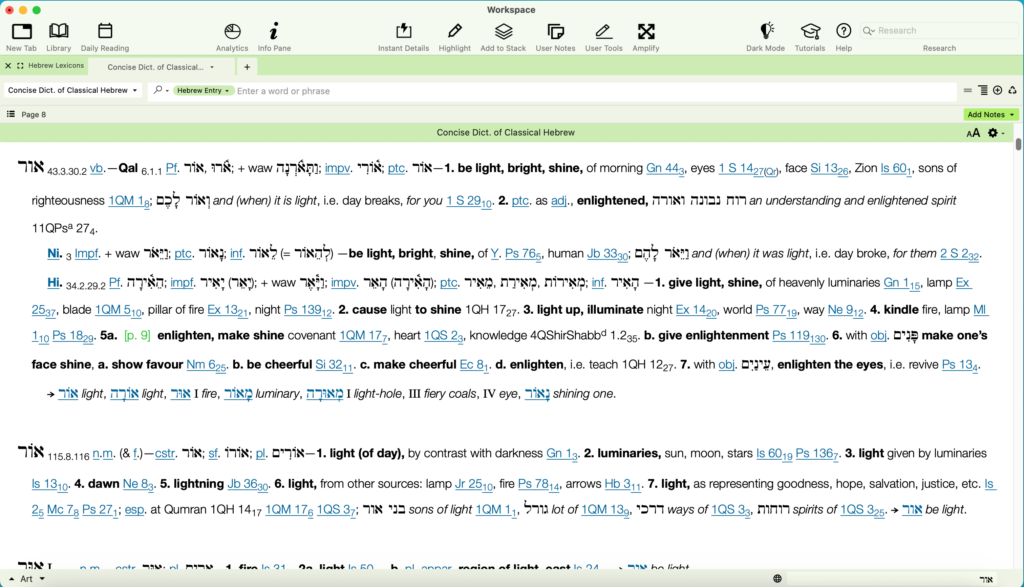
Students of Biblical Hebrew quickly discover that a good lexicon is one of the most important tools they can own. While familiar works such as BDB and HALOT remain essential, the Concise Dictionary of Classical Hebrew(CDCH), edited by David J. A. Clines, offers a somewhat different approach to the Hebrew language. When combined with Accordance Bible Software, it becomes an especially convenient resource for reading, word study, and research.

The CDCH was published by Sheffield Phoenix Press in 2009 as a condensed version of the much larger Dictionary of Classical Hebrew. Although the full dictionary extends across multiple volumes, the CDCH manages to place its vocabulary into a single, manageable volume. More importantly, it contains all the words represented in the original Dictionary of Classical Hebrew.

More Than Biblical Hebrew

What makes the CDCH particularly interesting is its broad understanding of “Classical Hebrew.” Many traditional Hebrew lexicons concentrate primarily on the Hebrew Bible. The CDCH takes a broader view. Along with the vocabulary of the Hebrew Bible, it incorporates words found in the Dead Sea Scrolls, the Hebrew text of Ben Sira, and ancient Hebrew inscriptions.

According to the publisher’s description, this results in more than 3,000 additional words beyond those normally represented in standard Biblical Hebrew dictionaries. This wider scope can be helpful even if your main interest is the Hebrew Bible. Biblical Hebrew did not exist in isolation, and seeing its vocabulary within the broader world of ancient Hebrew can provide additional perspective on how words were used.

Another welcome feature is the organization of the dictionary. Words are arranged alphabetically rather than being placed exclusively under reconstructed roots. Consequently, students do not always have to determine a word’s root before finding its entry. The dictionary also supplies English translations for the Hebrew words and phrases it cites and gives occurrence statistics across major bodies of Classical Hebrew literature.

Using the CDCH in Accordance

The electronic edition is where the CDCH becomes especially convenient.

Accordance has long made Hebrew lexical work remarkably fast. With a tagged Hebrew Bible open, you can triple-click a Hebrew word and have Accordance open the corresponding entry in your preferred Hebrew lexicon. Accordance also provides tools such as Instant Details, Amplify, and Live Click that make moving between the biblical text and lexical resources much easier.

This means that while studying, you do not have to interrupt your reading to locate a printed dictionary, identify the proper entry, and search through a column of Hebrew text. With a click or two, you can move directly from the biblical word in your text to the corresponding CDCH entry.

The Accordance edition also adds something a printed copy cannot provide: hyperlinks. Accordance states that its CDCH module includes links to original texts as well as internal links to related words. These connections can turn a simple dictionary lookup into a much more productive study session.

For example, you might begin by examining the meaning of a Hebrew word in a biblical passage, follow a related lexical form, and then investigate examples of its usage elsewhere. Instead of treating the dictionary merely as a source of English definitions, Accordance encourages you to use it as an entry point into the Hebrew evidence itself.

Strengths and Limitations

The CDCH’s greatest strength is probably the balance it achieves between breadth and accessibility. It gives students access to the broader vocabulary of Classical Hebrew without requiring them to work constantly through the full multi-volume DCH.

Its conciseness, however, is also its limitation. A concise dictionary cannot provide the same depth of discussion, bibliography, comparative Semitic evidence, and detailed argumentation available in larger scholarly lexicons. For serious exegetical work, I would not treat the CDCH as a replacement for HALOT, BDB, or the complete Dictionary of Classical Hebrew. It works best alongside them.

That is actually one of the advantages of using it in Accordance: several lexicons can sit beside one another digitally. You can begin with the CDCH for a clear overview and then compare its analysis with HALOT or another Hebrew lexicon when a word deserves closer investigation.

Final Thoughts

The Concise Dictionary of Classical Hebrew is an excellent addition to an Accordance Hebrew library. Its broader coverage reminds us that Biblical Hebrew belongs to a larger corpus of ancient Hebrew literature, while its concise format makes that scholarship accessible to students and regular readers.

Accordance makes the resource even more useful by connecting the dictionary directly to tagged Hebrew texts and providing quick lexical lookup, hyperlinks, and cross-references. For anyone who regularly reads the Hebrew Bible in Accordance, the CDCH is therefore more than another dictionary on a digital bookshelf. It can become a practical companion for daily reading, sermon preparation, classroom study, and more serious Hebrew research.

There is also a sense in which a resource like the CDCH fits naturally with the purpose of Ad Fontes. The phrase ad fontes—“to the sources”—expresses a commitment to return to the earliest and most authoritative evidence rather than relying uncritically on summaries, inherited assumptions, or secondhand interpretations. A lexicon is, of course, itself a secondary resource, but at its best it serves precisely that larger goal.

The value of the CDCH is not simply that it tells us what a Hebrew word means. It helps direct us back to the texts in which that word actually occurs. In Accordance, that movement can become especially natural: from a biblical word to its lexical entry, from the entry to related forms, and from there back into the Hebrew Bible and the wider corpus of Classical Hebrew, including the Dead Sea Scrolls, Ben Sira, and ancient inscriptions. The software does not replace close reading of the sources; used well, it facilitates it.

That is ultimately the kind of movement encouraged by ad fontes: from definitions and interpretations back to the evidence itself, where those interpretations can be examined, tested, and refined. A good lexicon should not become the end of lexical study but a guide into deeper engagement with the language and the texts.

One current point is worth noting: a revised Concise Dictionary of Classical Hebrew appeared in print in 2026, incorporating developments from the revised larger dictionary. The Accordance product page currently describes its module as the original 2009 CDCH edition, so prospective buyers interested specifically in the newest revision should check which edition Accordance is offering.

Hebrew/Aramaic Quote #1: Search the Torah Carefully

“Search the Torah carefully, and do not rely on my opinion.”

Traditional wording

חפישו באורייתא שפיר ואל תשענו על דעתי

Modern Hebrew

חפשו היטב בתורה ואל תישענו על דעתי

This well-known saying is traditionally attributed to Anan ben David, an eighth-century Jewish religious leader whose followers became known as Ananites. Anan is sometimes described as the founder of Karaite Judaism, although the historical picture is considerably more complicated. His movement was one of several non-Rabbanite Jewish currents that contributed to the emergence of Karaism in the following centuries.

The saying is especially interesting linguistically because it is not entirely Hebrew. The first clause is Aramaic, while the second is Hebrew:

חפישו באורייתא שפיר — Aramaic
ואל תשענו על דעתי — Hebrew

Brief Glossary and Parsing Notes

חפישו

An Aramaic plural imperative: “search,” “investigate,” or “examine.”

באורייתא

Aramaic: “in the Torah.” The word אורייתא (oraita) corresponds to Hebrew תורה.

שפיר

An Aramaic adverb meaning “well,” “properly,” or “carefully.”

Thus:

חפישו באורייתא שפיר
“Search the Torah carefully.”

The second clause is Hebrew.

ואל

Hebrew וְ, “and,” followed by אַל, the negative particle commonly used to express a prohibition:

“and do not.”

תשענו

From the Hebrew root שען, “to lean upon.” Here, with אַל, the sense is:

“do not lean upon” or “do not rely upon.”

על

“Upon” or “on.”

דעתי

דעת with the first-person singular suffix:

“my knowledge,” “my judgment,” or, more naturally in this context, “my opinion.”

Thus:

ואל תשענו על דעתי
“And do not rely on my opinion.”

Who Said It?

The saying is traditionally attributed to Anan ben David, but some caution is necessary. It is better to describe it as attributed to Anan than as a securely documented quotation from Anan himself.

An important witness appears in the tenth-century Karaite biblical commentator Yefet (Japheth) ben Eli, who cites the saying in Anan’s name in his commentary on Zechariah 5:8.

There is a further textual complication. The familiar saying consists of two clauses:

חפישו באורייתא שפיר
ואל תשענו על דעתי

But the manuscript history raises questions about whether both clauses belonged to the earliest form of the saying. The second clause—

ואל תשענו על דעתי
“And do not rely on my opinion”

—is absent from the oldest manuscript witness to Yefet’s commentary and may represent a later expansion.

The first clause therefore has the stronger claim to antiquity:

חפישו באורייתא שפיר
“Search the Torah carefully.”

Whether the complete formulation goes back to Anan himself or developed within later Karaite tradition, the saying came to express an important principle of Karaite engagement with Scripture: the biblical text is to be investigated carefully rather than merely received through the interpretation of an authority.

There is something striking about the traditional expanded form. The authority to whom the saying is attributed is made to tell his students not to rest on his own authority.

Ad Fontes

There is an obvious reason this saying appeals to me in connection with Ad Fontes.

The old humanist expression ad fontes means “to the sources” or “to the fountains.” Whatever the precise origin of this saying, חפישו באורייתא שפיר expresses something essential to the idea behind this site: go back to the sources, examine them carefully, and do not allow someone else’s conclusions—even those of a respected teacher—to take the place of reading and investigation.

That does not mean dispensing with teachers, traditions, lexicons, grammars, commentaries, or scholarship. Quite the opposite. Such resources are valuable precisely when they help us read the sources more carefully.

A good lexicon should send us back to the Hebrew or Aramaic text. A good commentary should make us examine the passage again. A good teacher should help us see what we might otherwise have missed.

The goal is not to eliminate secondary sources but to keep them in their proper place: they should lead us toward the sources rather than become substitutes for them.

That is the kind of study I hope Ad Fontes will encourage.

חפישו באורייתא שפיר
Search the Torah carefully.

Sources and Further Reading

Daniel J. Lasker, “Biblical Exegesis as a Source of Jewish Pluralism: The Case of the Karaites,” TheTorah.com.

Daniel Frank, Search Scripture Well: Karaite Exegetes and the Origins of the Jewish Bible Commentary in the Islamic East.

Haggai Ben-Shammai et al., “Karaites,” Encyclopaedia Judaica.

Yefet ben Eli, Commentary on Zechariah 5:8, for the attribution of the saying to Anan ben David.

  • Page 1
  • Page 2
  • Page 3
  • Interim pages omitted …
  • Page 15
  • Go to Next Page »

Primary Sidebar

SEARCH

Categories

Recent Posts

  • Miqra According to the Masorah: Manuscripts, Masorah, and the Editing of the Masoretic Text
  • Jude 5 The Textual Variant Ἰησοῦς / κύριος and the Agent of the Exodus
  • It Is Difficult to Know Oneself: Thales and the Byzantine Tradition
  • A Review of the Concise Dictionary of Classical Hebrew in Accordance Bible Software
  • Hebrew/Aramaic Quote #1: Search the Torah Carefully

Recent Comments

  • Mitchell on The Ethnachta Clause
  • Mitchell on Miqra According to the Masorah: Manuscripts, Masorah, and the Editing of the Masoretic Text
  • Mitchell on The Brown-Driver-Briggs Lexicon in Accordance
  • Ben Denckla on Miqra According to the Masorah: Manuscripts, Masorah, and the Editing of the Masoretic Text
  • Anonymous on The Brown-Driver-Briggs Lexicon in Accordance

136 PROUD SUBSCRIBERS

Copyright © 2026 · eleven40 Pro on Genesis Framework · WordPress · Log in