• Skip to primary navigation
  • Skip to main content
  • Skip to primary sidebar

Ad Fontes

  • About Ad Fontes
  • Blogroll & Resources

Reviews

The Brown-Driver-Briggs Lexicon in Accordance

The Accordance Edition of the “Hebrew and English Lexicon of the Old Testament, with an Appendix Containing the Biblical Aramaic, edited principally by Francis Brown, with S. R. Driver and Charles A. Briggs.”

For anyone who has spent serious time working in Accordance, BDB Complete is one of those modules that illustrates why the platform has long been so well suited to biblical-language research. The underlying work, of course, is the classic A Hebrew and English Lexicon of the Old Testament, with an Appendix Containing the Biblical Aramaic, edited principally by Francis Brown, with S. R. Driver and Charles A. Briggs. Commonly abbreviated BDB, it stands in the lexicographical tradition of Wilhelm Gesenius, particularly as that tradition came into English through Edward Robinson. But BDB is much more than a repackaged Gesenius. Brown, Driver, and Briggs carried out substantial additional lexicographical and comparative work of their own, and the result became one of the foundational tools of modern Hebrew Bible study.

The publication history can be a little confusing at first. The lexicon appeared in fascicles beginning in 1891, while the editors’ preface is dated March 1906. For that reason, one encounters both 1906 and 1907 in bibliographic records for the completed work. Accordance itself identifies the base edition for its module as Clarendon Press, 1907, so that is the date I would use when citing the Accordance resource specifically. More generally, it is probably safest to say that the work was completed in 1906 and appeared in complete form in 1906–1907.

What has always made BDB impressive is the sheer density of information packed into each entry. It is organized largely around Hebrew lexical roots, with senses subdivided according to usage, and it draws heavily on comparative Semitic evidence. Arabic, Aramaic, Syriac, Ethiopic, and Assyrian/Babylonian material appears throughout, along with extensive biblical citation. The Biblical Aramaic material is treated in an appendix. In print, all of this makes BDB extraordinarily rich but also notoriously compact and visually demanding. That is precisely where the Accordance edition becomes interesting.

BDB seems to have been part of Accordance from very early in the program’s history. During the development of Accordance 2.0 in late 1995, work was already under way on an abridged BDB, and Accordance 2.0, released in May 1996, introduced the “Tool” architecture that became the home for lexicons, dictionaries, commentaries, and other reference works. In other words, BDB belongs to the first generation of serious Accordance research modules.

For many years, however, the BDB available in Accordance was an abridged version. Accordance later explained that the electronic source text it had inherited omitted two enormous portions of the original work: the Scripture references and the comparative or cognate Semitic material. The abridged module was still useful—far more useful than some older electronic resources bearing the BDB name—but it was not the complete printed lexicon.

That changed around 2008, when Accordance released BDB Complete. An Accordance article from October 2009 refers to the unabridged edition as having been released “last year,” which places its arrival in 2008, even if the precise original release date is difficult to document. The important point is that the complete module finally restored the biblical references and comparative linguistic material that make the printed BDB what it is.

For me, though, the real value of BDB Complete is not simply that Accordance put the missing material back in. It is what Accordance did with that material.

Anyone who has used the printed BDB knows how compressed its typography is. A single entry may contain several levels of meaning, grammatical notes, numerous references, cognate forms, abbreviations, and typographical conventions, all packed together with very little visual breathing room. Accordance’s developers did not simply reproduce that density on a screen. They manually broke the material into subarticles, sections, and paragraphs, creating a much clearer hierarchical structure.

That may sound like a modest improvement until you actually work with the module. In practice, it makes a substantial difference. The print edition often requires the reader to decode the hierarchy visually from typography and indentation; in Accordance, that hierarchy is much easier to follow. The information is still BDB’s, but the electronic presentation makes the logic of an entry far more accessible.

The handling of Scripture references is equally important. In the printed lexicon, they are, naturally, just references on the page. In Accordance, they become live links. You can hover over them, inspect them through Instant Details, or move directly into the biblical text in your library. That transforms the way you use BDB. Instead of constantly moving between a lexicon and a printed Bible, the lexical entry and the passages supporting it become part of the same working environment.

The comparative Semitic material receives similar treatment. Much of it is represented as searchable text in the appropriate scripts rather than merely being reproduced as an image of the printed page. That matters if you actually use BDB for comparative work rather than simply for English glosses. Accordance did have to preserve certain unusual characters or forms as images, and the program later introduced image-scaling support to improve the display of such material. But the overall approach is clearly that of a genuine electronic edition rather than a page facsimile.

The module also continued to improve after its initial release. BDB Complete 4.0, released on July 22, 2014, included substantial proofreading and corrections to page numbers. That is worth noting because it means the current module is not simply the original conversion frozen in time; Accordance continued to refine the electronic text.

The older BDB Abridged also remained available as a separate module and received its own updates. In 2021, Accordance added Strong’s numbers and incorporated the previously separate Biblical Aramaic glossary into the abridged module. That makes the two resources somewhat different in purpose: the abridged edition is convenient and more accessible for quick lookup, while BDB Complete preserves the full scholarly apparatus.

The most important distinction, however, is between revision and digital enhancement. Accordance has not created a new lexicographical revision of BDB. The definitions, etymological proposals, semantic judgments, and comparative conclusions remain those of Brown, Driver, and Briggs, with all the strengths and historical limitations that this entails. BDB Complete should therefore still be read as an early twentieth-century lexicon, not as a modern replacement for more recent Hebrew lexicographical work.

But as an electronic edition of BDB, it is exceptionally well conceived. Accordance has taken an extraordinarily dense print reference work and turned it into a genuinely usable digital research tool. The hierarchical formatting, live biblical references, searchable scripts, structured fields, and later proofreading do not change the scholarship of BDB, but they make that scholarship far easier to navigate and exploit.

There is also something particularly ad fontes about using BDB in this form. The point of returning “to the sources” is not simply to prefer old books because they are old, nor is a lexicon itself the ultimate source for the meaning of a biblical word. Ideally, a lexicon helps send us back to the Hebrew and Aramaic texts, to the passages in which a word actually occurs, and to the linguistic evidence on which lexical judgments have been made. In that respect, the Accordance edition serves BDB unusually well. Its live biblical references and searchable linguistic material make it easier to move beyond an English gloss, examine the evidence cited by Brown, Driver, and Briggs, and then return to the biblical text itself.

At the same time, the complete electronic edition allows us to go ad fontes in another sense: back to BDB as BDB actually was. Rather than relying upon an abridgment that removed much of its biblical and comparative evidence, we can consult the complete historical work and distinguish what Brown, Driver, and Briggs actually argued from what later summaries or electronic derivatives may have preserved. Returning to the sources does not require us to accept every conclusion of an older authority. It allows us to see the evidence and the argument more clearly—and therefore to judge both more responsibly.

That is why I would describe BDB Complete for Accordance not simply as a digitized BDB, but as a carefully engineered electronic edition of the 1906–1907 lexicon. It preserves the historical content while taking advantage of the strengths of the Accordance environment. For anyone who still uses BDB regularly—and especially for anyone who works seriously with Biblical Hebrew—the Accordance version is one of the best ways to experience the lexicon today.

The Masora Thesaurus (part two)

I originally posted the following as a series of replies on the Accordance forums in December of 2015.

The printed BHS only contains the Masora Parva, Masora finalis (and a highly edited form of that). The editors of the BHS put theMasora Magna in a separate volume that is now out of print (although a digital edition of that does exist).

The  Masorah Thesaurus has so much more. It has the unedited Masorah Parva, the Masorah Magna of the Leningrad Codex(and other sources, too), as well as cross-references to other Masoretic lists, notations, and texts (as well as more). The Masorah Thesaurus is of course searchable in ways that neither the print edition of the BHS nor the digital edition of Gerard E. Weil’s Massorah Gedolah: Manuscrit B. 19a de Léningrad are.

MP notes

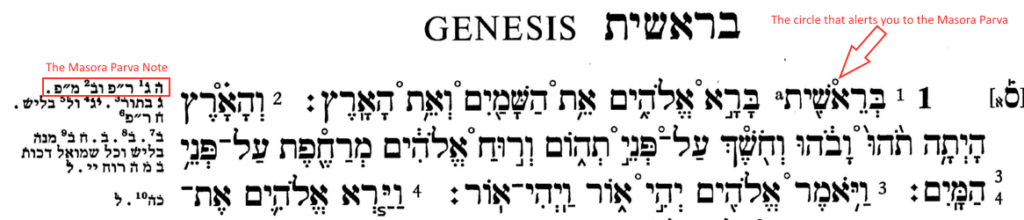
In a printed edition of the BHS we turn to page one or to Genesis 1:1. Now, we notice the raised circle above  בְּרֵאשִׁית . That circle in our printed BHS alerts us to the marginal notes called Masora Parva. To better illustrate what has just been said take a look at the following: 

In the photo (or in the BHS) we notice that the first letter of the note is the fifth letter of the Hebrew Alphabet  ה̇.  We also notice that the  ה̇ has a small dot over it. When we see a dot over a letter that often tells us that the letter is meant to be read as a number. In this case, we read this as telling us that there are five occurrences of the word  בְּרֵאשִׁית in the text of the Tanach/Hebrew Bible.

We also notice that there are two other Hebrew letters in the note with dots; both ג̇ and ב̇ followed by abbreviations or shorthand notes.   ג̇ being the third letter of the alphabet represents 3, and ב̇ being the second letter represents two (2 plus 3 is, of course, five). So, the Masora tells us that בְּרֵאשִׁיתstarts a stanza(ר״פ)   three times (ג̇) , and is embedded in a stanza ( מ״פ)   two times(ב̇).

This may help us understand the above abbreviations:

(Within, inside) מ = מצעא

(Head, start)      רֹ =ראש

(verse/Stanza)  פ  = פסוקֹ, פסֹ, פסוֹ

Sometimes (or at least I have seen some use) קֹ in place of פסוקֹ

However, since the Masora Parva is brief it does not list those occurrences mentioned above. Before the advent of the Masorah Thesaurus, we would need to run an Accordance search, consult a paper concordance, or work through Masoretic lists to locate all of the occurrences mentioned in the BHS’ Masora Parva.

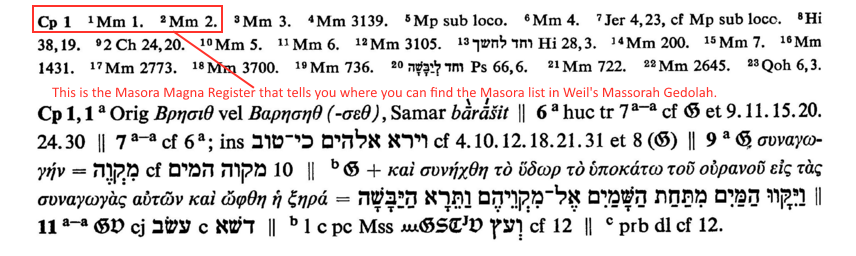
The Masora Magna Register at the bottom of the printed BHS, however, does indicate where we can (or could in past time) quickly locate the list in Weil’s Massorah Gedolah.

Unfortunately, the Massorah Gedolah is out of print, but as mentioned before, there is a digital version of it in another software platform. Before I got access to the Masorah Thesaurus module I will admit, I used to use the digital version of Weil’s Massorah Gedolah a fair bit and it still has its place. However, the  Masorah Thesaurus module  offers much more than what Weil’s Massorah Gedolah does.

Now, turn to Genesis 43:8 in a printed edition of the BHS (page 71). Let’s look at a rather famous example:

וַיֹּ֨אמֶר יְהוּדָ֜ה אֶל־יִשְׂרָאֵ֣ל אָבִ֗יו שִׁלְחָ֥ה הַנַּ֛עַר אִתִּ֖י וְנָק֣וּמָה וְנֵלֵ֑כָה וְנִֽחְיֶה֙ וְלֹ֣א נָמ֔וּת גַּם־אֲנַ֥חְנוּ גַם־אַתָּ֖הגַּם־טַפֵּֽנוּ׃

Take a look at the Masora Parva note for Genesis 43:8 : י̇ב̇ פסוק̇ גם גם גם

י̇ב̇ = 12

Verses =פסוק̇

גם גם גם = a construction/string גם

The meaning = There are 12 verses in the Tanach where גם occurs three times.

The Mm register for Genesis 43:8 only has Mm index numbers for the following words:

שִׁלְחָה= Mm index number 2915

וְנָקוּמָה = Mm Index number 3078

In other words neither the BHS nor its companion volume Weil’s Masorah Gedolah can help you in finding the list or references for the 12 occurrences of the גם גם גם construction.

Also, in this case, a paper concordance will be of little help since

גם appears something like 769 times in the Tanach/Hebrew Bible.

Click-searching on גם will similarly not help you much.

(However, Accordance’s construction search can find examples of the structure and depending on how many intervening words you select between each of the גם your results will vary).

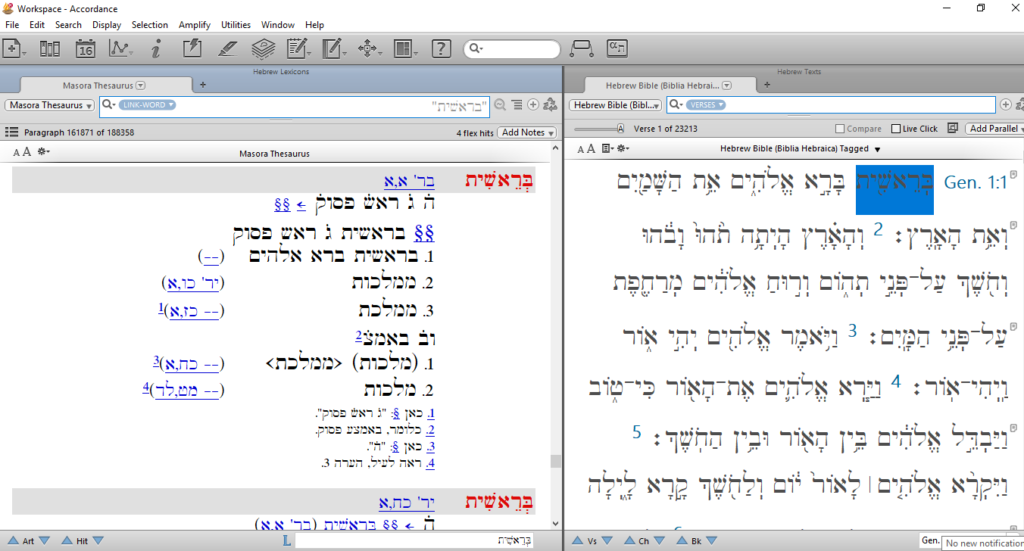
However, since we have the Masorah Thesaurus we can easily find everything the Masora Parva note of the BHS was alluding to:

(1) Open the Masorah Thesaurus

(2) Open the Table of Contents

(3) Type in גם and search

(4) Now, we will find the information we wanted to know at:

Paragraph 43839 of 188291

Paragraph 43844 of 188291

Paragraph 43850 of 188291

As we can see there simply isn’t enough space in the printed/paper BHS to provide that type of detailed information for every Masorah Parva note. This is one reason (there are many more) why the Masorah Thesaurus is indispensable for Masoretic studies.

The Masorah Thesaurus

Yet, another reason to get excited about Accordance for Windows and the original Mac OS version as well! Accordance has just released the first part of the Masora Thesaurus. When completed this encyclopedic like volume will contain the complete text of the Masorah Gedolah, Masorah Ketanah, and the Masorah Finalis of the oldest complete codex of the Hebrew Bible/Tanakh known as the Leningrad Codex B19a. This work will also include 30 years worth of Aron Dotan’s notes on the Masora. Aron Dotan is chair of the International Organization for Masoretic Studies and editor of the Biblia Hebraica Leningradensia. Now, this begs the question of what is the Masora?

The term Masorah is ordinarily used in modern biblical studies to refer to the body of marginal notes (i.e., Masoretic notes) which are transmitted with the text, either in a manuscript or in a printed edition. However, this is the narrow sense of the word. In its broadest sense, Masorah refers to traditions and rules, passed down in Judaism for generations, which regulate all aspects of the copying and use of Bible manuscripts…

The Masorah can be divided into several subdivisions. The Masorah Parva (Mp) consists of the Masoretic notes in the side margins of manuscripts (cf. BHS). The Masorah Magna (Mm) includes the notes in the upper and lower margins of the manuscripts…

The Masorah Finalis (Mf) refers to the material collected at the end of a particular book, section (e.g., Torah) or manuscript. In manuscripts, the Mf consists of summary lists, such as the number of verses, sedarim, etc., and information of this type is included in BHS at the end of books.

Kelley, Page H., Daniel S. Mynatt, and Timothy G. Crawford. The Masorah of Biblia Hebraica Stuttgartensia: Introduction and Annotated Glossary. Grand Rapids, MI: William B. Eerdmans Publishing Company, 1998.

The Biblia Hebraica Stuttgartensia (BHS) the longtime popular edition of the Hebrew Bible. only contains the Masora Parva, Masora Finalis (and a highly edited form of that). The Masora not unlike the annotations one finds in a reference Bible. However, the Masora goes further, noting issues like grammar, syntax, spelling, unusual/rare words, word counts, and even typography. The editors of the BHS put the Masora Magna in a separate volume that is now out of print (although a digital edition of that does exist) and hard to find. The Masorah Thesaurus makes the Masoretic information associated with Codex Leningradensis available in a searchable electronic format and supplements it with cross-references to other important Masoretic resources.

Enter Accordance Bible Software‘s Masorah Thesaurus database.

Screenshots illustrating the Masorah Thesaurus and BHS Masoretic notes discussed in the article

The Masorah Thesaurus has so much more than the printed Masora Magna of the BHS. Accordance database has the unedited Masorah Parva, the Masorah Magna of the Leningrad Codex(AND other manuscripts, too), as well cross-references to other Masoretic lists, notations, and texts (as well as much more). Accordance digital Masorah Thesaurus database is, of course, searchable in ways that neither the print edition of the BHS nor the standard digital edition of Gerard E. Weil’s Massorah Gedolah: Manuscrit B. 19a de Léningrad are. 

So, that we can better appreciate the Masorah Thesaurus let’s first take a quick look at what the printed BHS offers. 

In a printed edition of the BHS we turn to page one or to Genesis 1:1. Now, we notice the raised circle above  בְּרֵאשִׁית . That circle in our printed BHS alerts us to the marginal notes called Masora Parva. To better illustrate what has just been said take a look at the following screenshot: 

Screenshots illustrating the Masorah Thesaurus and BHS Masoretic notes discussed in the article

In the photo above (or in the BHS) we notice that the first letter of the note is the fifth letter of the Hebrew Alphabet  ה̇.  We also notice that the ה̇ has a small dot over it. When we see a dot over a letter that often tells us that the letter is meant to be read as a number. In this case, we read this as telling us that there are five occurrences of the word  בְּרֵאשִׁית in the text of the Tanach/Hebrew Bible.

We also notice that there are two other Hebrew letters in the note with dots; both ג̇ and ב̇ followed by abbreviations or short hand notes.   ג̇ being the third letter of the alphabet represents 3, and ב̇ being the second letter represents two (2 plus 3 is of course five). So, the Masora tells us that בְּרֵאשִׁית starts a stanza(ר״פ)   three times (ג̇) , and is embedded in a stanza ( מ״פ)   two times(ב̇).

This may help us understand the above abbreviations:

  (Within, inside) מ = מצעא

  (Head, start)      רֹ =ראש

  (verse/Stanza)  פ  = פסוקֹ, פסֹ, פסוֹ 

Sometimes (or at least I have seen some use) קֹ in place of פסוקֹ

However, since the Masora Parva is brief it does not list those occurrences mentioned above. Before the advent of the Masorah Thesaurus, we would need to run a quick Accordance search, consult a paper concordance, or wade through Masoretic lists to find all of the occurrences mentioned in the BHS’ Masora Parva. The Masora Magna Register at the bottom of the printed BHS, however, does indicate where we can (or could in past time) quickly locate the list in Weil’s Massorah Gedolah. See:

Screenshots illustrating the Masorah Thesaurus and BHS Masoretic notes discussed in the article

At the time this post was written, Weil’s Massorah Gedolah was difficult to find in print, though a digital edition was available on another software platform. The Accordance Masorah Thesaurus was also priced at roughly $100, so I considered it the better value because it contained substantially more Masoretic material and search functionality.

ACCORDANCE FOR WINDOWS HAS BEEN RELEASED!

Accordance may be new to Windows, but it has over two decades of experience in the industry. For, at least one of those decades it has had an emulator capable of running it on Windows OS, but finally, a truly windows native version has been developed and released make the superseding the emulator and making it redundant.

So, what does it look like?
It looks like Accordance 10 has always looked like, Eloquent.

What does it cost?

Only 49.99 USD to get started!

From there one can either upgrade to one of the larger packages

or cherry-pick from one of OakTree Accordance’s various bundles and individual modules.

Where can I find out more?

https://www.accordancebible.com/

Home
http://www.accordancebible.com/Accordance-For-Windows

Primary Sidebar

SEARCH

Categories

Recent Posts

  • Miqra According to the Masorah: Manuscripts, Masorah, and the Editing of the Masoretic Text
  • Jude 5 The Textual Variant Ἰησοῦς / κύριος and the Agent of the Exodus
  • It Is Difficult to Know Oneself: Thales and the Byzantine Tradition
  • A Review of the Concise Dictionary of Classical Hebrew in Accordance Bible Software
  • Hebrew/Aramaic Quote #1: Search the Torah Carefully

Recent Comments

  • Mitchell on The Ethnachta Clause
  • Mitchell on Miqra According to the Masorah: Manuscripts, Masorah, and the Editing of the Masoretic Text
  • Mitchell on The Brown-Driver-Briggs Lexicon in Accordance
  • Ben Denckla on Miqra According to the Masorah: Manuscripts, Masorah, and the Editing of the Masoretic Text
  • Anonymous on The Brown-Driver-Briggs Lexicon in Accordance

136 PROUD SUBSCRIBERS

Copyright © 2026 · eleven40 Pro on Genesis Framework · WordPress · Log in