• Skip to primary navigation
  • Skip to main content
  • Skip to primary sidebar

Ad Fontes

  • About Ad Fontes
  • Blogroll & Resources

Accents

How the accents of the Hebrew Bible can change the meaning?

Does the study of the accents/cantillation marks of the Hebrew Bible aid one in understanding or interpreting the meaning of the text?

Yes, I believe so take Deuteronomy 26:5 for example. Below is an image of the text in Hebrew. Notice that the text of Deuteronomy has been mirrored. The Hebrew consonants’ of both texts colored in black as well as the ‘vowels’ colored in blue are identical. The accents/cantillation marks are colored red. However, to demonstrate how accents can radically change the meaning of the text one accent on the first word (on the right) has been substituted for another:
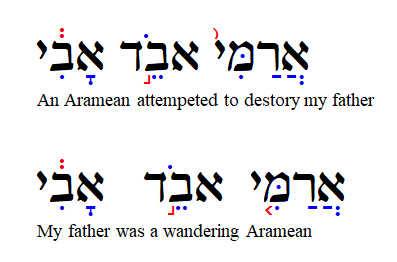
Hebrew text illustration showing the accent and reading comparison discussed in Deuteronomy 26:5
Disclaimer: Each of the translations above represent only one of the multiple ways each of the parallel lines of text could be understood or translated in English. You may find this reading in the haggadah which in turn was getting this from an interpretation of Mechilta or maybe from Reshi. There are no Bible manuscripts that have this reading. It is just that when you look at a Sefer Torah or any other text without vowel points the verse in question could be, in theory, interpreted this way.

Now, examine how this same verse appears in a Torah scroll the verse appears neither with accents nor with vowel points. So a reader without these Masoretic notations would have had to decide from him or herself how to interpret this verse:
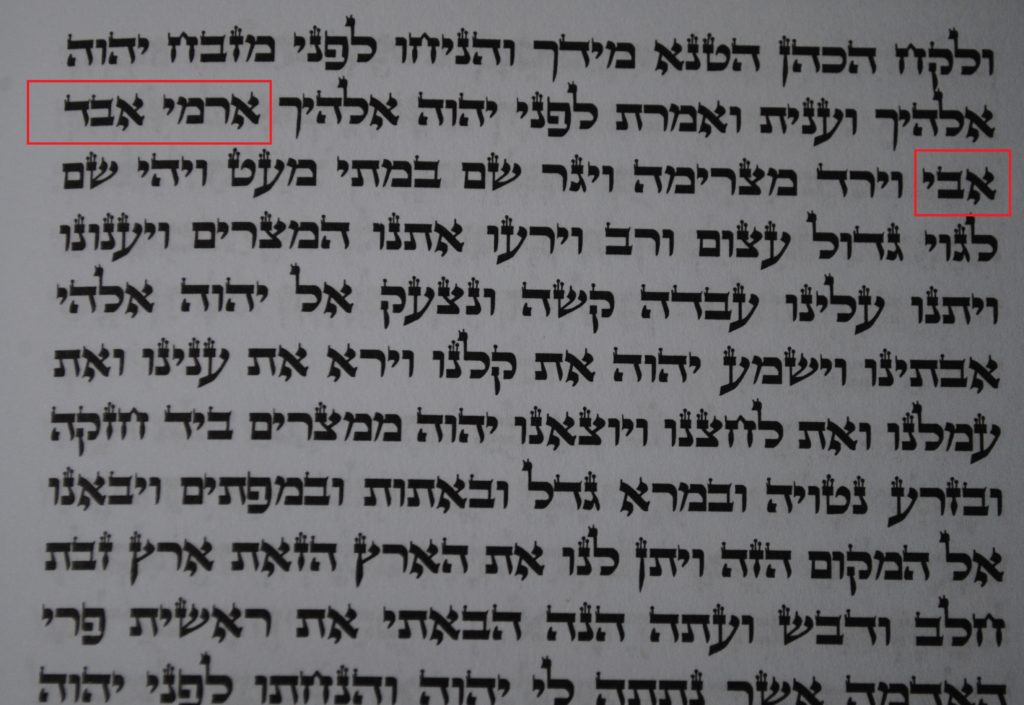
Hebrew text illustration showing the accent and reading comparison discussed in Deuteronomy 26:5

For more on the on the issue mentioned above check out:

https://www.thetorah.com/article/did-an-aramean-try-to-destroy-our-father

https://www.myjewishlearning.com/article/an-aramean-destroyed-my-father/

The above was originally posted back n 2018 on the Logos forums: https://community.logos.com/forums/p/135738/1008148.aspx#1008148

Here I have made a few minor changes and additions.

Accent Searches in Accordance Bible Software

Accent Searches in Accordance Bible Software

Late last year I bought a license for an Accordance bundle/base package for the Mac Emulator. My purpose in getting Accordance was to acquire another database and software platform to run searches on Hebrew Accent patterns in the Tanakh/Hebrew Bible.  It isn’t easy to find programs with such capabilities.

Since I am a bit busy and maybe lazy at the moment I will re-post a short description of an Accent search I posted on the Accordance  Forums last year:

Originally Posted on the November 6th, 2012 – 11:10  pm. I’ve always envied Accordance users and the multitude of Semitic texts available to them! Now, that I too am an Accordance user I thought I might as well make an attempt at running a few queries. I welcome any suggestions and corrections as I start learning to make efficient use of Accordance. It’s commonly known that the Shalshelet (accent/cantillation mark) occurs only four times in the Pentateuch/Torah. This is something also confirmed by popular literature on the subject:

  1. Cantors Marshall Portnoy and Josee Wolf, The Art of Torah Cantillation pg. 61
  2. James D. Price, Concordance of the Hebrew accents in the Hebrew Bible: Volume 1 pg 6.
  3. Joshua R. Jacobson, Chanting the Hebrew Bible pg. 107-108 (Out of his list of seven occurrences of the Shalshelet four are from the Pentateuch)

Since I already know how many times the Shalshelet should appear in the Pentateuch I thought this would be a great search to start with. So, here is my attempt:

  • Opened Accordance
  • Selected the BHS-W4
  • Limited the Search range to the “Law” or the Pentateuch using the button bar above the text window.
  • Clicked on the “Window” heading on the menu bar at the top of the screen. A drop down window opened.
  • Then selected “Character Palette” from the drop down window(Or the 5th choice from the top).
  • In the character palette window I then selected the Yehudit (font)
  • Made sure that there was a check mark next to the “cantillation” option.
  • Then, on the command line I entered: A wildcard period(.) followed by Shalshelet (I used the character palette to select it)
  • Finally, I hit Enter

Sure enough, Accordance brought back all four verses in the Torah/Pentateuch which contain the Shalshelet. That was great! Now, I know what people mean when they say Accordance is intuitive! I was able to run this query basically without typing any codes in, and with only an elementary knowledge of Accordance.

Searching the Cantillation Marks (Ta’amim) of the Hebrew Bible

Historical note: This post was originally written in 2013 and describes BibleWorks as it existed at that time. BibleWorks ceased operation as a commercial Bible-software provider in 2018, although existing users may still maintain installations.

Modern software makes it possible to search individual accents/cantillation marks as well as specific combinations of them in the Hebrew Bible. BibleWorks included two different databases that could be used for accent searching: the WTM (Westminster Morphological Database) and the JDP (Dr. James D. Price accent database). The accent codes differ between the databases, and the JDP database also uses different codes for prose and poetic books. Let’s say you’d like to search for every occurrence of the Mereka accent in the WTM.
(1) Enable the Permit accent code searching in Hebrew morph. version(s) option. (2) Select the WTM database as your search version. (3) On the command line, type: .*@*Zy*

This yielded 286 hits in 283 verses.
For reference, here are the WTM accent codes:

  1. Segolta (a)
  2. Sinnorit (s)
  3. Zarqa, Sinnor (b)
  4. Pazer (t)
  5. Pashta, Azla Legarmeh (c)
  6. Pazer Mag or Qarne Parv (u)
  7. Pashta (with previous left) (d)
  8. Zaqep Magnum (v)
  9. Telisha Parvum (e)
  10. Mahpak or Mehuppak (w)
  11. Paseq [separator] (f)
  12. Mereka (y)
  13. Yetib (g)
  14. Mereka Kepulah (z)
  15. Dehi or Tipha (h)
  16. Tipha, Majela, or Tarha (0)
  17. Mugrash (i)
  18. Munah (1)
  19. Telisha Magnum (j)
  20. Silluq [meteg (left)] (9,2)
  21. Ole or Mahpakatum (k)
  22. Meteg (right) (3)
  23. Geresh or Teres (l)
  24. Tebir (4)
  25. Gershajim (m)
  26. Atnah (5)
  27. Azla or Qadma (n)
  28. Galgal or Jerah (6)
  29. Illuj (o)
  30. Darga (7)
  31. Shalshelet (mag,parv) (p)
  32. Telisha Qetannah (med) (A)
  33. Zaqep Parvum (q)
  34. Telish Magnum (med) (B)

Primary Sidebar

SEARCH

Categories

Recent Posts

  • How to Display Noncontiguous Verses in Accordance
  • Miqra According to the Masorah as Structured Textual Data: Technical Examination of Its Machine-Readable Representations and Software Ecosystem (initial thoughts)
  • The curious case of 1 Chronicles 10:1
  • Greek Quote #13
  • Miqra According to the Masorah: Manuscripts, Masorah, and the Editing of the Masoretic Text

Recent Comments

  • Mitchell on The Ethnachta Clause
  • Mitchell on Miqra According to the Masorah: Manuscripts, Masorah, and the Editing of the Masoretic Text
  • Mitchell on The Brown-Driver-Briggs Lexicon in Accordance
  • Ben Denckla on Miqra According to the Masorah: Manuscripts, Masorah, and the Editing of the Masoretic Text
  • Anonymous on The Brown-Driver-Briggs Lexicon in Accordance

136 PROUD SUBSCRIBERS

Copyright © 2026 · eleven40 Pro on Genesis Framework · WordPress · Log in